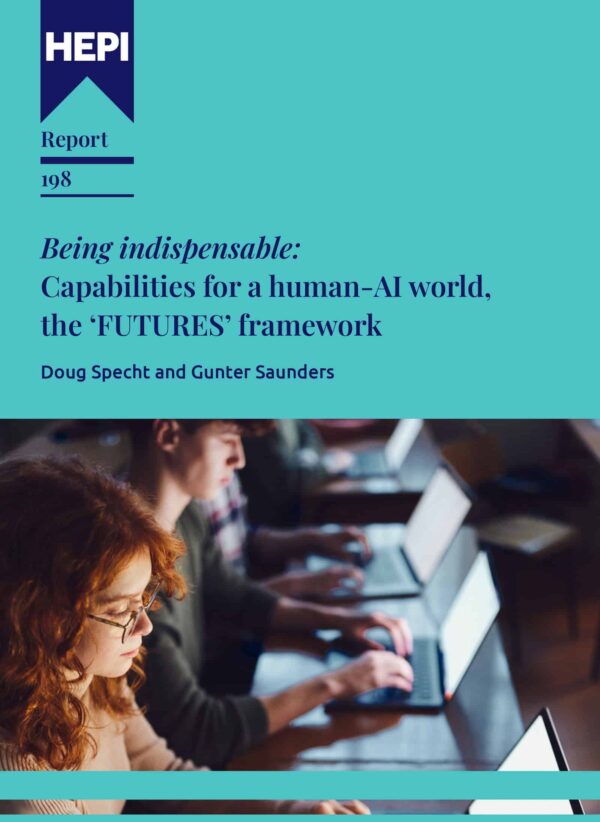
New HEPI Report: ‘Being indispensable: Capabilities for a human-AI world, the ‘FUTURES’ framework’
A new HEPI report argues universities must move beyond cautious experimentation with generative AI and instead take decisive steps to integrate it into teaching and learning – while putting human capabilities firmly at the centre.
HEPI Report 198 Being indispensable: Capabilities for a human-AI world, the ‘FUTURES’ framework, by Dr Doug Specht and Professor Gunter Saunders, warns that with most young people already using GenAI, higher education cannot afford to treat the technology as a peripheral issue.
The report highlights both the opportunities and the risks of widespread AI adoption. GenAI could personalise learning, reduce staff workload and expand access to academic support, but it also raises concerns about bias, inequality of access, environmental impact and the potential erosion of originality and independent thinking. To address these challenges, the authors argue universities must adopt a dual strategy: embedding human-AI collaboration in curricula while deliberately strengthening core human competencies such as ethical reasoning, critical thinking, social intelligence and resilience.
Central to the report is the FUTURES framework, a practical model designed to help institutions translate high-level AI ambitions into day-to-day educational practice. By focusing on areas such as AI fluency, technology ethics, wellbeing and professional engagement, the framework offers universities a roadmap for preparing students to thrive alongside AI rather than compete with it.
To explore the full framework and the report’s recommendations for institutions, sector bodies and government, click here to access the download link as well as the press release.

Comments
Add comment