WEEKEND READING: Educating for the AI economy: skills, social mobility and the future of opportunity
This blog was kindly authored by Professor Aleks Subic, Vice-Chancellor and Chief Executive, Aston University (Incoming Vice-Chancellor and President of Torrens University Australia).
For decades, the pathway from higher education into work underpinned social mobility in the UK. A university degree was a gateway to higher earnings, professional roles, and expanded life opportunities. That narrative remains powerful; recent data show that graduates aged 21-30 years are substantially more likely to be employed than non-graduates.
Yet the graduate labour market is rapidly transforming. Artificial intelligence is reshaping how work is organised and which skills deliver value. Early professional roles that once served as developmental entry points for young graduates are being reconfigured or replaced as automation takes on routine analytical and administrative tasks, as well as some advanced tasks, such as language translation or computer coding. In this context, the future of opportunity must be reframed. Higher education still matters, but how universities prepare students for lifelong careers must evolve.
Why social mobility matters and what the data show
In the UK, social mobility has long been a policy priority, grounded in the idea that where you start in life should not determine where you end up. Traditionally, mobility is measured in:
- intergenerational terms – whether young people progress beyond their parents’ socioeconomic status;
- intragenerational terms – movement within a person’s own career over time;
- relative terms – how background affects outcomes compared with others.
Despite progress in access to higher education, inequality persists. Young people from working-class backgrounds in the UK are significantly more likely to remain in working-class occupations compared with those from professional backgrounds. Access to high-status graduate roles also remains uneven; advantaged students disproportionately enter sought-after professional employment early in their careers.
Graduate labour market data already point to challenging early-career conditions. HESA’s Graduate Outcomes figures show that the share of first-degree graduates in full-time employment fell from around 61% for the 2021/22 cohort to 59% for 2022/23, with analysis from Prospects suggesting a further decline to approximately 56% for the 2023/24 cohort. At the same time, the volume of qualifications awarded increased by 6% in 2022/23 and a further 8% in 2023/24, meaning that more graduates are entering this increasingly competitive labour market.
The AI economy: a new landscape for opportunity
Artificial intelligence (AI) is reshaping the foundations of early graduate-level work. As agentic AI advances, many routine tasks traditionally performed in entry-level roles across law, finance, consulting, IT, software engineering, and other engineering disciplines are being automated or reconfigured. This is not a distant prospect; the CEO of Microsoft AI has indicated that within 12-18 months, AI systems may be capable of automating the majority of ‘white‑collar’ tasks.
Early-career pathways are consequently shifting away from routine execution toward higher-order problem solving, integration and oversight. When the activities that once served as training grounds for early-career professionals evolve in this way, universities must prepare graduates not only with technical expertise but with adaptable, human-centred capabilities that allow them to thrive in an economy defined by change.
This transformation has direct implications for social mobility. If the traditional graduate entry routes narrow or change faster than education systems adapt, early-career progression becomes more uncertain for an entire generation of graduates. Sustaining opportunity in the AI economy therefore depends not simply on access to higher education, but on how effectively universities equip students with the resilience, networks and transferable capabilities needed to navigate evolving career landscapes.
In the past, early graduate roles provided developmental scaffolding: learning by doing, building networks, and accruing experience that enabled progression across a career. If those roles are reduced or re-conceived, young people, regardless of family background, face greater uncertainty entering the labour market. An aspirational law graduate from Birmingham, for example, may find that entry-level paralegal roles are scarcer than before if AI tools can efficiently perform the tasks that once filled those roles. A graduate from a well-connected family may have access to alternative pathways; for others, the absence of traditional entry routes threatens longer-term mobility.
The traditional metric of social mobility, first job and early earnings, is no longer sufficient, particularly since rates of downward mobility are increasing. Mobility must now be conceptualised as ongoing adaptability, the ability to access multiple learning and career pathways over a lifetime.
This imperative ought to be enabled by the introduction of the Lifelong Learning Entitlement (LLE). It’s crucial that the LLE’s design keeps pace with the dynamic AI economy into which it will be implemented. A lot weighs on this policy. If it succeeds, it could support the success of the Industrial Strategy and foster the high skills that will underpin economic growth. If it falters, it will be seen as a profound missed opportunity.
Aston University: an applied model for the AI era
Universities should play a pivotal role in sustaining opportunity by designing education for the realities of the future of work. Aston University offers an example of how an applied, ecosystem-oriented approach can support students across backgrounds to thrive in an AI-shaped economy.
Aston has long embedded work‑based learning into undergraduate programmes at scale through placements and employer partnerships. As this model itself adapts to the AI economy (including through virtual placements), it continues to broaden networks, build confidence, and provide vital workplace experience for students with less social capital.
Building on this foundation, to address the changing nature of work and increase the adaptability of our students, Aston is deploying a university-wide Power Skills Framework across every undergraduate programme. This framework encompasses four interconnected domains:
- AI and Digital Fluency – grounding students in the capabilities and limitations of emerging technologies;
- Innovation and Entrepreneurship – equipping learners to identify and act on opportunities;
- Inclusive Leadership – preparing graduates to lead diverse teams and understand ethical implications;
- Environmental Sustainability – linking future careers to global challenges and value creation.
These are not peripheral add-ons but core elements of the curriculum, delivered in context, ensuring that students are prepared for their placements and graduate with both disciplinary depth and cross-cutting human skills.
At the postgraduate level, Aston guarantees internships for all Master’s students, supplemented by structured professional development through the Aston Global Advantage programme. For doctoral students, the PhD+ model integrates extended industry placements with advanced training in leadership and innovation. These initiatives acknowledge that education must not only prepare learners for a first job, but for sustained careers where adaptability is essential.
Crucially, Aston engages beyond campus through the Birmingham Innovation Precinct, an engine for local economic growth that brings research-led businesses into direct collaboration with students and faculty. When universities help generate local opportunities, social mobility is strengthened both within and beyond individual pathways.
Policy priorities for an AI-shaped labour market
To sustain and enhance social mobility in the AI era, policy must evolve across multiple fronts:
- Rethink success metrics. Earnings and first destinations remain important but should be supplemented by measures of adaptability, skill diversity, and long-term progression across careers.
- Mainstream work-integrated learning. Government, regulators, and funding bodies should support partnerships that embed high-quality placements and employer engagement into learning. Apprenticeships can be one element of the solution, but since demand outstrips supply for this form of learning, traditional models must also adapt.
- Expand and increase accessibility of lifelong learning. The Lifelong Learning Entitlement must prioritise modular, stackable credentials aligned with emerging fields such as AI, data science, and digital ethics, and be accessible across socioeconomic backgrounds.
- Enable agile curriculum innovation. Regulatory frameworks should allow universities to co-create programmes with industry partners quickly, ensuring curricula remain responsive to the labour market’s rapid evolution. Universities should embed AI-related learning outcomes in all programmes.
- Support regional innovation ecosystems. Universities, local authorities, and industry must be empowered to build local clusters that generate high-value employment opportunities and reinforce pathways for diverse learners.
The mission remains, but the strategy must evolve
The case for higher education as an engine of social mobility and opportunity remains compelling, but the pathways into and through work are becoming more complex and dynamic. Social mobility needs reframing accordingly, from a static milestone achieved at graduation, to a trajectory of lifelong opportunity. What matters most is not simply whether students can get a job, but whether they are prepared to shape the future of work – and, in doing so, extend opportunity to the next generation, regardless of where they started.
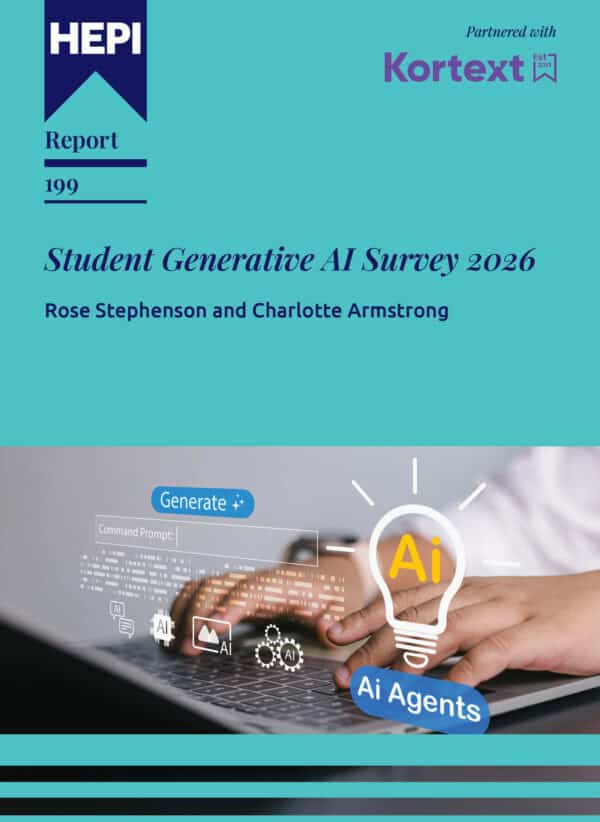
Interested in AI? HEPI and Kortext’s Student Generative AI Survey 2026 is available here.



Comments
Add comment