
Labour continues to lose the student vote as students disengage from politics altogether
This blog was kindly authored by Myles Hanlon, Account Director at PLMR.
Eighteen months on from the General Election, Labour’s relationship with students is extremely fragile. Last summer, I argued that the Party’s grip on the student vote was weaker than many had assumed, but the picture has since become far worse. Not only is support shifting to other parties, but more students appear to be disengaging from the political system entirely.
PLMR’s latest polling challenges the assumptions that students remain a dependable electoral base for Labour. Voting intentions among 18-to-24-year-olds (a significant demographic within UK higher education) are volatile, support is fragmenting across the political spectrum, and disengagement is rising sharply among a demographic that has historically played a decisive role in the electoral outcomes of university constituencies.
As parties look ahead to 2029, the role of young people – and particularly students – in deciding the outcome of the election cannot be overlooked or taken for granted.
Labour squeezed from both sides
At a national level, the topline figures will most definitely worry Labour strategists. If a General Election were held tomorrow, our polling suggests that Reform UK would secure a landslide majority with at least 335 seats once tactical voting is factored in.
Labour would be out of Government, and higher education would enter a period of significant uncertainty and reform from a party that has made its scepticism towards the sector clear.
But it’s the detail within the top student-heavy constituencies that is arguably most revealing.
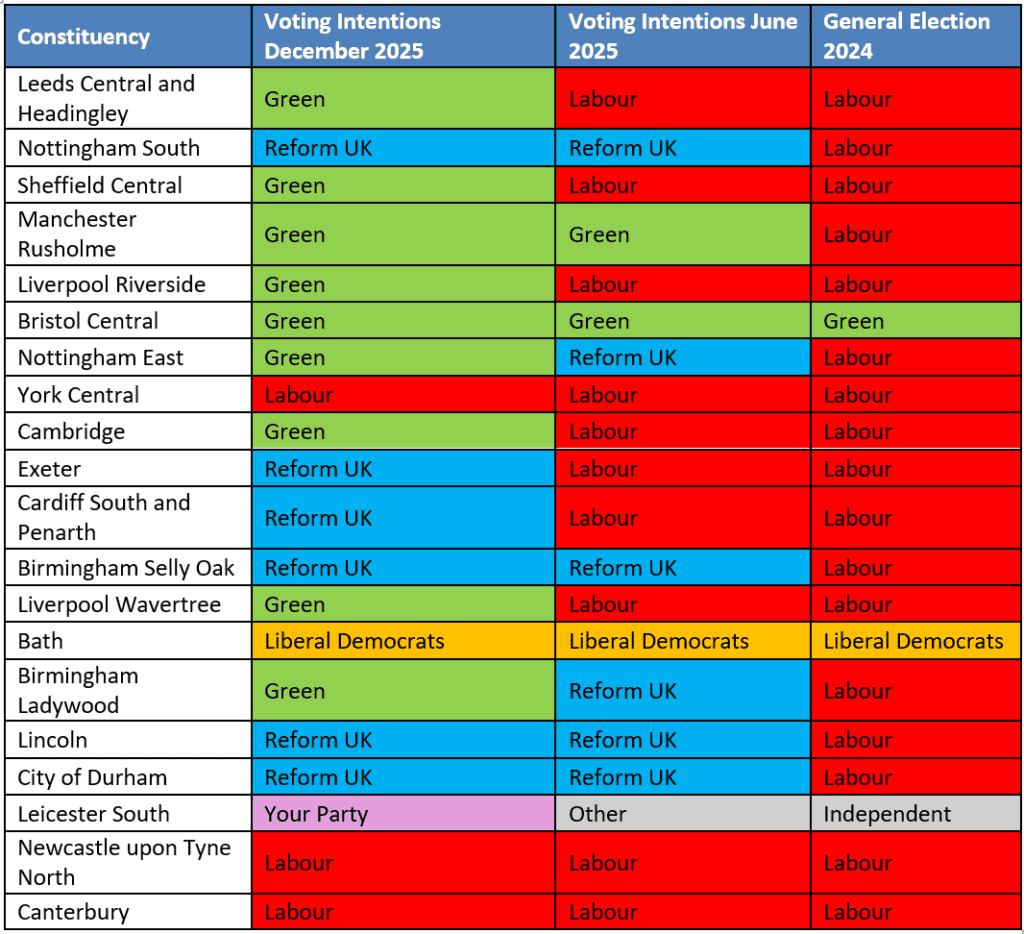
Among the top 20 constituencies with large student populations – identified by HEPI at the last election – around half have seen significant shifts in voting intentions since last summer. This is despite 17 of those 20 seats returning Labour MPs in 2024.
Based on current intentions, nine constituencies are now projected to return a Green MP; six will go to Reform MP; just three to Labour; one for the Liberal Democrats and one to Your Party.
What stands out is not a swing from Labour to a single alternative, but severe fragmentation in political affiliation amongst the student vote. These seats now look genuinely competitive and uncertain, with opportunities for all parties if they can mobilise student support ahead of the next election.
The common denominator, however, is explicit dissatisfaction with Labour.
The missing electorate
One of our most striking findings is how many students are opting out of the electorate entirely.
Almost half (48 per cent) of 18–24-year-olds now say they would not vote if an election took place tomorrow. That figure stood at 35 per cent last summer – less than a year ago. While there is still a significant amount of time before the next election for this to change, it’s clear that political apathy among young people is increasing, and it’s up to the parties in question to mobilise votes in their favour.
If we look at those who intend to vote, 47 per cent would back the Greens, 18 per cent Reform and just 14 per cent Labour (down from 24 per cent in June), with Conservatives trailing even further behind on 8 per cent.
This represents a remarkable shift when set against the 2024 election, where Labour MPs were returned at scale, many with comfortable majorities.
Attention will now be turning towards the Greens and Reform to see how they navigate rising popularity among young people in the polls. They will need to determine if
(a) this is a genuine shift in political affiliation in their favour, and
(b) how do they maintain this momentum in the run-up to the next election without relying on Labour losing more support.
If these trends persist, the electoral map could look radically different in 2029, particularly in seats where student turnout has historically helped to underpin Labour victories.
The cost of living, not learning
We asked participants what the top three cost-of-living priorities should be for the current Government. For 18-to-24-year-olds, 45 per cent said rent and housing costs are the biggest priority, followed by food prices (41 per cent) and energy bills (32 per cent).
Interestingly, only five per cent said student loan repayments should be a priority. Perhaps surprisingly, but this aligns with our wider polling across age cohorts. Student finance continues to be a politically contentious debate, yet for students and young people, it’s day-to-day affordability which is dominating their list of concerns.
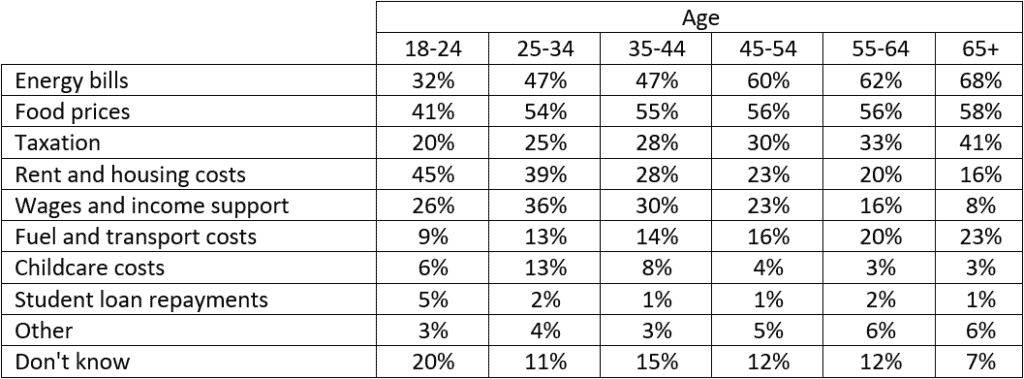
The implication for Labour is uncomfortable. Many of the policies it has relied upon to signal alignment with students – such as reintroducing contextual maintenance grants – do not appear to align perfectly with their current priorities. Likewise, dissatisfaction with the costs of renting, food prices and economic opportunity is being channelled into other parties, or into disengagement altogether.
Engaging beyond the comfort zone
First and foremost, Labour mustn’t see students as a default or ‘safe’ voter base ahead of 2029. Whilst the Government has looked at how it can support post-16 education, the relationship between young people and Labour has become incredibly fractured since they came into Government. Labour must now work to win that vote back, starting with policies that genuinely matter to young people.
The disengagement of young people should also worry all parties. Despite plans to lower the voting age to sixteen, a generation that clearly feels alienated from formal politics is harder to mobilise. The rise in support for both Reform and the Greens among those who do vote suggests that young people are looking for an alternative to the status quo, but keeping them engaged in the first place must be the main objective.
For the sector, if Westminster looks anything like the projections in our polling in 2029, institutions’ political engagement strategies shouldn’t be anchored solely around Labour. In the run-up to the next election, universities, Students’ Unions, and sector bodies will all need to engage more deliberately across the political spectrum, including with parties that have historically been sceptical of HE. That means demonstrating the role, value and impact of universities locally, nationally and internationally. It means engaging early in manifesto development, and it means helping to co-create credible positions that champion higher education as a fundamental asset to the country and its economy.
With 2029 on the horizon, the student vote is not only up for grabs but also increasingly up for loss.



Comments
Jonathan Alltimes says:
The Labour Party was the political party of the breaks in the economic trend caused by wars disrupting the British Empire, which the social trends then followed (the African War, the First World War and the Second World War). First the pandemic and then the Ukraine War combined to cause a major break in the economic trend again, from which the Labour Party was able to win politically. The turnout at the 2024 general election was just under 60%, the same as the 1918 election. After the voting age was extended from 21 to 18 in 1969, 72/% voted at the 1970 election. Turnout has declined since 1997, when it was 71% There has been no economic effect of war since the voting age was extended in 1969, so we have not been able to gauge the effect of the 18-24 age group on general elections until 2024 (the energy shocks of the 1970s were too early for this age group). The Labour Party has yet to prove it has an effective response to the cost of living crisis. None of the other parties are explaining how they can control the cost of living crisis, as it outside of their control and that of the British state, as it is driven mainly by energy costs. It is the ongoing cost of living crisis which explains why the 18-24 age group is moving towards Reform UK and the Greens or disengagement. The British state must agree how to control energy costs.
Reply
Add comment