
WEEKEND READING: What a decade of student enrolment data reveals about what the UK really studies
This blog was kindly authored by Dr Fadime Sahin, Senior Lecturer at University of Portsmouth London.
The UK higher education sector faces mounting difficulties, including financial strains, student recruitment challenges and operational issues. These challenges shape which disciplines universities can sustain. Student enrolments across disciplines now carry structural significance. Enrolment data over the period 2012/13 to 2024/25 shows how these pressures have quietly reshaped what the country actually studies.
A recent survey of Vice-Chancellors reveals that these are being intensified by challenging market conditions, policy shifts and a persistent decline in funding and income. Higher education leaders describe the current landscape as marked by threats and uncertainties on a scale that the sector has never experienced. Against this backdrop, long-term patterns in student choice take on new significance.
In this context, how student enrolments across disciplines have evolved is no longer simply a question of student preference, but of structure. Using Higher Education Statistics Agency (HESA) discipline groupings, I examined enrolment patterns between the 2012/13 and 2024/25 academic years. I analysed four benchmark years to identify long-term shifts.
It is important to note that in HESA’s classification, data up to 2018/19 were recorded by using the Joint Academic Coding System (JACS), while data from 2019/20 onwards use the Higher Education Classification of Subjects (HECoS). This transition affects the comparability of some sub-discipline trends, although broad subject groupings remain consistent over time.
The picture that emerges is not simply one of shifting tastes, but of a system increasingly organised around digital transformation, employability and public health priorities. The pattern suggests a sustained shift toward career-aligned disciplines.
Undergraduate Studies
Shifts in broad subject rankings over time
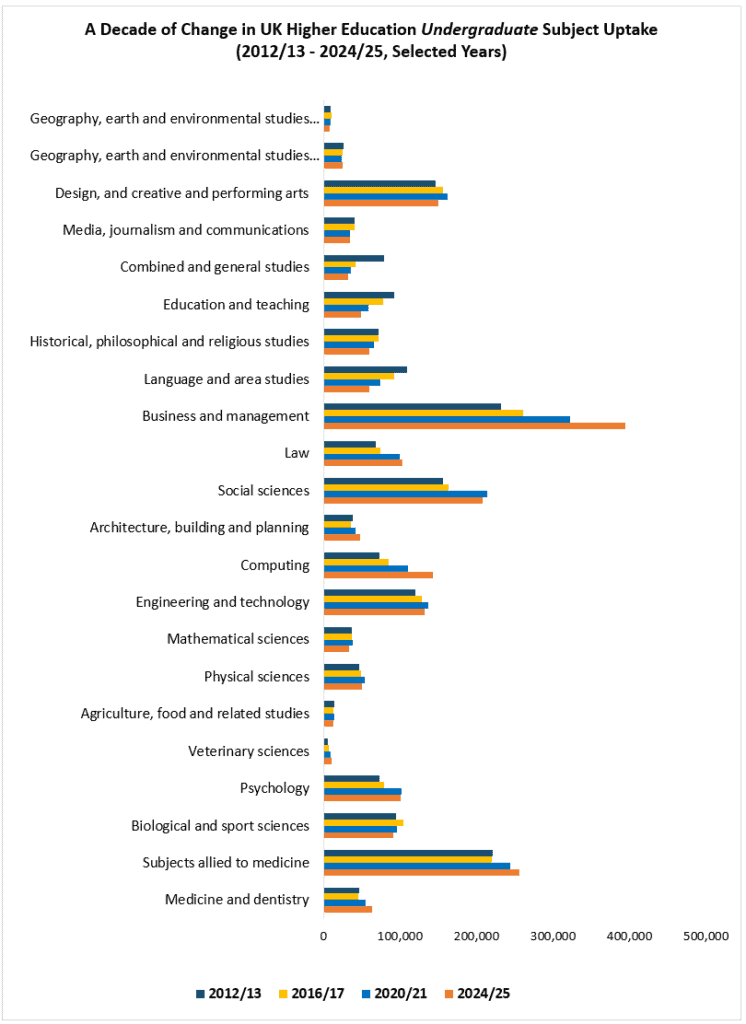
Using student enrolment data from four benchmark years (2012/13, 2016/17, 2020/21 and 2024/25), I found that business and management; subjects allied to medicine; and social sciences retained their top three positions in absolute enrolment values. In 2024/25, business and management accounted for the largest share of undergraduate enrolments (19%), followed by subjects allied to medicine (12%) and the social sciences (10%).
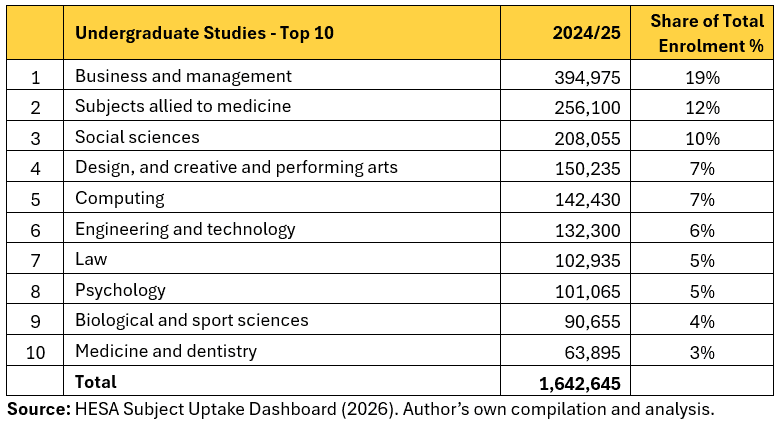
Together, these 10 out of the 22 subject areas comprised nearly 80% of the just over 2 million undergraduates enrolled in 2024/25.
This stability at the top masks significant movement elsewhere in the system, with the remaining entries revealing a notable reshuffling of academic priorities and student interests.
Computing was the most striking climber, moving from tenth place in 2012/13 to fifth in 2024/25, reflecting the growing centrality of digital skills within the higher education sector. The popularity of law and psychology also grew. Law was in thirteenth place in 2012/13 and moved to seventh in 2024/25 while psychology rose from eleventh to eighth, replacing language and area studies; and combined and general studies.
Which subjects gained – and lost – momentum
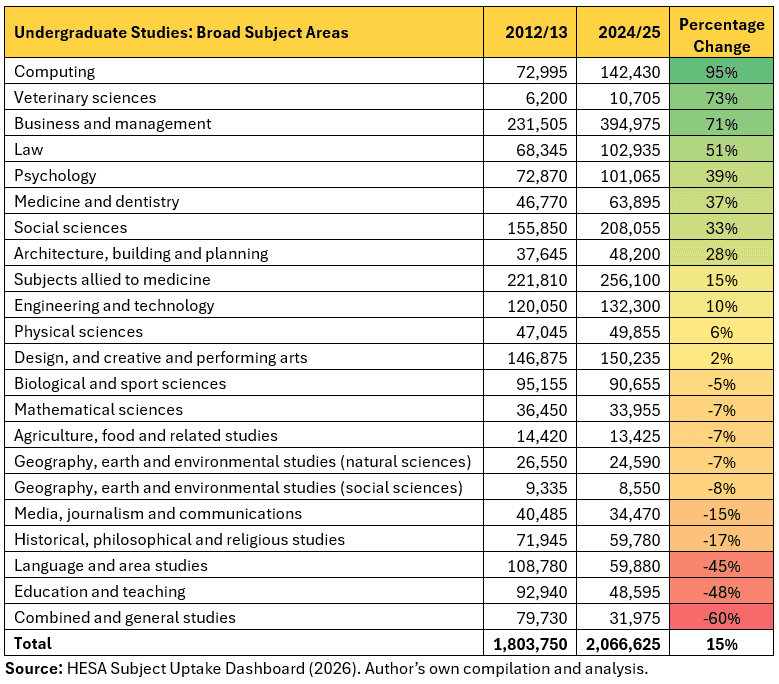
Across broad subject areas, the largest proportional increase in enrolments (2024/25) was observed in computing (+95%), followed by veterinary sciences (+73%), business and management (+71%), law (+51%) and psychology (+39%), compared with 2012/13. These patterns are consistent with an increasing emphasis on subjects that are often associated with clearer professional identities, skill sets and recognised career paths.
Medicine and dentistry (+37%), social sciences (+33%), architecture, building and planning (28%), subjects allied to medicine (+15%) and engineering and technology (+10%) also experienced notable increases.
By contrast, the sharpest declines occurred in combined and general studies (-60%), education and teaching (-48%), language and area studies (-45%) and historical, philosophical and religious studies (-17%). Media, journalism and communications declined by 15% while all remaining subjects, the change in enrolments was within ±10%.
Business and Management still dominate
The Business and Management subject area remains the largest in UK higher education. In 2012/13, around 230,000 students were enrolled in undergraduate business-related degrees at UK universities. By 2024/25, the figure had grown to approximately 400,000 students, representing a just over 70% increase. The proportion of business and management students in the total student population increased from 13% (2012/13) to 19% (2024/25). Along with general business and management, growth was also driven by Finance (+78%), Marketing (+42%) and Accounting (+9%) in 2024/25, compared with 2012/13.
Conversely, enrolments in human resource management (-31%) and tourism, transport and travel (-30%) saw downturns, highlighting that even within the largest discipline group, growth is uneven and selective.
Computing redefines the academic landscape
Computing provides the clearest illustration of how UK higher education has reoriented towards digital, application-focused and innovation-led provision over the past decade.
Several computing sub-fields display dramatic percentage increases, particularly information technology and business computing. However, these shifts stem from very small enrolment bases in the early 2010s from changes in the HESA’s subject coding practices, which limit the reliability of long-term percentage comparison by sub-grouping, although the broad subject growth (+95%) is clear.
To avoid distortions created by this transition, the analysis for some of the broad discipline sub-fields focuses on the more comparable period between 2020/21 and 2024/25. Within this window, the more robust evidence of rising student interest appears in information systems (+182%), artificial intelligence (+86%) and software engineering (+61%), followed by computer science (+24%) and computer games and animation (+14%).
Although artificial intelligence shows strong growth, the full extent of recent demand is unlikely to be captured in the current dataset, given the release of ChatGPT in late 2022. The data, which only goes up to the 2024/25 academic year, possibly does not yet reflect the wider surge in interest in AI that followed its release.
Law, Psychology and Health consolidate their dominance
Enrolments in law increased (+51%) from around 68,000 (2012/13) to 103,000 (2024/25). Psychology was similarly popular, increasing from around 73,000 to 101,000 over the same period (+39%).
Growth within psychology was uneven across sub-fields. Psychology (non‑specific) remains by far the largest sub‑field, growing from around 64,000 students in 2012/13 to 90,000 in 2024/25, an increase of around 40%. Alongside this, a sharp increase in applied psychology (+163%) signals growing interest in practice-oriented career progression.
Expansion in psychology is also visible across related disciplines. Within subjects allied to medicine, ‘counselling, psychotherapy, and occupational therapy’ experienced a notable growth (+32%) and stability, indicating students’ overall interest in mental health and therapeutic career routes.
Overall growth in subjects allied to medicine, medicine and dentistry and psychology reflects a system-wide shift towards health, clinical, therapeutic and care-related fields, possibly driven by workforce shortages, NHS demand and the expansion of the field. Within this broader pattern, medical technology expanded steadily (+36%), rising from around 5,500 enrolments in 2012/13 to 7,400 in 2024/25, reflecting continued demand for technologically enabled clinical and diagnostic skills.
STEM growth concentrates in future-facing specialisms
Engineering and technology grew by 10% overall, but this aggregate figure obscures important variation across sub-fields. For example, enrolments in engineering went from around 110,000 (2012/13) to 124,000 (2024/25), an increase of 14%. However, materials and technology declined by 28% from around 11,000 to 8,000 over the same period.
In mathematical sciences, statistics grew by 23% while operational research declined by 25%. Mathematics, despite its foundational status, has also declined (-9%).
Across the physical sciences, physics (+19%) and astronomy (+14%) rose moderately, chemistry (-7%) and forensic and archaeological sciences (-6%) slightly declined.
Environmental and biological sciences rise with societal concerns
At the headline level, biological and sport sciences fell by 5%. Yet, this conceals important variations. Ecology and environmental biology doubled over the period, rising from around 3,000 in 2012/13 to 6,200 in 2024/25, reflecting growing attention to environmental sustainability and ecological sciences.
Environmental and public health showed particularly sharp growth (+149%), increasing from 900 enrolments in 2012/13 to 2,240 in 2024/25, underscoring rising student interest in public health, sustainability and environmental risk. Biotechnology also recorded moderate growth (+11%) over the period, rising from 395 to 440 enrolments, although the absolute numbers remain relatively small.
Similarly, within geography, earth and environmental studies, enrolments in environmental sciences have risen by 54%, from around 4,600 to 7,000 during the same period. Physical geography declined, but environmental pathways strengthened.
Languages and humanities face systemic decline
Language and area studies experienced widespread contractions between 2012/13 and 2024/25, with declines across English studies (-37%), Celtic studies (-33%) and modern language disciplines (-55%). The pattern points to a clear shift away from traditional language education within UK higher education.
Only a small number of areas saw increases: Gaelic studies (+19%) and linguistics (+7%) recorded growth. Creative writing also stood out as a notable exception within English studies, as the enrolment numbers grew from around 4,500 in 2012/13 to nearly 6,600 in 2024/25, a sharp increase of 46%.
Humanities within ‘combined and general studies’ dropped by nearly 50% in 2024/25, compared with 2012/13, while liberal arts experienced a small decline (-6%), compared with 2016/17. One striking countertrend was ‘personal development’ within the combined and general studies, which rose by 66% in 2024/25, compared with 2012/13, indicating student demand for skills-focused and reflective provision.
Historical, philosophical and religious studies declined by 17% overall, but patterns varied. Heritage studies surged (+119%) from 105 enrolments in 2012/13 to 230 in 2024/25, although the absolute numbers remain very small. Classics (+20%) and philosophy (+10%) held steady with modest growth, while archaeology saw a slight decline (-7%).
By contrast, traditional pillars such as history (-21%), history of art, architecture and design (-30%) and theology and religious studies (-45%) experienced sharper falls.
Media studies shrink amid structural transformation
Media, journalism and communications declined by 15%, from just over 40,000 (2012/13) to 34,000 (2024/25). Publicity studies (-64%), information services (-61%), publishing (-33%) and journalism (-27%) all contracted, likely reflecting the structural shifts in traditional media industries and the uncertainty around career pathways.
Agriculture, food and related studies
This subject group shows a highly uneven pattern, with some areas growing steadily and others contracting sharply. Overall undergraduate enrolments in agriculture, food and related studies fell by 7% in 2024/25, compared with 2012/13, but a closer look reveals a more uneven landscape.
Agriculture (+56%) and food sciences (+48%) grew strongly, reflecting rising interest in food security, sustainability and the provision of applied sciences.
By contrast, several smaller sub‑fields within this group experienced sharp declines, partly reflecting reclassification effects during the transition from JACS to HECoS.
Postgraduate (Taught) Studies
The overall hierarchy is remarkably stable, but growth is much stronger
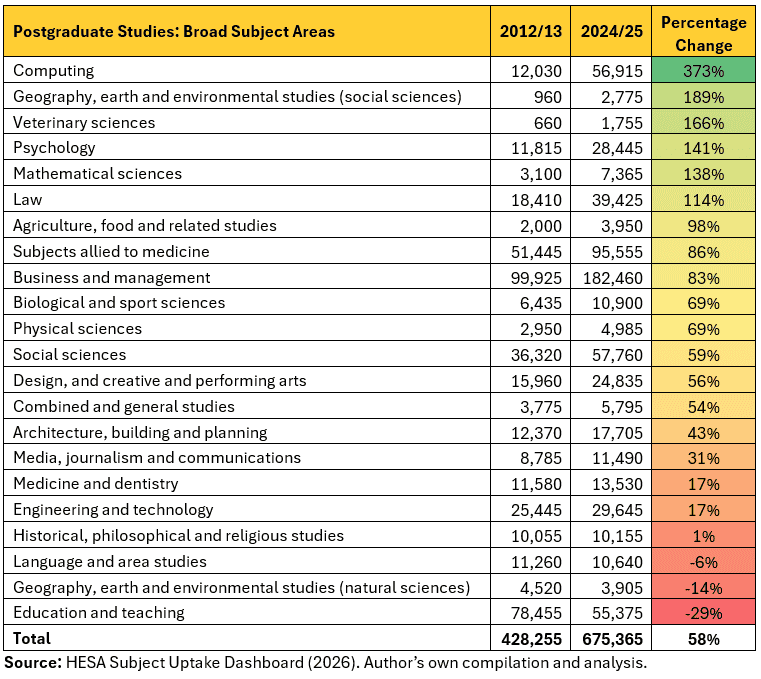
Across both undergraduate and postgraduate taught levels, the same broad subject categories dominate, though not always in the same order, and the growth was much stronger. Postgraduate taught enrolments increased by nearly 60% over the period, compared with a 15% rise in undergraduate enrolments.
Business and management studies are the largest subject area at both undergraduate and postgraduate levels, followed by subjects allied to medicine and social sciences. These three subject areas account for around half of all postgraduate enrolments.
Computing, engineering and technology, law and psychology are within the top ten. Education and teaching also sit within the top five postgraduate subject areas in absolute terms, despite experiencing an overall decline of nearly 30% over the period.
Computing surged by 373%, followed by substantial increases in geography, earth and environmental studies (social sciences) (+189%), veterinary sciences (+166%), psychology (+141%), mathematical sciences (+138%), law (+114%) and agriculture, food and related studies (+98%).
Compared to 2020/21, information technology (+165%), business computing (+157%) and artificial intelligence (+132%) increased sharply in 2024/25. Statistics increased by around 300%, mathematics nearly doubled in 2024/25 compared to 2012/13, while marketing increased by almost 90%.
While ‘design, and creative and performing arts’ saw only marginal growth (+2%) at the undergraduate level, the increase was far more substantial (+56%) at the postgraduate level.
The overall trend in postgraduate studies reflects a combination of domestic and international student demand, professional upskilling and the growing role of postgraduate qualifications in workforce development. In 2024/25, international students represented roughly one in four students in the UK higher education sector, with nearly 60% enrolled on postgraduate (taught & research) programmes.
Postgraduate (Research) Studies
At the postgraduate research level, strong growth is concentrated in Psychology (83%), Computing (49%) and Business and management (39%) and several STEM fields, aligning with the same career‑aligned pattern seen at undergraduate and postgraduate levels.
In absolute terms, the largest postgraduate research cohorts in 2024/25 were in engineering and technology (14,585), social sciences (10,085), biological and sport sciences (9,825), physical sciences (9,485) and business and management (9,275).
What this shift reveals about the future of UK higher education
These patterns reflect more than changing student preferences. Student choice operates within a higher education system increasingly shaped by digital transformation, employability frameworks, public health priorities, financial constraints and regulatory incentives, which collectively prioritise certain forms of knowledge over others. As universities respond to these system-level dynamics, some disciplines have been structurally deprioritised, not simply ‘chosen less’. Disciplines that don’t align as tightly with prevailing policy, funding and labour market narratives become progressively marginalised, even if not explicitly ‘deprioritised’ by individual departments.
Over the past decade, UK student enrolment has shifted decisively towards career-aligned fields, such as computing, veterinary sciences, business and management, law and psychology. The question now is what happens to the disciplines that cannot easily demonstrate short-term employability or immediate economic return?
Can we live without them, and who ultimately bears the cost of their decline?





Comments
Paul Wiltshire says:
It would be far more useful if this data then showed what career the graduates end up in say 5 years after graduating to see how strong (or more likely weak) the link is between course subject and career. It would be even more interesting if it was possible to establish the extent to which the same graduates would have been just as able to have exactly the same career outcomes if their employer would have been willing to employ them as a non graduate trainee 18-year-old, thus avoiding the life long debt for the graduate and write-off for the taxpayer.
Reply
Replies
Dr Fadime Sahin says:
Many thanks for your response. Absolutely- that is a great idea. This blog may act as a foundation to those further studies.
Reply
Replies
Jonathan Alltimes says:
It was an earlier generation of vice-chancellors who led us to this state.
Reply
Jonathan Alltimes says:
OECD Survey of Adults Skills 2023
Reply
Gavin Moodie says:
Thanx very much for this informative analysis. I believe there have been similar trends in Canada and Australia.
I presume the figures include international students, who in Australia enrol disproportionately in business and STEM.
In Australia there was a big peak in enrolments in computing in the dot com bubble, followed by a sharp and sustained drop in enrolments following the dot com crash in March 2000. I wonder whether artificial intelligence will have a similar effect on computing enrolments.
Reply
Replies
Dr Fadime Sahin says:
Thank you very much for your comment and for sharing the trends in different contexts.
I expect it will. I was also mentioning that the existing data does not yet fully capture the AI effect. The next five years will reveal the scale of the shift.
Reply
Jonathan Alltimes says:
I edit quotes from the OECD Survey of Adults Skills 2023:-
1. In England, 41% of employed adults aged 25-65 who are not self-employed, report a mismatch between their field of study and their job because their highest qualification is not in the field that is most relevant to their job.
2. In England, about 37% of workers are over-qualified (OECD average: 23%).
3. In OECD countries, adults who are overqualified for their job incur significant economic and social costs. This is less the case in England (United Kingdom): on average, their wages are 18% lower than peers in well-matched jobs who have similar educational attainment (OECD average: 12% lower).
(The graduates of disciplines requiring high levels of numeracy gravitate to financial services, in particular as traders.)
The original justification expansion for higher education was a route out poverty using foundation degrees and to close the productivity gaps with other nations. The government policy has not worked on its own terms and the expansion of higher education has not caused a well-functioning labour market for graduates or for employers. It has turned out to be too costly a government policy and therefore unsustainable hence mass redundancies for years, deficits, and inevitable rationalization of the sector. Why students study particular degree disciplines is driven by fads rather than government policies and I think most likely to be increasingly caused by new media.
Reply
Replies
Dr Fadime Sahin says:
Many thanks for your response. The data you highlight reinforces how complex the relationship is between higher education and labour‑market outcomes.
As AI also now reshapes both the skills landscape and employer demand, the sector is facing an additional layer of disruption that will likely further influence value, performance and delivery models. The measures used to assess graduate outcomes need to be re‑examined/reviewed.
Reply
Add comment