
What do we want? Mergers! When do we want them? When we know how…
This blog was kindly authored by Mark Gray, Independent consultant on knowledge exchange.
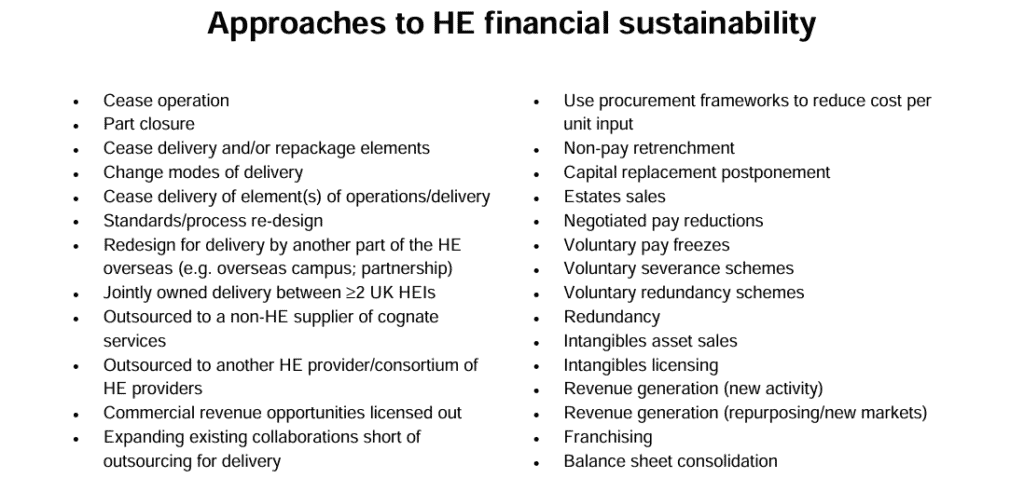
In wrestling with financial sustainability, governing boards of universities and Vice Chancellors have to hand a range of potential remedies, from shutting up shop entirely to selective and hopefully targeted and logical cuts to combinations of finicky alterations to their institutions’ finances and operations [Fig 1]. Each of those options has risks, payoffs, wider benefits or costs, and it cannot be easy for Chief Finance Officers to assemble packages that help – particularly in the face of ongoing policy changes in everything from apprenticeships to visas. Moreover, the scale of the problem – a forecast £1.6bn aggregated sector deficit for 2025/6 even after corrective action in the previous two years – means a complex and varied sector is selecting from a menu that isn’t guaranteed to make inroads into the total.
Over the last three years, one solution has been widely discussed – and in a few cases attempted. That has now taken centre stage. It has been touted by some as a leading option for restoring the sector’s health, maintaining higher education’s obligations to society, and achieving the efficiency gains that translate to institutions’ bottom-line benefit. This, of course, is mergers.
So, one might have expected that by now, a detailed framework for mergers in the higher education sector would have been published; guidance on process created; and evaluation metrics settled. Frankly, though, there is not anything very much of that in existence. A HEPI seminar explored the experience of models in the UK and in the US – where merger activity has been more common – as well as the school sector in the UK. It is part of an ongoing conversation within the sector that seems to be happening without one key actor. Government.
That matters because, as with schools and hospitals, universities provide services to local populations with footprint monopolies or quasi-monopolies. Significant social benefit (‘anchor institution’ work, ‘civic engagement’ activity, graduate skills, knowledge exchange, research impact, and employment, in addition to direct delivery of education for the local population) is intended to arise from local provision. Merger, then, might affect the scale of that social benefit.
There’s no need for too deep an acquaintance with Green Book logic to recognise the connection. Any intervention or policy change may have direct and exchequer costs, but there should be arising benefits to set against them. A positive net social benefit of a merger is a key test applied by merger authorities internationally (including by the CMA) where commercial entities merge, and public interest effects are noted. So why isn’t there a similar test framework for university mergers that boards might use as they consider options? Why didn’t the White Paper at least foreshadow or propose the commissioning of one? Is Government interested in optimal solutions?
In the NHS during the waves (plural) of mergers since 1997, guidance on net social benefit has steered the assessment of proposed mergers. It has taken into account a wide range of sources of social welfare loss – like patient access travel distance; the extension of availability of specialist clinical services; and the effect of a thinning of cover. Trusts, under a variety of guidance regimes, have considered these questions because, frankly, mergers are supposed to have benefits beyond mere survival of provision. Are there economies of scale or scope? Are there opportunities to construct nationally significant areas of clinical excellence? Can mergers improve delivery efficiency through greater buyer power or more public health influence in the community?
In higher education, comparable questions about sources of social benefit and the extent of net social benefit will spring to mind – things like the creation (or absence) of an integrated regional learning offer; national capacity gain (or loss) in research; and positive (or negative) effects on student lives (travel times, programme transitions etc.) It is not hard to work out what some aspects of the net social benefit calculation might look like.
While much talk inside higher education focuses on accountability, governance and civic engagement, in merger, other parts of the public sector offer clues on where to look to understand net benefit capture. Key lessons from NHS mergers, for example, are that during the merger wave of 1997-2006 trusts consistently overestimated the reduction in capacity and elective activity (broadly, cost saving) while during 2012-2022 period they overestimated benefits and underestimated disbenefits. ‘Appraisal optimism bias’ will need to be watched in assessing higher education mergers too, hence the need for a common framework for assessment. (That bias, by the way, is likely to be greater on the learning delivery side than on the professional services side).
Similarly, Trust mergers during 2000-2008 consistently reduced competition with no seeming offsetting efficiency gains, and in one closely studied amalgamation, researchers could find ‘no strong evidence the benefits could not have been achieved without merger’ – so baselines will need to be set with care. Then there are those elements of the merger process easily missed in an appraisal, like the negative effects on recruitment and staff morale that are not uncommon after merger (‘they took us over’ is hardly a thought to inspire). In general, too, those economies of scale and scope – top items on a merger benefits shopping list – seem hard to lock down. ‘Benefits realization plans’, which the sector will need, should be realistic and detailed.
Higher education cannot do this alone. Government needs to commission and mandate a common framework for merger assessment before the sector walks into the same problems other parts of the public sector have experienced in making mergers work. Our universities are too important to our national life (and to your ambitions for the country, Government) to leave this to chance. Frame the common guidance, share best practice, assess the cases, and require boards follow through on benefits realisation.





Comments
Jonathan Alltimes says:
What is proposed is an analogy between the history of mergers in the NHS and contemporary mergers in higher education, but the constitution of the healthcare provided by the NHS is not the same as the constitution of the education sold by higher education. The need for the merger of trusts was caused in many cases by the cost of replacing the local Victorian fever hospitals, the buildings of their ancillary services that grown up around them and their infrastructure, which been founded by charities. Transport no longer made local hospital provision a necessity, as mass vaccinations had got stopped communicable diseases, and general practice and other local services, notably the district nurses, were provided locally. What was experimented with in the 80s and 90s was the coordination by strategic health authorities of the commissioning of services between primary and secondary care. This is not the same situation as experienced for higher education today. What is similar is the financial squeeze caused by lower revenue and higher cost. The management accounts and not only the financial accounts would need to be known for each provider in order to understand the need for merger and which mergers are possible. In mergers, savings could in theory be achieved by reducing duplication of jobs, so lowering unit costs, but in practice operational integration is likely to cost more and require longer than expected, mostly because the management does not know the operational details. Automation could replace operational processes, but itself is costly, look at the failed IT projects. Where savings are mostly likely to occur is in the rationalization of the physical estates, their uses, their efficiency of use and maintenance contracts, which could be replaced by remote provision for teaching information for some courses. I think it unlikely that they will be many major material benefits, as it is the wage costs which are in part causing the financial squeeze and so needs be balanced by redundancies and the costs of the physical estate. The other option is to raise the price of tuition fees for international students. Universities need to think about what they actually selling.
Reply
Mark Gray says:
Jonathan Alltimes comprehensively misses the point. The motivations for merger form no part of my argument, nor their logic – only their effect outside of the accounts of the institutions involved. Happy to see responses to posts, but please focus on the argument rather than riffing on your own causes.
Reply
Add comment