WEEKEND READING: Housekeeping and higher education regulation
This blog was kindly authored by Dr Paul Greatrix, Director of Higher Education Consultancy, and Smita Jamdar, Partner and Head of Education, Shakespeare Martineau.
With the current state of higher education in England, the newly appointed CEOs of the Office for Students (OfS) are going to have a great deal to do when they start in June 2026. Although it may not be what they see as their highest priority, somewhere near the top of their to-do list needs to be some serious housekeeping in relation to the OfS Regulatory Framework. It is a real mess and requires a major spring clean to make it usable by registered institutions and those applying to the Register. The OfS has recently consulted on changes which aim to build on the current Framework, but there is a need to get the basics right first so that institutions and those seeking to register clearly understand how the OfS will regulate them lawfully, fairly and proportionately.
Following the recent High Court decision in favour of the University of Sussex against the OfS, there is an urgent need for the regulator to review its approach as represented in part by its Regulatory Framework. The sector needs to know what the rules really are and who is making the decisions at the OfS. Recent regulatory changes and proposals have set out requirements that institutions publish single comprehensive sources of information in three different areas. It’s time the OfS got its act together and provided a single comprehensive Regulatory Framework.
Dog’s breakfast or just a few rough edges?
The current version of the Regulatory Framework was published in November 2022. Alongside the Regulatory Framework the OfS has published a series of other documents including:
- regulatory notices;
- regulatory advice;
- a list of prohibited behaviours;
- funding terms and conditions;
- letters, covering various topics;
- Insight briefs on current higher education issues;
- reports and case studies of various kinds;
- data and analysis reports;
- reports of OfS investigative activity;
- notices about student number and other data returns; and
- consultations on planned regulatory changes.
These are scattered all over the OfS website and it is very much up to institutions to work out what matters, what has regulatory force, what is guidance and what is advice and, frankly, what the difference between these two is intended to be. Unlike institutions, which are expected to maintain clear and accessible policies and procedures, the regulator seems fairly relaxed about recording critical changes to its Framework and indeed defining its terms.
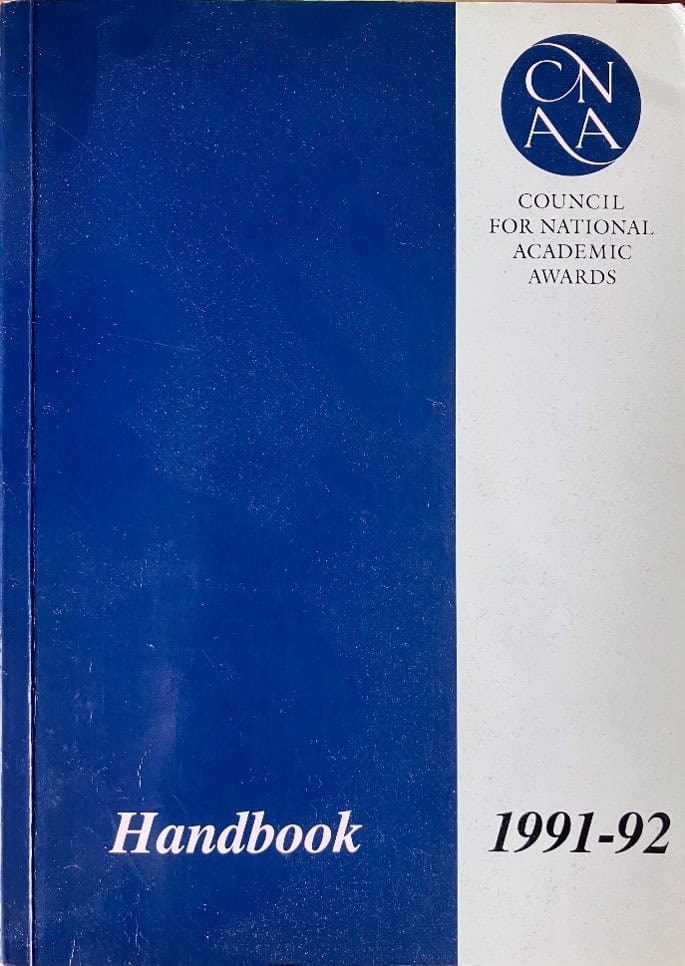
It really is a mess. The CNAA (the regulator of public sector higher education until abolished by the Further and Higher Education Act in 1992) in the pre-digital 1980s managed to produce an annual updated version of its regulatory framework as a definitive, comprehensive hard copy handbook for all institutions. It seems that now everyone is expected to piece everything together themselves. These are not good foundations on which to build a new framework.
Latest arrivals
There are also some significant lessons to be learned about regulatory practices following the recent High Court judgment which found against the OfS and in favour of the University of Sussex. Some of the findings related to the regulator’s bias, its ‘closed mind’ and pre-determination of the outcome of its investigation and apparent desire to make an example of Sussex. These are not the behaviours of a regulator which would wish to be seen as mature and trusted by those it regulates.
The OfS is also currently consulting on what it describes as a new approach to consumer and student protection. This will see a new Condition of Registration, ‘Treating students fairly,’ which would become condition C6, replacing two existing conditions, Guidance on consumer protection law (C1) and Student protection plan (C3), and seeks explicitly to go beyond the law. Again, this is a questionable approach, which when combined with the lack of judgment that the Sussex decision has highlighted, is high stakes for both the regulator and the sector. This is a moment that calls for a rethink about what the OfS is realistically capable of delivering in terms of clear, proportionate and robust regulation.
As it stands: the OfS Regulatory Framework
The OfS Regulatory Framework as at 24 November 2022 is an updated version of a document first issued in February 2018. It constitutes the regulatory framework for higher education in England required under section 75 of the Higher Education and Research Act 2017 (HERA).
The framework is intended to set out how the OfS will undertake its regulatory role and provide guidance for registered higher education providers on the ongoing conditions of registration.
The OfS also indicates on its website that it will publish regulatory notices that provide additional information about its regulatory requirements. These constitute part of this regulatory framework under section 75 of HERA (which is about the preparation and publication of the framework) or are issued under section 29 of HERA (which relates to Access and Participation Plans).
In addition, the OfS states that it will publish regulatory advice to support providers in understanding and meeting its regulatory requirements. This advice does not constitute part of the Regulatory Framework.
Finding your way around
One of the OfS’s web pages is helpfully titled “Navigation of this regulatory framework” and it is clear on examining the range of documents forming the Framework why you might need at least a map and compass to find your way through the rather overgrown regulatory landscape.
The November 2022 consolidated version incorporates seven amendments to the Regulatory Framework made during 2022. These include changes to the B Conditions of Registration (quality and standards) and C4 relating to student protection directions. There are also revisions to reportable events requirements under the ongoing Condition of Registration F3, as well as a few other, less significant changes.
So far, so good. However, since November 2022, a further set of changes has been made. These appear as follows on the OfS website under the heading ‘New Conditions of Registration’.
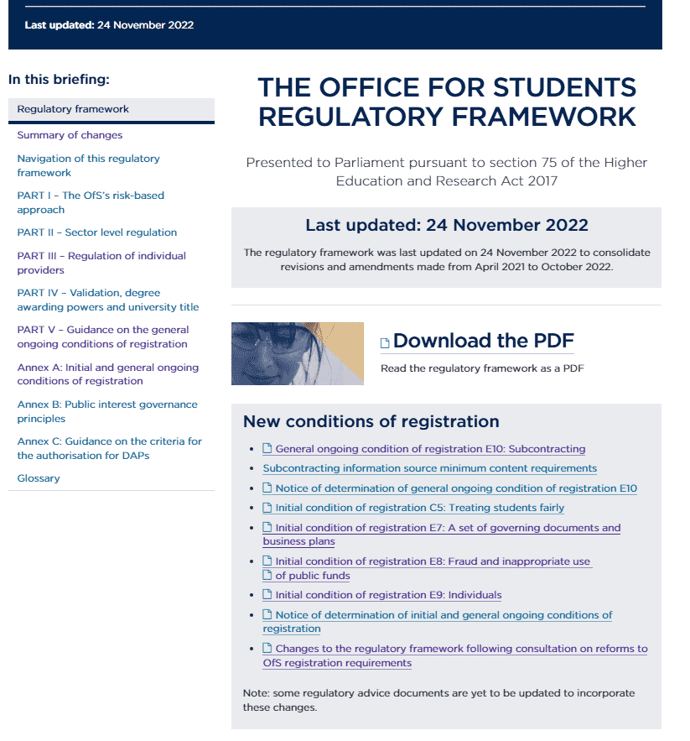
And then there is the caveat that ‘some regulatory advice documents are yet to be updated to incorporate these changes.’ That is not terribly reassuring, although it is undoubtedly correct.
Stepping back from the detail of the changes discussed below, is it really acceptable for the Regulatory Framework not to have been updated for nearly three and a half years? How would the OfS regard a provider whose central regulations were not updated for such a period despite significant changes being made? It is quite extraordinary that the November 2022 version of the Regulatory Framework also refers back to the OfS’s Analysis of responses to consultation [on the B conditions] and decision to explain its regulatory approach. Why not simply incorporate the approach into the Framework or a Regulatory Notice – the two categories of documents actually stated to comprise the Regulatory Framework?
There are four items on the list of ‘New Conditions of Registration’ which are new initial Conditions of Registration and, although in force, these have not been added to the Regulatory Framework, which continues to refer to different initial Conditions of Registration. If an institution is looking to register with the OfS, then it does need to piece together its own more comprehensive Framework from these separate items. Those considering registration with the OfS need to study closely the final document on the list, titled Other Amendments to the Regulatory Framework, an exceptionally difficult to follow paper, which sets out a series of amendments to the Regulatory Framework that arise as a consequence of the introduction of the new initial conditions C5, E7, E8 and E9. These changes form part of the Framework, but for some reason, the November 2022 document (erroneously identified in Other Amendments to the Regulatory Framework as being dated November 2024) has not been updated to include them. Again, applicants have to piece this together themselves.
A major area of concern and focus for the sector, government, wider society and the OfS is harassment and sexual misconduct. Despite the publication of an important new Condition of Registration though, Condition E6 on Harassment and sexual misconduct, which came into effect on 1 August 2025, it is not visible in the Regulatory Framework section of the OfS website (although there is plenty of material elsewhere on the site). This is something institutions themselves have to add to their own Regulatory Framework scrapbook.
Regulatory notices
The OfS also publishes ‘regulatory notices’ that provide additional information about its regulatory requirements. According to the OfS, these notices form part of the Regulatory Framework and registered providers must treat them as formal requirements. Again, though they have not yet been incorporated into the primary Regulatory Framework document, meaning that institutions have to work out for themselves which apply. To be fair though, Regulatory notices 2 through to 5 are no longer really relevant and represent transitional arrangements from the previous regime and from the pandemic period, which does rather call into question their continuing presence in this section of the OfS website. The three other live regulatory notices cover Access and Participation Plans, student protection directions and application requirements.
More than just advice?
The OfS also publishes what it describes as ‘regulatory advice’ to help providers understand and meet its requirements. It states that these do not form part of the Regulatory Framework, but given that many of them relate directly to specific Conditions, it is difficult to distinguish them from the guidance that forms part of the Regulatory Framework itself. The 24 pieces of advice cover everything from exempt charity status to preparing financial statements and from University Title applications to reportable events.
Some of these papers stretch the definition of advice beyond any sensible meaning: the summary of Regulatory Advice 24 published by the OfS states that ‘it gives examples of steps that providers and constituent institutions must take to secure freedom of speech’ which has a distinctly non-advisory feel to it, and the Director of Freedom of Speech and Academic Freedom at the OfS regularly refers to the examples in the advice as setting out definitive expectations.
What this fragmented picture means is that there can be contradictions in the advice. For example, one OfS webpage says that the termination of a partnership is always a reportable event, but Regulatory Advice 16 says this is only reportable if it has an impact on students. This really is not an acceptable approach to regulation.
Beyond notices and advice
Also on the list of documents connected to the Regulatory Framework the OfS published is a prohibited behaviours list on 21 August 2025. This is stated to form part of the initial Condition of Registration C5, which requires providers applying to register with the OfS to treat students fairly, which raises the question of why it is not simply included in the condition itself.
There is also a range of other communications which, whilst not listed as part of the Regulatory Framework, clearly are expected to be read, considered and in some cases acted upon.
There are letters such as this one from the Director of Free Speech and Academic Freedom titled Protests on campus: tackling harassment and securing freedom of speech in which he sets out how the OfS was then thinking about its regulatory role on these issues.
Then there is this April 2025 letter from John Blake, at the time the OfS Director for Fair Access and Participation, entitled ‘Protecting the interests of students during industrial action.’ Together with the attached regulatory statement, these two documents appear to have effectively become perceived as part of the Regulatory Framework and are presented as if they carried the full force of regulation.
There are also what are described as Insight briefs, which aim to give an overview of current issues and developments in HE, ‘drawing on the data, knowledge and understanding available to us as the regulator.’ There are around 25 of these at present covering topics such as Protecting Students as Consumers, Tackling sexual misconduct in universities and colleges and Transnational education: Protecting the interests of students taught abroad. They often set out how the OfS expects providers to act, but they are not, it appears, Regulatory Advice. While they cover important issues and are meant to be useful documents, their precise status is not clear.
It does not end there. We also have a range of discrete reports of one kind or another where the status of each is not entirely clear, although some do clearly reflect regulatory expectations, despite not being explicitly referred to in the Regulatory Framework. These cover subjects such as Financial sustainability and market exit cases and Blended learning and OfS Regulation. There is also a collection of reports focusing on sector Data and analysis, reports on investigative activity, strategy updates, consultations and notices about various regulatory returns. Universities and colleges, though, have to be on top of all of this documentation, whatever category it is.
Despite its own requirements in regulations such as the E6 Condition, where institutions are required to maintain a single comprehensive information source, this does not yet seem to apply to the OfS itself. The OfS website search function does not provide comprehensive returns for key items. For example, there appears to be no single repository or search term through which all the regulatory action or assessment reports can be found, diminishing their usefulness in informing how other providers can adapt their own practices. This is despite the fact that a key part of the OfS’s regulatory strategy appears to be to incentivise compliance on the part of others, which requires such documents to be accessible. Instead, we are left with a regulatory mish-mash.
Moving on from the DIY Regulatory Framework
It is a bit of a challenge to build a rational, effective and efficient framework on foundations which are so uneven but, following its recent consultation on revising its approach to quality assessment, the OfS intends to present details for consultation in autumn 2026. The Post-16 Education and Skills White Paper arrived in late October 2025 and promised yet more powers for the Office for Students, although it is unclear what this means for the Regulatory Framework.
Perhaps then this would be a good time for a rethink. The recent OfS consultation and timescale provide an opportunity to review the English regulatory regime in the round and come up with a rationalised model and a more effective and efficient approach. This would enable the OfS and its new Chief Executives the space to get their housekeeping done and pull everything together into a more coherent Regulatory Framework. We should take the time to get this right. It is in everyone’s interest.




Comments
Jonathan Alltimes says:
There are two principle conditions why the regulatory framework is a collection of bric-a-brac. First, the Higher Education and Research Act is badly specified and does match the constitution of higher education purpose, functions, and practices. The second is the OfS is exhibiting the behaviour of a bureacracy in which its leaders has failed to settle political disagreements since its inception and its plurality of ideas do not match the realities of higher education. The OfS can not line up the Act with their interpretations and how higher education works and with whom they disagree, as a plurality. Universities UK has not helped.
Reply
Add comment