
A differentiated picture of commuter student success
This is the third part of HEPI’s themed week of blogs all about commuter students. You can read the first blog in the series here, and the second blog here. The fourth blog is here.
This blog was kindly authored by Dr Mark Wilding, Professor Adrian Wright, Martin Lowe, and Mary Lawler from the University of Lancashire, authors of Student Working Lives (HEPI Report 195).
The Student Working Lives reporthas highlighted the complex lives of commuter students and the challenges of interpreting their experiences, particularly in relation to paid work. New analysis builds on this by exploring factors shaping commuter students’ outcomes, extending beyond employment.
The project drew on student survey responses and linked with institutional data, which allowed us to understand the impact on student outcomes. Using relative risk (a statistical approach comparing the likelihood of outcomes across groups; values above 1 indicate higher likelihood, below 1 lower), the analysis provides a more nuanced understanding of the pressures commuter students face and when they are more (or less) likely to achieve positive degree outcomes.
Not all student work is the same
We know that commuter students tend to carry larger overall workloads than their non‑commuting peers, spending three hours more per week in paid work on average, in addition to their significant travel commitments. Student employment is spread across several sectors, as seen recently in the Student Academic Experience Survey 2026. However, our data suggest that commuter students are more likely to work in health and social care than in any other sector (32.6%), followed by retail (21.5%) and hospitality (15.4%).
By examining relative risk by sector to understand the relationship between outcomes and sector of work, we found that students in health and social care are 19% less likely (RR 0.81) to achieve good outcomes compared to those working outside that sector, while those in retail (+6%; RR 1.06) and hospitality (+3%; RR 1.03) show slightly higher likelihoods. This reinforces the sector of work as a significant factor in educational outcomes.
Type of transport and distance travelled
The type of transport also appears to be an important indicator of student success. Those taking public transport or a taxi to get to work are less likely to achieve a good honours degree (11%; RR 0.89 and 25%; RR 0.75, respectively) relative to those not using that mode, while those using a personal or company vehicle are 4% more likely (RR 1.04),. This may partly reflect socio-economic differences, as access to a car suggests greater financial security, but also indicates the benefits of greater travel autonomy and flexibility for student success.
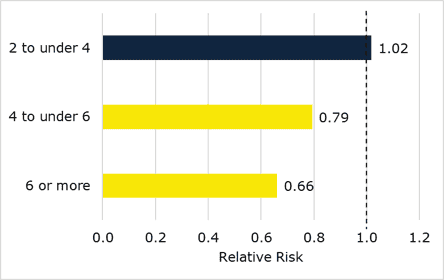
Our data also shows that the likelihood of achieving good honours varies based on how long students spend travelling each week, versus a comparison category of under 2 hours. The pattern suggests that moderate travel times do not negatively affect attainment, but longer travel times do. Students travelling between two and under four hours have a relative risk of +2% (RR 1.02), compared to those who travel less than two hours per week.
However, the picture changes for those with longer commutes. Students travelling four to under six hours per week are 21% (RR 0.79) less likely to gain good honours, again compared to the two hours. This reduction becomes even more pronounced for those travelling six hours or more per week, resulting in a 34% (RR 0.66) lower likelihood of achieving good honours compared with students with minimal travel time.
Where students live matters
Housing is another lens through which these dynamics can be understood. Intuitively, and recently highlighted by the OFS, we know living conditions are an important factor within the student experience. Our data found relationships between accommodation type and the likelihood of achieving a good honours degree. Living in halls of residence or purpose-built student accommodation is associated with a notably higher likelihood of achieving a good honours degree (+12%; RR 1.12) compared to other housing types, while living in a house share (-6%; RR 0.94) or alone (-13%; RR 0.87) negatively impacts the likelihood of good honours outcomes.
This is likely to be about more than proximity. It speaks to belonging and support: access to peer networks, informal academic support, and the ease of engaging with on‑campus services and facilities. For commuter students in particular, distance from these networks can compound the challenges created by work and travel.
A finely balanced experience
Taken together, these findings point to a more differentiated picture of commuter student success. Outcomes are shaped by a set of interrelated, nuanced factors: the type and location of paid work, how students travel, and the environments they return to outside their studies. For some, these align in ways that support success; for others, they create cumulative, overlapping barriers and raise important questions for widening participation.
This matters in the current policy context, as the government continues to push higher education provision towards greater specialisation, which risks increasing subject cold spots, at a time when the proportion of commuters increases. If the sector is to respond effectively, it will need to move beyond a single narrative of commuter disadvantage or resilience, and recognise the complex, contingent realities captured across their lives.




Comments
Jonathan Alltimes says:
It is a serious problem. What is the historical causality? To be of use, a statistical model must be a better predictor of degree result than other representations of historical causality. A statistical model is not historical causality it is a representation thereof. The argument is commuting is a determinant of degree result. The argument assumes prior experience of commuting and degree result, but the relative power of commuting in relation to other determinants of degree result is unknown and a qualitative model of historical causality is not proposed, so we can not compare the historical model with the statistical model or any other predictive model. The argument proposes complexity, but the thinking does not account for the real causal processes, which model reduces to classes of commuting. We do not the predictive power of the model, relative to say asking participants if the quality of their study is controlled by commuting. A post-hoc causal model of other explanatory factors is added. Everybody who has ever worked in person to person dealings knows how tiring such work can be. Why? Control over the mode of transport also lacks an explanatory causal model. I think commuting is likely a determinant of degree result, but other determinants are relatively more powerful and could vary in their power, except of course when commuting becomes an overwhelming constraint on the time for study (and its quality): time causes degree result.
Reply
Add comment