
Reflections from Labour Party conference 2026
This blog was authored by Rose Stephenson, Director of Policy and Strategy at the Higher Education Policy Institute.
HEPI is determinedly a non-partisan think tank and, as such, attends as many party conferences as our capacity allows. You can read a roundup from the Reform UK party conference from HEPI’s CEO, Nick Hillman, here and find out about our events at the Conservative Party conference here.
There is always an interesting discussion in the HEPI office about which party conferences we will attend and which ones we will run events at. The determining factors depend upon the electoral cycle. For the first two to three years of a parliament, our decision is weighed against the number of MPs in parliament. In the later stages of parliament, both the number of MPs and polling figures are taken into account. At this midpoint in the current parliament, this means attending both Labour and the official opposition Tory party conferences, as well as a sojourn by Nick to the Reform Party conference, given that at the time of our discussions they were the highest polling party in the UK.
And so, to Liverpool. This is the third Labour Party conference since they came to power, but the first for the new Prime Minister, Andy Burnham. There was certainly some strong messaging in action, with electronic billboards everywhere bearing the words ‘hope again’. But was there any hope of some focus on the higher education system?
Many, many NEETS (and occasionally some PEETS)
There were an impressive 17 events on NEETS at this year’s conference. This included a focus from our own sector, with the new Research+ (a new collaboration of research-intensive universities) hosting a panel on how to progress NEETS (those ‘not in employment, education or training’) to PEETS (who are ‘preparing for employment, education and training’). Across these events, themes such as mental health, neurodiversity, social capital (or lack thereof) and confidence were raised repeatedly. With Alan Millburn’s interim report stating that 21% of NEETs have a Level 3 (equivalent to A-level) qualification, and 15% have a university degree, the higher education system clearly has a place in solving this current crisis.
And that leads us on to …
Employment is everything
There is a clear drive across many institutions to focus on the employment of their students. And I am purposefully using the term employment rather than employability. Employability is helping the students to go out and develop their skills, but providers are now increasingly focussing beyond this – on employment itself. Many providers were discussing their programmes for providing work-based learning (including the University of Leicester, who held an early morning roundtable event on their new report with the Graduate Futures Institute). Others talked about a data-driven approach to graduate employment. Tracking those who were un- or underemployed after graduation and offering them internships at their own institutions or supported traineeships at local employers.
With a government that continues to focus on growth (now in every postcode), youth inactivity and intergenerational unfairness, this work feels on the money.
What else was being discussed?
Localism was big. Devolution is being supercharged by the Burnham government, and there was much discussion about working with mayoral combined authorities, and some helpful discussion about how institutions that sit outside of MCAs can act together to support funding being invested into these devolution cold spots until the devolution map is fully coloured in.
Vocational courses are in vogue. Perhaps inspired by governmental interest in vocational and technical education as an ‘alternative’ pathway to going to university.
VCs, including Penny Haughan of Liverpool Hope University, brought many of these themes together, talking proudly about their local student intake (57% are from the North West, 37% are from the City of Liverpool), their role in training teachers and social workers and the cyclical positive impact this has on the city and the region. As well as aligning with the messaging on youth employment, local focus and vocational learning, this institution has ‘hope’ in the name – how is that for supporting the agenda of the day?
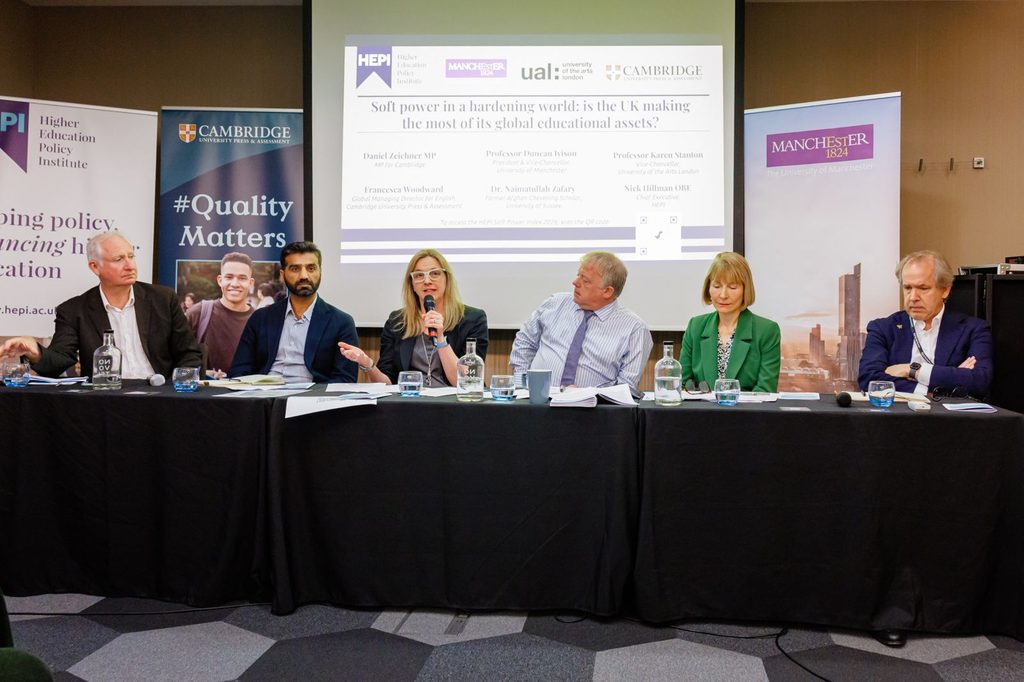
We also ran an event about ‘soft power’, with Dr Naimat Zafary reminding us that international students are more than immigration numbers, tuition income figures or potential future monarchs. They’re students and humans and fathers and cricket players and dreamers of a better future who make a deep and lasting impact on the communities they join in the UK.
The elephant in the room?
At several higher education events, it felt that something was being unsaid. The issue of poor-quality provision was barely mentioned, including by the Minister for Skills at an evening reception. (Although I did enjoy Baroness Smith’s description of the higher education sector as ‘not unargumentative’ and her recognition of how helpful the ‘constructive tension’ between higher education and the Government could be).
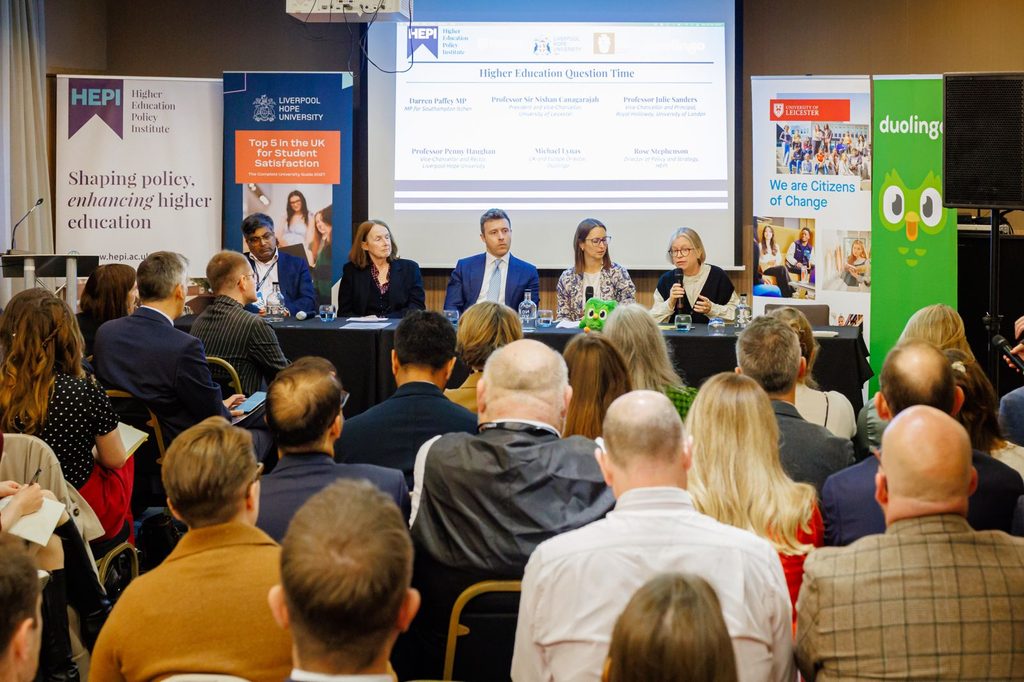
Sometimes, the most interesting talking points come from those listening to events. We hoped to capture this with our ‘Vice-Chancellor Question Time’ event, and it did not disappoint. One audience member asked a barnstormer of a question: if the Government is so concerned about the quality of franchised provision, is transnational education (UK institutions delivering courses abroad) going to be the next scandal?
And so – onto Birmingham for the Conservative Party Conference. HEPI will be running a panel event on Soft Power and Vice-Chancellor Question Time will be making a comeback; so if you do have a spicy question to ask – get yourself there, we’re outside the secure zone so no pass required.
With huge thanks to our partners and sponsors for the Liverpool Party Conference events: Duolingo, the University of Leicester, Royal Holloway, University of London Liverpool Hope University, Cambridge University Press and Assessment, the University of the Arts, London and the University of Manchester. We could not put on these events without your support.





Comments
Gavin Moodie says:
Thanx very much for this informative report.
I am very glad that UK universities are finally ditching the employability nonsense.
Reply
Jonathan Alltimes says:
I hope you do not mind if I am in a sharing mood. When I was lad, secondary school pupils and students found employment in Saturday and evening work. A few youth found work through family and friends. Some older pupils could join apprenticeships. Most worked their way up an organization. A few favoured undergraduates could be offered summer internships or the option of choosing an intercalated year of training and employment. Most flocked to the Milk Round towards the end of their degree for training programmes in the larger companies. Graduates did not talk about public sector employment. There is now, obviously a mismatch between the education of the under 25s and the likelihood of private sector employment, which was formerly bridged by minor jobs. Why are we in this situation? The under 25s used to look for minor jobs and training, now the State talks about work experience and voluntary work, even for undergraduates. Public services like education, welfare, and healthcare have not caused the situation, they have responded to it. Was there any discussion about the Milburn report and the responses of the Government? For example, the causes of the mental health crisis. Are the responses of the Government matched to the mental health crisis and its scale?
There is a strange irony that at the same time as the government is focusing on employment for the under 25s, the higher education sector is shedding jobs comparable to the decline of other major industries since the 1950s, about which very little is said by the government.
Reply
Add comment