
Britain’s education system has a data problem
This blog was kindly authored by Rob Phillpotts, Chief data officer at Jisc.
Ministers want colleges and universities to become more responsive to skills shortages, local economies and changing labour markets. The information infrastructure on which those ambitions depend is not yet up to the job.
Everyday services have reshaped what we expect from data. We assume information will be available quickly, services will respond to needs, and decisions will reflect what is happening now, not months ago. Algorithms raise questions about transparency and trust, but fast, reliable and usable data is now part of how modern services are delivered.
The same expectation applies to tertiary education, which is central to the government’s ambitions for growth, productivity, social mobility, lifelong learning and regional innovation. Providers need to understand demand, make timely recruitment decisions and help learners move between college, university and employment. Students expect institutions to respond to their needs at pace, so providers must be able to mobilise information quickly.
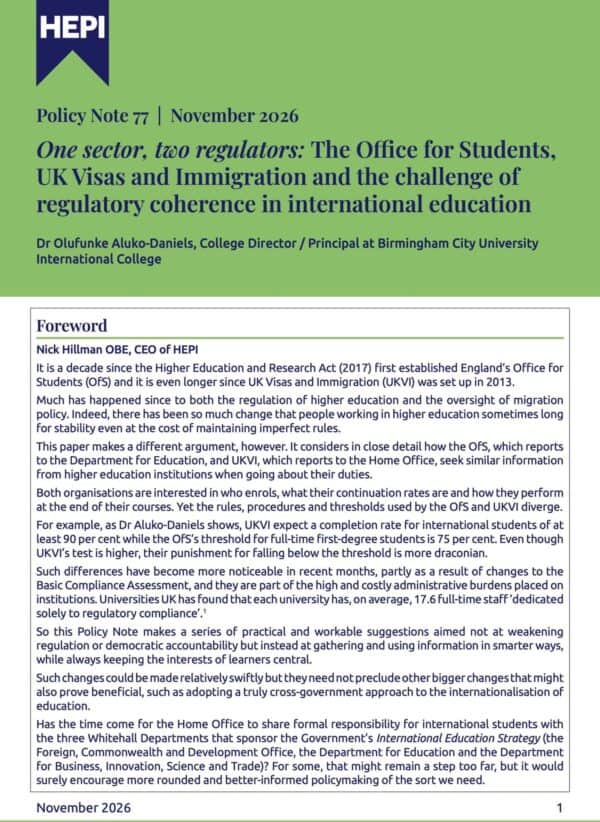
However, the education system has a data problem. The data infrastructure supporting this is not equipped to meet these ambitions. Providers supply similar information, in different formats, to different organisations. Across the sector, legacy systems and under-investment have left many without the data capability needed. System-wide insight is hard to achieve because data does not link or respond quickly enough to emerging needs (although the in-year programme aims to improve timeliness of HE data).
The problem is pressing
The challenge has several ingredients. First, no single authority is responsible for coordinating data across the system. Platforms are not always interoperable, data sources do not link sufficiently and learner identity is not applied consistently.
Second, the landscape is becoming more complex. Education policy rightly varies across the four UK nations, and various government and statutory bodies hold distinct responsibilities from further education through to higher education and research. Devolving more to the regions could make the data landscape harder still to navigate.
Third, persistent financial pressure means providers must reduce avoidable costs while making better decisions. Data should be a real enabler, not just a way of understanding the student body: student support should be portable, learner records should link skills and credits across the system, and careers services should draw on a connected understanding of future regional demand, not just what previous graduates did.
Change is needed if individual institutions and the sector are to resolve these challenges and unlock the potential of a data-enriched sector.
What value could be unlocked?
There are already areas where better data coordination would make a difference:
- Institutions could spend less time resubmitting similar data for different purposes, and statutory bodies could reduce the cost of processing fragmented data.
- Better understanding of graduate outcomes, and so of the value of education to graduates’ lives, wellbeing and contribution to society, requires agreement across multiple bodies.
- Shared ownership of cross-system data is needed for topics such as higher education delivered in colleges, university estates, climate data, and definitions like ‘degree apprenticeship’, ‘estranged student’ or ‘care leaver’.
- Emerging priorities, including regional innovation and skills, need coordinated, consistent and comparable data arrangements.
- Learner progress through the system and between providers could be facilitated, tracked and potentially transformed with a common learner identity.
Whole system issue
The tertiary data system is complex, and this is a long-term, multi-faceted issue. Jisc, as the designated data body (DDB) in England, has a key role in HE, but the system includes many organisations, including UCAS, SLC, OfS, DfE, Medr, SfC and other government departments and statutory bodies. Jisc already works with many of these to bring people together, coordinate approaches and deliver services. However, progress depends heavily on individual relationships, bilateral engagement and programme-specific collaboration.
In England, for example, the Office for Students determines what data the DDB can collect and publish for HE regulatory purposes, and Jisc fulfils this within a framework. That framework remains important, but the next stage of reform and ambition may require a more joined-up, system-wide tertiary level mechanism for decision-making.
A way forward
Resolving these challenges will be a large-scale undertaking and cannot happen all at once, but practical, no-regret measures could improve the rate of progress and further develop our understanding of the challenges ahead. A first step could be to enhance governance for tertiary data, bringing together the principal data and statutory bodies, the devolved governments and the sector: DfE, OfS, UCAS, Jisc, UKRI, Medr and SLC, alongside organisations such as UUK, AoC, GuildHE and IHE.
However, our long-term ambition must extend beyond coordinating data silos and convening to collaborate, to a joined-up approach that resolves cross-system issues and puts learners at the centre in the long term. If a stronger foundation is needed, government may need to consider legislative change.
Any reform should respect how education is delivered in each nation and underpin the functions statutory bodies must perform. The goal should be high-quality data at the heart of evolving education services, and a foundation for a more coherent, efficient and future-ready tertiary system.




Comments
Add comment