
WEEKEND READING: Who should decide what AI does in the lecture hall?
This blog was kindly authored by Mike Bond, co-founder of Bond & Coyne; and Baba Sheba, Professor of Digital Education and Transformation and Director of Digital Transformation at City St George’s, University of London.
Few in the higher education sector need persuading that artificial intelligence (AI) is here to stay. The question that is still vexing many is what to do about it. So far, the sector’s thinking has largely focused on how to manage the risks. Academics worry that AI will undermine students’ learning, or that it will absorb much of the drafting, analysing and problem-solving, meaning students miss out on developing their own critical thinking.
To address this, City St George’s, University of London, has – like other institutions – been moving away from policing the presence of AI to designing learning and assessment around its existence. We have done this by building an AI learning tool called Duologue to make students think harder, not less.
How it works
A student logs in to Duologue through the university’s usual online learning system and opens a short course, for example on AI literacy and ethics. Each course is broken into a handful of tasks.
With an ordinary chatbot, the student asks and the machine answers. Duologue works the other way round. The AI asks the first question and the student types a reply. The AI doesn’t mark the reply right or wrong, and it does not supply a model answer – it asks a follow-up question that tests the student’s reasoning. An exchange might go like this:
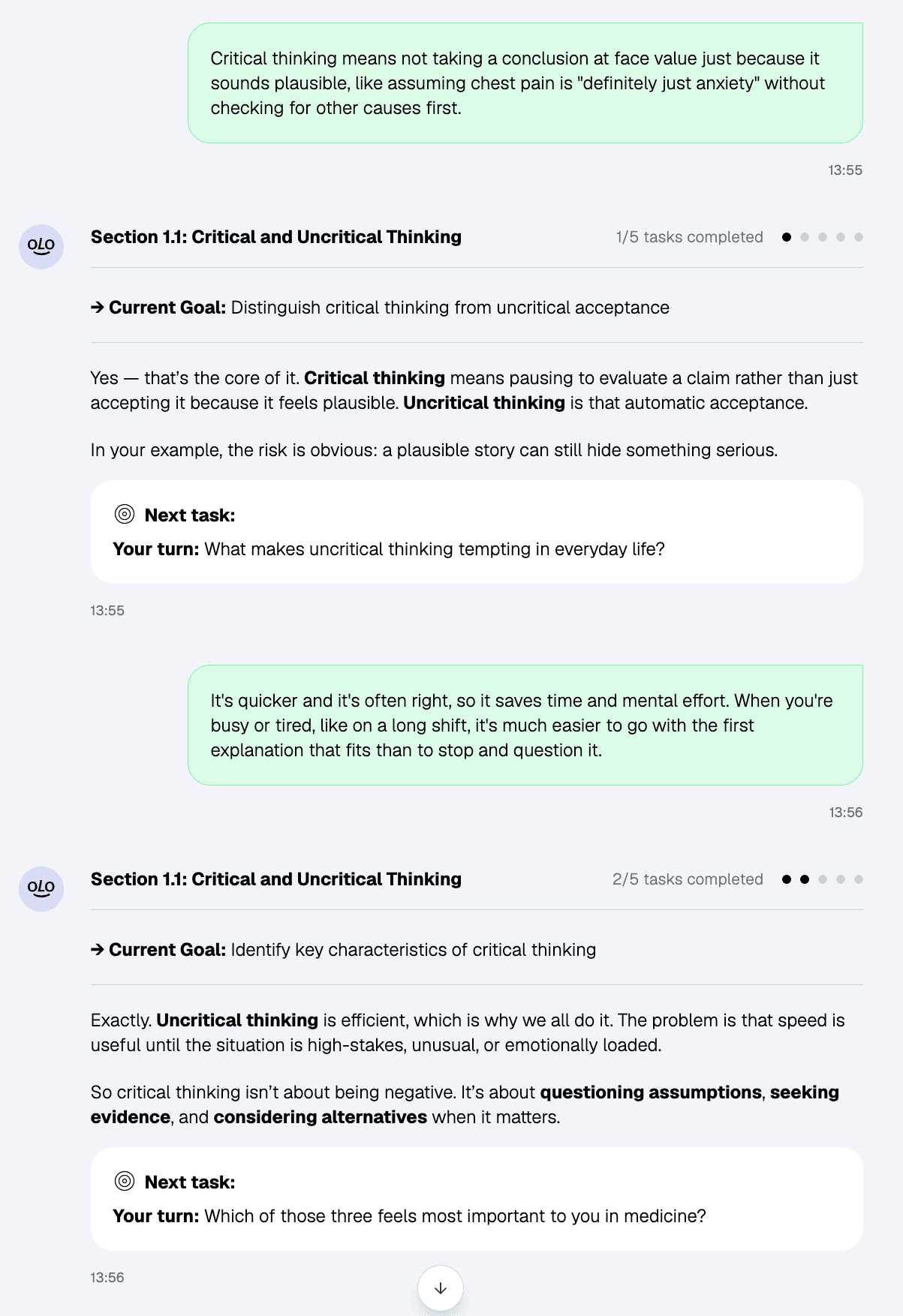
The questions adapt as the conversation goes on. A student who answers confidently is pushed further, and a student who is struggling has the idea broken into smaller steps.
‘Modules’ are for independent study – students work through them at their own pace and they are designed to slot into existing courses. ‘Labs’ are longer sessions in which groups work through more complex problems together.
Now that AI can produce an essay in seconds, a finished piece of writing tells us less about what a student genuinely understands, instead we need to focus on how students reason through a problem and arrive at their conclusions.
So far, the courses cover critical thinking, AI literacy and computational thinking (breaking a problem down into logical steps). City St George’s academics from Economics, Optometry, Science and Technology and policy have been involved, and the teaching approach has been led by the philosopher and author Tom Chatfield, working with the technologist and neuroscientist Timo Hannay.
Why build rather than buy?
Most educational technology has to be designed to serve as many institutions as possible to satisfy a commercial imperative. That is true of most off-the-shelf technology, and for a timetabling system for example, it does not really matter.
An AI tutor is different. It decides which question to put to a student next, when to give a hint and when to hold back the answer. Those are teaching decisions. Duologue is not a substitute for lecturers or tutorials, it adds to them, giving students more opportunity to be questioned and challenged.
The advantage of building technology within a university is that you are not trying to retrofit an external product to an institutional issue. You can build around the needs of your students and academics from the outset, test it in the real environment and adapt it as those needs change.
It gives an institution an opportunity to place pedagogical needs first – starting with how people learn and building to serve that, rather than starting with a tech product.
We wanted to begin with what higher education is for and build AI to support that.
Building is harder than buying, and for institutions under financial pressure it can look like a luxury. But a university that hands these decisions to a supplier is giving up more than money – it is giving up control over how its students are taught.
We were seeing the effect of AI on students, with 95% use. The academic publisher Sage was watching content being summarised rather than read. Wolfram and the Raspberry Pi Foundation saw a generation using computing to outsource thought rather than extend it. Tom Chatfield has been writing about how technology changes the way we think.
The shared conclusion was not to resist AI but to design with it deliberately, with the Socratic method of teaching through questions offered to every student, not just those in a small tutorial. These were experiences we could use to shape design when building our own tood.
What does this mean for the sector?
This is not a case for every institution building its own AI platform – that is not realistic or necessary. But here are three things to consider.
First, institutions serious about shaping AI need to treat it as a leadership and capability question. That means having senior leaders who understand the technology well enough to commit resources to it and who are willing to engage with the tension it creates among staff.
Secondly, not every university has the scale to build alone. Sector bodies like Jisc, for example, could support shared research-and-development groups, so smaller institutions can help shape AI tools too.
Thirdly, assessment needs to catch up. Educators in higher education should be asking not just how to detect AI misuse, but how evidence of the way a student learns over time might replace one-off assessments.
None of this means commercial providers have nothing to offer. Firms bring scale, investment, engineering expertise and long-term support that few universities can match. The question is not whether to work with industry, but who sets the direction – partnerships work best when the pedagogy comes first and the technology is built to serve it.
The alternative – waiting to see what the big tech companies offer and then deciding which one to buy – could amount to ceding control of our own AI and learning futures.




Comments
Add comment