
Are students still ‘woke’?
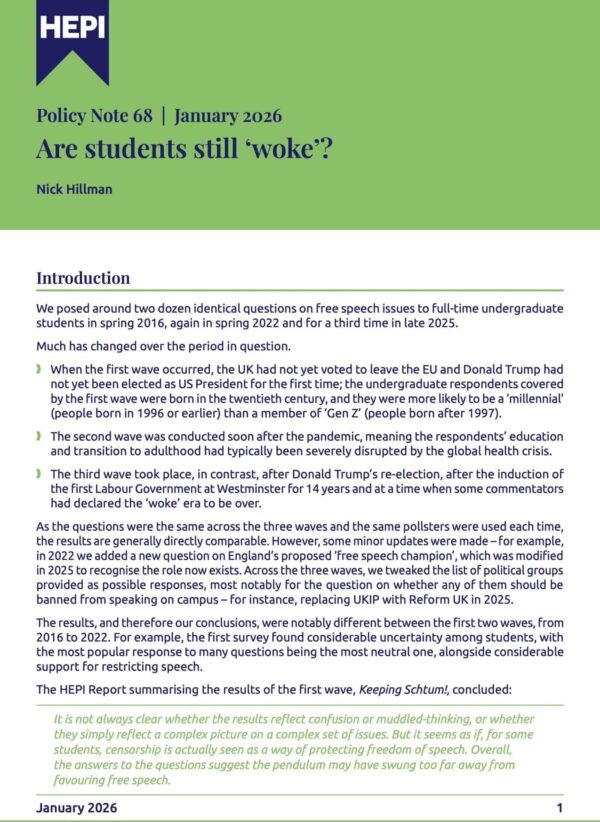
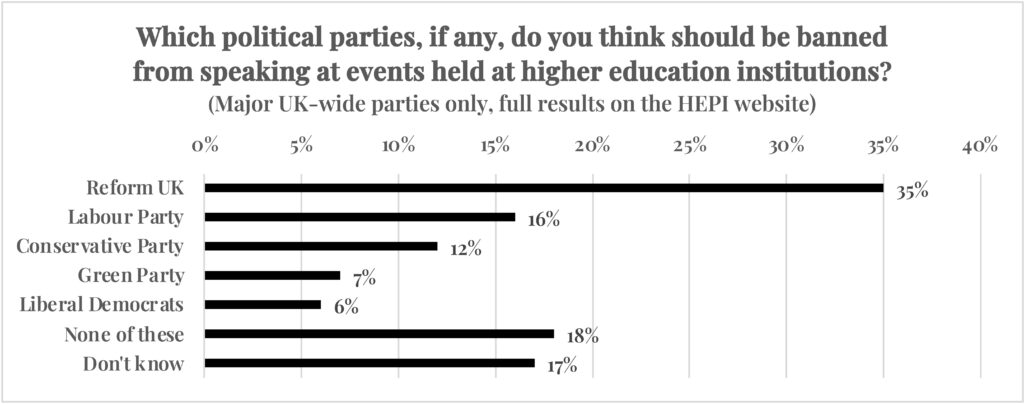
In a new poll on a range of free speech issues, 35% of full-time undergraduate students say they Reform UK ‘should be banned from speaking at events held at higher education institutions’.
The new opinion poll, which was conducted by Savanta for the Higher Education Policy Institute (HEPI), took place in November 2025 and generally repeated questions that were previously posed in 2016 and 2022, allowing a comparison of changing views over time.
Overall, the results show students’ views on free issues tend to be nuanced and they sometimes seem contradictory. In particular, while the principle of free speech has stronger support from students than in the past, so do specific bans.
- Nearly all (90%) students feel personally able to express their views without obstacle – 45% feel ‘completely’ able to do so and a further 45% feel ‘somewhat’ able to do so.
- However, around half of students (47%) agree with the idea that ‘universities are becoming less tolerant of a wide range of viewpoints’, double the proportion in 2016 (24%).
- Two-thirds (69%) of students say ‘universities should never limit free speech’, up from 60% in 2016 and 61% in 2022, while more students than in the past think ‘Academics should be free to research and teach whatever they want’ (61%, up from up from 45% in 2016 and 51% in 2022).
- Yet today’s students are also typically more supportive of specific policies that are thought to impact other people’s freedoms: for example, support for ‘safe spaces policies’ has risen to 79% (up from 48% in 2016 and 62% in 2022).
- Over one-third of students (35%) believe the political party that led the opinion polls for most of 2025, Reform UK, should be banned from speaking at events in higher education institutions. This is higher than the previous results for any other political group – in 2016, 31% of students wanted the British National Party (BNP) banned and, in 2022, 26% wanted the English Defence League (EDL) banned.
- When it comes to university libraries, just one-quarter (25%) of students agree ‘All resources should be included for the purpose of academic study, regardless of content’, down from nearly one-half (47%) in 2016 and one-third (34%) in 2022.
- Support for trigger warnings, which was already close to universal back in 2022, has grown slightly further, to 88% of students (up from 67% in 2016 and 86% in 2022).
- Most students (71%) support the broad approach of the current and previous Governments towards free speech in higher education, whereby English higher education institutions not only have to ‘promote’ free speech but are also monitored and regulated by a ‘free speech champion’ in the Office for Students.
The results are outlined in more detail in Are students still ‘woke’? (HEPI Policy Note 68) written by HEPI Director, Nick Hillman OBE.
Nick Hillman OBE, Director of HEPI and the author of the new report, said:
We have been tracking students’ views on free speech issues for a decade. Today’s students are more definite in their views than their predecessors. Confusingly, however, they offer stronger support for the principle of free speech while also being even keener to see specific barriers against free expression.
I am shocked that more than one-in-three students support banning Reform UK from university campuses. The best way to take down democratic political parties that you disagree with is surely through free, fair and fierce debate – whether that is on campus or beyond.
It is also clear that students recognise they may not always be well-equipped to draw their own lines on free speech matters. For instance, they express strong support for the free speech champion in the Office for Students whose job it is to oversee what actually happens.
Notes for Editors
- HEPI polled 1,006 full-time undergraduates in March 2016, 1,019 more in May 2022 and a further 1,012 in November 2025. The first two waves were undertaken by YouthSight and the third by Savanta (who bought YouthSight in 2021). Quotas were set for gender, university group and year of study and the margin of error is +/- 3.08%.
- HEPI was founded in 2002 to influence the higher education debate with evidence. We are UK-wide, independent and non-partisan. We are funded by organisations and higher education institutions that wish to support vibrant policy discussions.



Comments
Robin Naismith says:
Yes I believe they are because they choose to listen to the lies there government tells them
Reply
Bea says:
So a lot of them, leftists mainly, think they want free speech but don’t really? They want to ban reform from speaking, wonder what they say about an imam? The hypocracy is interesting to say the least..
Reply
Add comment