
WEEKEND READING: Does Positive Affect Journaling have a role to play in higher education?
This blog was kindly authored by Dr. Lesley Black and Dr. Glenn Fosbraey, The University of Winchester.
Mental health and higher education
The focus on student mental health and wellbeing has never been sharper. In 2024, The University of Winchester made its own effort to further the conversation around mental ill health and continue to chip away at the barriers that may prevent people from seeking the help they need with the book Breaking Barriers. During the booklaunch, at a panel conversation, a student contributor to the book spoke about their experiences with Positive Affect Journaling (PAJ), and from one project, a new one was born.
Positive Affect Journaling
Positive Affect Journaling (PAJ) is a process which encourages individuals to write about positive aspects of life experiences. Recent studies (including Richelle and Alea (2023) and Maclsaac et al. (2022)), have shown that PAJ can decrease mental distress and increase well-being.
Additionally, studies (including Flett, G.L. (2018), and Prihadi, K.D.,Wong, C.Y.S., Chong, E.Y.V., & Chong, Y.X. (2020)) show that feelings of belonging and mattering contribute to overall positive mental wellbeing. Mattering is also shown to be a protective factor against self-harm and can be seen as a base for resilience.
Through a series of organised writing sessions, this project aimed to utilise PAJ to improve mental wellbeing among both the student and staff bodies at the University and, in the longer term, foster a culture of positivity, belonging, and mattering.
The project part 1: student engagement (Glenn)
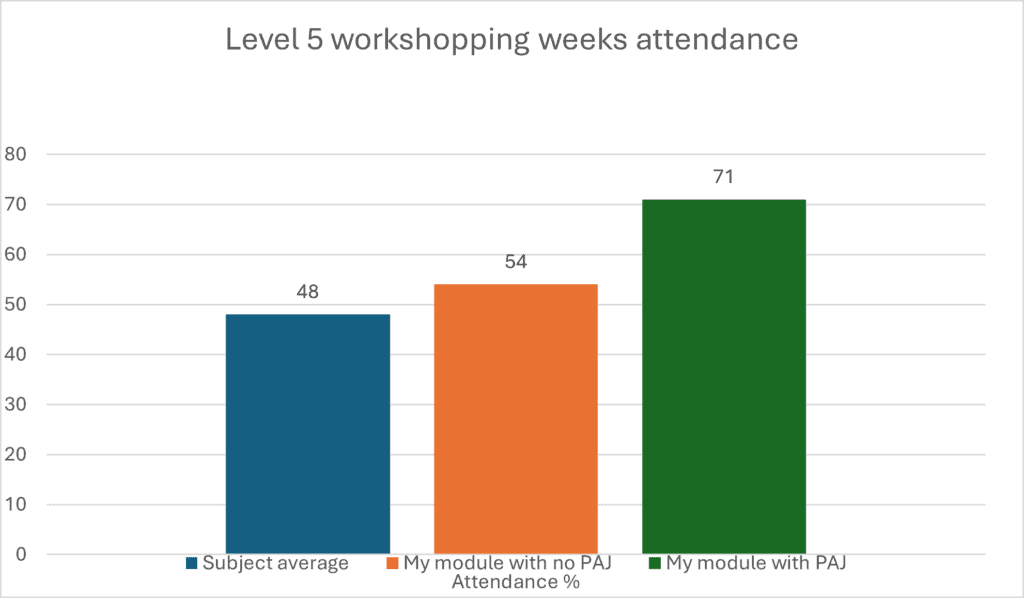
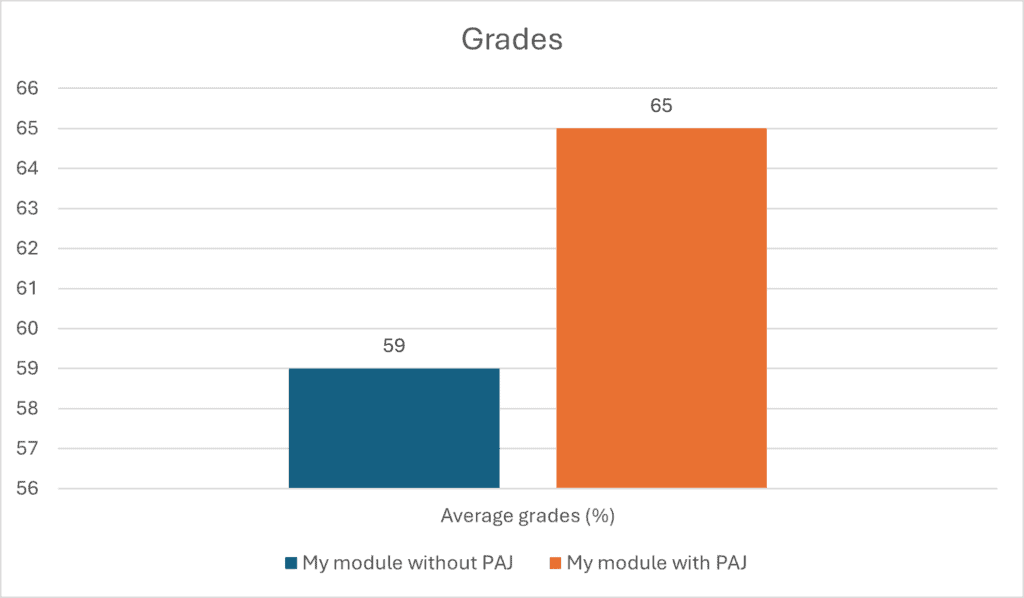
I’ve long known that, if we are to maximise student engagement with any project, the classroom is the place to do it. In Semester 1, 2024/25, I taught on two Level 5 Creative Writing modules which consisted of largely the same students. This presented a great opportunity to run PAJ activities in one class (‘Playwriting’) but not in the other (‘Composing Song Lyrics’) to examine any differences (or lack of) they might have on student attendance and attainment. It was vital that any in-class PAJ activities didn’t ‘steal’ module time, so I knew early on that they needed to be not just relevant to lesson content, but integral to it. In the past, I have usually begun my classes with 10 minute ‘warm-up’ writing exercises, designed to get the students in a creative mindset, but also to introduce them to the theme of that week’s content. It struck me, then, that this would be the best place for the PAJ activities, and that the exercises I’d been setting could quite easily be repurposed in this way. Examples of the prompts I used on the Playwriting module (with lesson themes in parentheses):
- A concept for a play where a character revisits bad experiences and draws positives from them (idea generation).
- Find a recent news story that makes you feel positive about the environment (setting).
- Script a happy event from your life which involves you and two or more family members (dialogue).
For the very last PAJ prompt of the module, I did deviate from lesson content, firstly because we were into workshopping weeks by then, so there was none (beyond students reading and critiquing each other’s work), but secondly because I wanted to leave them with positive feelings about their writing prior to assignment submission. As such, the final prompt was:
You’ve won some kind of award for your writing.
- What was it for?
- What do you say during your acceptance speech?
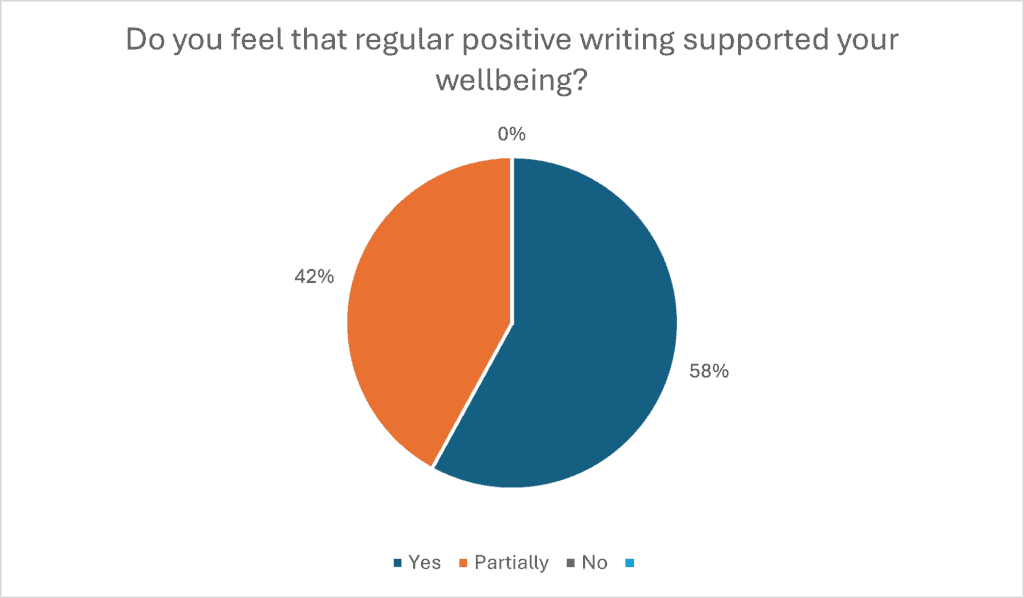
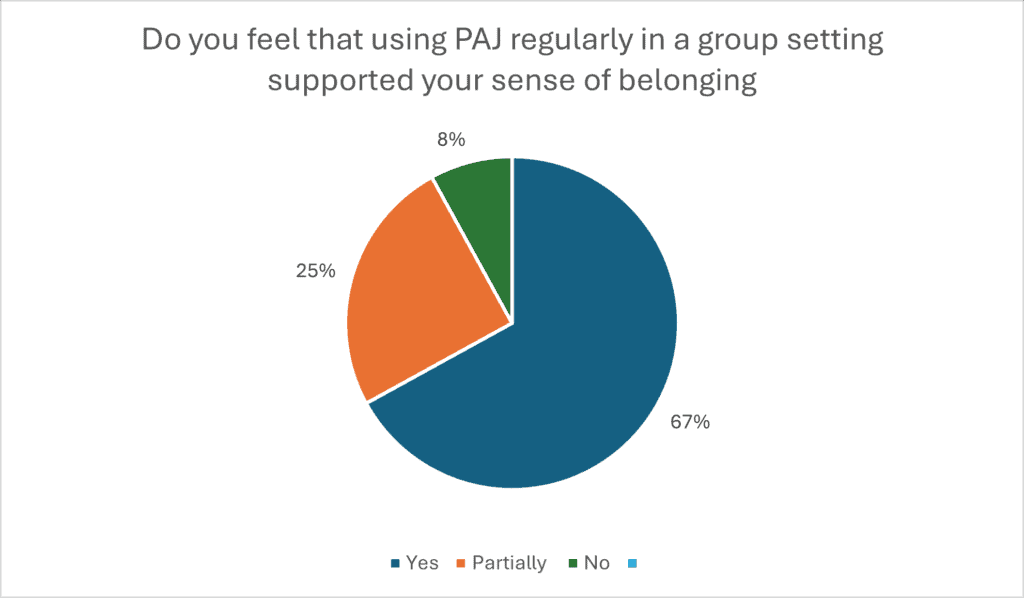
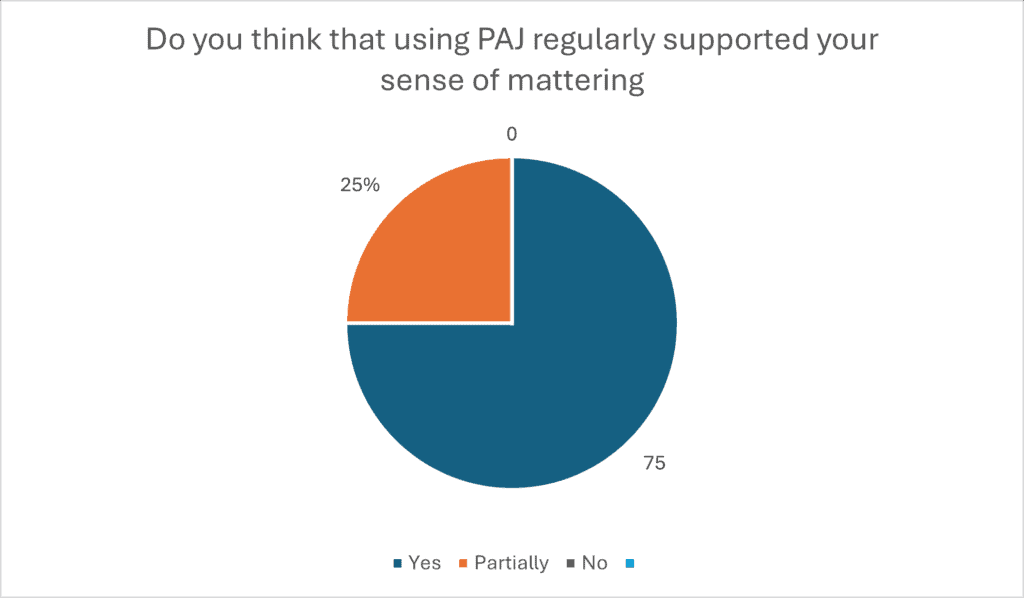
Below are some graphs detailing the outcomes.
The project part 2: staff engagement (Lesley)
As well as exploring how PAJ could support our student body, we also wanted to explore how it could support staff. In particular, we were keen to use PAJ with senior staff, taking into account the challenges many of these colleagues face on a daily basis. We also hoped that by working with staff, we could further support the understanding of the impact of mental wellbeing (positive and negative) on the student experience and that the project would encourage staff to think creatively about how they could embed PAJ in some format into their curricula.
We identified colleagues to participate using purposive sampling, with maximum variation, and invited them to take part. Staff then self-selected from that initial purposive sample. This allowed us to be intentional in our group constituency. We ran two separate staff groups (Head of Department level or above) from both academic and professional service roles. The groups met fortnightly, one in a morning slot and one in an early evening slot. We had up to an hour per session and allowed 20-30 minutes writing, with ten minutes or more for discussion at the end. We started and finished each session with a PANAS questionnaire (developed by Watson, D., Clark, L. A., & Tellegen, A. (1988) before moving onto a series of 3 positive affect prompts. At the end of the project, we ran an evaluation and feedback survey.
Prompts included things such as:
- What have you done recently that you are proud of?
- When did you last laugh and why was it so funny?
- Write about a win, no matter how small, from today
Colleagues could write about whatever they chose in response to the prompt – work or non-work related. We didn’t ask to see what was written nor did we ask them to share, but during the discussion section at the end of each session, people often chose to share how easy or hard they had found any particular prompt and how they felt their mood or emotions had shifted.
The PANAS questionnaires showed us that both groups had improved positivity after every writing session, with both increasing by over 40 points in average positive reporting. We had a 90% response rate to the post survey evaluation. 100% of respondents said that regular positive writing had supported their wellbeing, and 100% said it had supported their sense of belonging. 90% of respondents said it had supported their sense of mattering. 78% wanted to continue with positive writing as a staff group, and 56% said they would also like to continue on their own as well as with a staff group.
All of the staff wanted to consider how they could use PAJ within their own disciplines, and we are looking forward to developing more PAJ activity within both professional services delivery and within subject areas.
We set out to explore whether using PAJ within the classroom and with staff would support:
- Self-reported improved mental wellbeing within student body
- Increased understanding on the part of colleagues of the role of positivity, mattering and belonging in supporting student learning
- Increased levels of student attendance
- Innovative curriculum development possibilities
We succeeded in achieving all of this and more – we also got improved student grades and an increased sense of belonging and mattering in the staff cohort. Whilst we didn’t explore this further, we believe that staff who feel more connected with their institution and that they matter more must impart that positivity into their work, and therefore, we expect that this must have an impact on student outcomes as well.
The outcomes of the staff groups, coupled with the clear positive impact of PAJ technique within the classroom, provide a strong case for embedding positive thinking within a university setting to support not just mental wellbeing, but to also support academic success, and we can’t wait to expand on our work.




Comments
Jonathan Alltimes says:
The rationale for the project is student mental health and wellbeing. The use of narratives to improve mental and wellbeing is a common method in counselling to control self talk used to reinterpret one’s own experience and has ancient Greek origins. Traditionally the diagnosis of medical doctor was the technique transferred from healing physical ailments to healing psychological ailments, which later became the supposed neutral non-judgmental sounding board used in counselling practice as a reflective mirror in which the experience of the patient is reinterpreted through medical and scientific models of understanding. There is no doubt that journalling can be used as a partial substitute for talking about one’s day with other people. What it lacks is the interpretative perspectives of other people giving the events of the day other meanings which make sense of the day’s experience and enable integration into the wider and longer meaning of one’s life. What it lacks are the conditions and the constraints which are likely to be causes controlling student mental health and wellbeing and which no amount of narrative reinterpretation can change, that is limit of the talking therapies. The summary offered here in the blog does not refer to the research on the causes of student mental health and wellbeing or that of employees.
Reply
Add comment