
A breed apart? What do young undergraduates think of controversial and divisive issues?
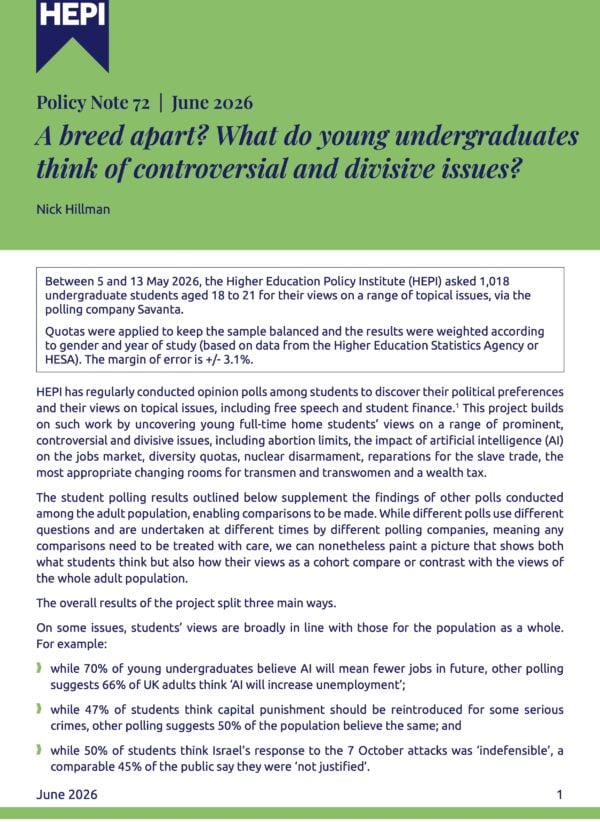
New polling of young undergraduates from the Higher Education Policy Institute reveals young undergraduates views on a range of topical issues, including:
- abortion limits;
- the impact of artificial intelligence on jobs (AI);
- diversity quotas;
- nuclear disarmament;
- reparations for the slave trade;
- the most appropriate changing facilities for transmen and transwomen; and
- a wealth tax.
HEPI asked 1,018 undergraduate students aged 18 to 21 for their views on a range of topical issues between 5 and 13 May 2026, via the polling company Savanta. The results are published in A breed apart? What do young undergraduates think of controversial and divisive issues? (HEPI Policy Note 72) by Nick Hillman OBE, HEPI’s Chief Executive.
The results are compared with those for other polls conducted among the adult population as a whole. While such comparisons need to be done carefully, given different polls have different features and are undertaken at different times, this allows us to see how students’ views compare and contrast with those of others.
The results split ways.
- On some issues, students’ views are broadly in line with those for the population as a whole. For example, 70% of young undergraduates think AI will mean fewer jobs in future while 66% of UK adults think ‘AI will increase unemployment’. Half (47%) of students think capital punishment should be reintroduced for serious crimes as do 50% of the wider population.
- On other issues, students’ views veer in the same direction as the balance of opinion in the population as a whole but to a greater degree. For example, two-thirds (67%) of students think the current rules on abortion time limits are ‘about right’ compared to one-half (49%) of the population as a whole. Three-quarters (75%) of students think man-made climate change has not been exaggerated, which is higher than the result for all adults (62%).
- In a limited number of areas, students’ views seem to be starkly different. For example, half of students (47%) favour reparations for the slave trade, but only one-quarter (24%) of the public do so; 28% of students think Hamas’s attacks on Israel on 7 October 2023 were ‘defensible’, whereas just 4% of the general public thought they were ‘justified’; and 72% of students favour unilateral nuclear disarmament, which only 11% of the public support.
The new poll also covers students’ current voting intentions. The Greens are in a secure first place on 35%, far ahead of Labour (12%), Reform UK (8%), the Liberal Democrats (7%) and the Conservatives (6%). One-in-four students (24%) say they ‘would not vote’ and 5% are ‘undecided’.
Nick Hillman OBE, the Chief Executive of HEPI and the author of the new report, said:
We decided to ask students for their views on a range of issues because of the idea that a “culture war” has taken root and because universities and those who oversee them have been wrestling with new rules on free speech.
In general, our results prick the idea that students are “woke snowflakes”. Their views often resemble those held among the adult population as a whole, either closely or to a notable extent.
Yet on a small number of issues, students’ opinions are strikingly different. They are more sympathetic to the proscribed terrorist group Hamas, more supportive of reparations for the slave trade and more in favour of unilateral nuclear disarmament.
Comparing the views of students with those of all adults is revealing because today’s students are tomorrow’s leaders. However, it is an inexact science based on different polls from different polling companies undertaken at different times. So these conclusions come with methodological health warnings. We urge others to undertake similar work to see if their results corroborate ours.
Notes for Editors
- Quotas were applied to the polling results in order to keep the sample balanced and the results were weighted according to gender and year of study (based on data from the Higher Education Statistics Agency or HESA). The margin of error is +/- 3.1%.
- HEPI was founded in 2002 to influence the higher education debate with evidence. It is UK-wide, independent and non-partisan. We are funded by organisations and higher education institutions that wish to support vibrant policy discussions, as well as through our own events. HEPI is a company limited by guarantee and a registered charity.




Comments
Gavin Moodie says:
I was surprised at the extent of UK students’ support for capital punishment (47%) and the UK’s unilateral nuclear disarmament (72%).
Reply
Jonathan Alltimes says:
How likely is the subculture of students the same as the culture of the general adult population? The author finds it is mostly similar.
The administration of providers have a legal duty to protect freedom of speech. Supposed culture wars do not exist, as the culture of students and the general adult population is mostly similar. As culture wars do not exist, it is likely provider administrators will find it easier to protect freedom of speech than assumed. But it does not follow that providers will all find it equally easier to protect freedom of speech, as providers themselves are not representative of the general adult population, it is the culture of the providers themselves which is likely to be a determinant of the protection of freedom of speech. Unlike the assumption of the survey, it is also likely that the political expression of student opinions will vary across providers and that the culture of the provider is a source of opinions and their expression. Other sources of opinions includes the family, friends, school, books, the media, and political groups. Will these students be the leaders of tomorrow? What is your model of historical causation?
Reply
Add comment