
Will you really be £143,000 better off if you plump for an apprenticeship over a regular degree? And why my email inbox fills with junk every August …
HEPI Director, Nick Hillman OBE, bemoans the annual wave of ill-informed emails hanging on the public exam results.
Every August, around results day, my email inbox fills up with silly-season unsolicited and clickbaity news stories. These generally incorporate some eye-grabbing but highly questionable data.
It is frustrating because HEPI is a specialist higher education think tank (and charity). It is not a home for poorly-conceived stories that are really thinly-disguised attempts to get a specific company’s name into the headlines.
At the risk of unleashing the Streisand effect, here are a couple of this year’s examples.
The first is about student safety, sent on behalf of an ID card company:
With A-level results day landing this Thursday (13 August) and UK searches for ‘A-level results day’ up 157% in the past month, and ‘safest university’ up 426% year-on-year, safety is becoming a real factor in where students choose to study alongside course quality and cost of living.
New data from ID Card Centre has ranked all 124 UK universities with 3,000+ students on safety.
(Ulster is their safest place, in case you are wondering.)
The second example hails from ‘the number one academic summer school in Europe.’ It is based on a (seemingly self-selecting) survey in which 1,433 Gen-Zers rank 100 different countries for levels of ‘youth optimism’, though – just to make sure the data are really robust – the results only include the 41 countries that attracted at least ‘five student respondents’:
Sri Lanka, Kenya and Nepal are home to the world’s most optimistic young people, while Kuwait, Rwanda and Turkey rank among the least hopeful … The UK ranks 33rd out of 41 countries with political optimism of just 3.04 out of 5 and environmental optimism of 3.06 out of 5.
The really big firms do it too, as with this example from Adobe who emphasise ‘a new experience’, ‘new research’ and ‘new technology’:
With A and A* results rising from 28.2% to 28.7% year on year, students are celebrating their future in university, which will be a new experience. New research from Adobe Acrobat, found that new technology is reshaping academic life, with 68% claiming AI is their biggest time-saver at university.
Such missives are a pain but easily solved by the Delete button.
This year, however, I also received a more worrying one that risks adding to the (mis)conceptions on how apprenticeships compare to traditional degrees. It has been bugging me ever since I received it (as usual from a PR-firm conduit) less than 24 hours before the main results day.
Titled ‘Results Day: Apprenticeships could leave school leavers up to £143k better off by 21’, the email called for a ‘Results Day Reset’ … but it was really just a plug for a specific apprenticeship provider.
With A-Level Results Day tomorrow, Impact Futures Group is calling for a ‘Results Day Reset’, urging school leavers and parents to look beyond the traditional university route when weighing up their next step.
The national apprenticeship training group has launched a new Apprenticeship vs. University Calculator, which shows that choosing an earn and learn route could leave a young person up to £143,000 better off by age 21, when university tuition fee debt and earnings while training are taken into account.
In other words, if you use their calculator (as I have), you will see that person A, who leaves full-time education to enter the labour market via an apprenticeship, is richer at the age of 21 than person B, who stays in full-time education before graduating and then getting a job. In a sense, this is all pretty obvious because an apprenticeship is a job with training attached, attracting a wage, whereas a traditional degree is likely to be largely funded through debt.
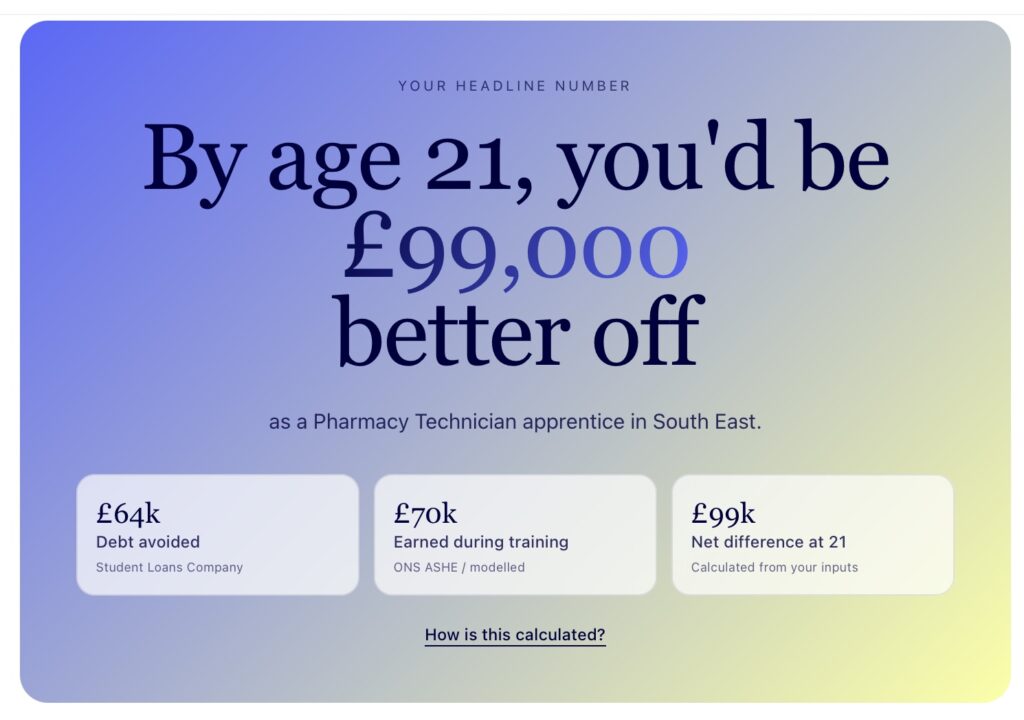
To recap, the precise argument is you should start an apprenticeship at, say, the age of 18 so that you are better off at age 21 than someone from the same cohort who stays in full-time education until the age of 21. Duh!
This is akin to arguing that you would be better off financially if you left school at 16 or 14 or 11 (which have all been school leaving ages) and then persuaded someone to pay you a little money while your former classmates continue in full-time education. Even a paper round would do – as you would be earning while your unimaginative former classmates opt to go on learning.
If you think I am exaggerating, take a look at the specific worked-up example that was offered in the email I received:
For a typical school leaver, the difference can be significant. An 18-year-old choosing an apprenticeship through The Childcare Company could move straight from sixth form into an Early Years role, working towards a Level 3 qualification while earning a salary and gaining practical experience from day one. Within around two years, they could be fully qualified and already building their career, at a point when many of their university-going peers are still studying.
So the apprentice is better off because they get a salary while doing their training and, having sprouted wings, they then get a fully-fledged job earlier than the full-time undergraduate, who is taking on interest-bearing debt. (I shall ignore for now, as the example does, that two-thirds of full-time young undergraduates have jobs on the side even during term time these days, so they most definitely are also earning.)
There are lots of reasons for doing an apprenticeship – perhaps you know quite early on in life what career you want to enter, or perhaps you are simply fed up with full-time education or perhaps you have an apprenticeship provider with an enticing offer on your doorstep etc etc etc – if only you can find one you want (given most apprenticeships go to people already in the labour market rather than just out of school). I have a close relative far in to a degree apprenticeship and she has not regretted opting for this route for a moment.
There are, nonetheless, lots of reasons for doing some due diligence before picking your route, given apprenticeships contrast poorly on a number of metrics (such as drop-out rates) with other educational routes. Moreover, in the example that was offered up in the unsolicited email quoted above, the apprentice is getting (another?) Level 3 qualification while the undergraduate is studying not for a Level 3, nor a Level 4, nor a Level 5 but a Level 6 qualification.
When it comes to degree apprenticeships specifically, there is growing evidence that not everything is rosy compared to more traditional higher education routes. The recent HEPI / Advance HE 2026 Student Academic Experience Survey, for example, found: ‘Students on Degree Apprenticeship courses are notably less likely to be satisfied with their choice’. Similarly, as reported by Research Professional, this year’s National Student Survey results shows some striking differences:
Apart from questions about work placements, the apprenticeship satisfaction rates are lower on almost every question than the general student average. On course organisation and management, apprenticeship satisfaction is considerably lower. Only 71 per cent of apprentices are happy on this metric, compared with 80.9 per cent of students in general, with only 68.7 per cent of apprentices saying their course is well organised.
In short, arguing an apprenticeship is generally a path to greater riches than a traditional degree, which it will be for some people some of the time, only makes sense if you take a sensible time horizon and have good data. For example, IF it could be shown that 40somethings who started apprenticeships aged 18 are better off financially than those who studied on full honours degrees until they were 21, that would be powerful evidence to insert in an earnings calculator aimed at people still in school. In reality, however, such a tool would be extremely hard if not impossible to build because of the paucity of directly comparable data.
It so happens that there was an important debate in the House of Lords on all this just a fortnight before the A-Level results landed. The former Minister for Universities and Skills, the Rt Hon. the Lord Willetts, pointed out:
As a minimum, analysis along the lines of that from the IFS [Institute for Fiscal Studies] should surely also be applied to apprenticeships. We need to compare like with like and, although there are some useful assessments of apprenticeships, they do not have anything like the rigour of this IFS analysis. Will the Minister commit today to apply this analysis to other forms of education and training as well?
The Opposition Spokesperson, Baroness Cash, pushed the Minister on this too:
I agree with the noble Lord, Lord Willetts, that perhaps there is more data to be collated by the Government.
These comments elicited an important response, including a new commitment, from Baroness Smith, the Minister for Skills, promising better data in future:
In relation to the point made by the noble Lord, Lord Willetts, and the noble Baroness, Lady Cash, about the returns to apprenticeships, there is already a variety of evidence on the economic returns to apprenticeships that has been published by the department, the Centre for Vocational Education Research and others. We will be considering how to apply a methodology similar to that used by the IFS to apprenticeships as we go forward.
Let’s hope this happens soon, let’s hope it leads to a more enlightening stream of emails next summer and let’s hope too that – if we must measure higher education solely by the level of relative earnings – then better information is put in the hands of future school leavers.





Comments
Add comment