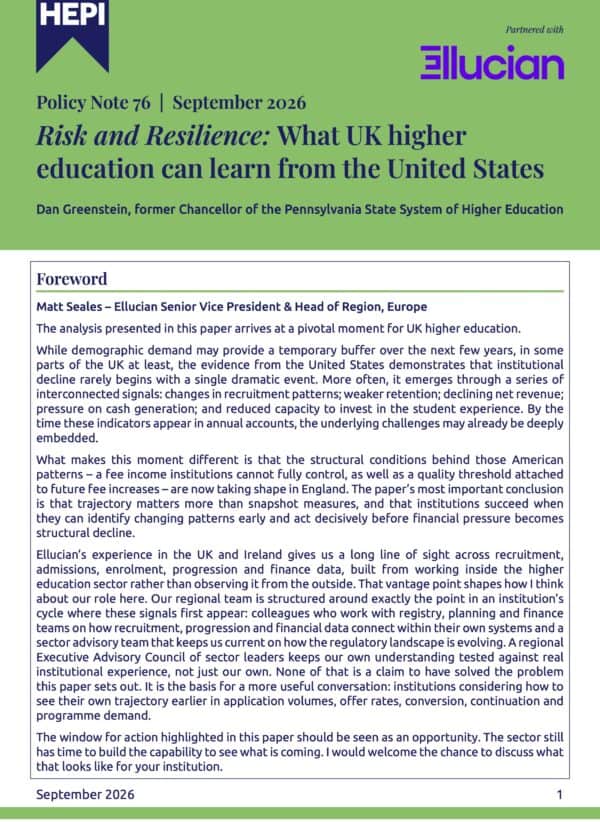
Risk and Resilience: What UK higher education can learn from the United States
UK universities ‘carry private-sector exposure at public-sector speed’: Lessons from America.
A new HEPI Policy Note, Risk and Resilience: What UK higher education can learn from the United States (HEPI Policy Note 76), by Dan Greenstein uncovers seven lessons for the UK from more than a decade of US experience.
The Policy Note argues English higher education is funded like American private higher education, with little direct public funding, but governed like American public higher education, with the price set externally.
While English higher education institutions are heavily dependent on fees, meaning any drop in demand hits immediately, they are unable to set their own price and have limited room for manoeuvre.
The author, Dr Greenstein, was formerly the Chancellor of Pennsylvania’s State System of Higher Education and also Vice Provost for Academic Planning, Programs and Coordination at the University of California. Earlier in his career, he was a Lecturer in History at the University of Glasgow and he is currently Chief of Industry Transformation at Ellucian, a leading higher education technology solutions provider, who have sponsored the new HEPI Policy Note.
Dr Greenstein’s lessons from the US are:
- Funding levels do not predict distress, but funding design does (eg whether public support is indexed to inflation and whether institutions can raise their prices)
- Sector averages hide the position of individual institutions – and even an institution’s own headline numbers can hide its true financial condition
- One revenue line alone, international students, is currently holding the sector up
- Institutions rarely fail from just one problem; they fail when different problems drive one another
- From 2028/29, when fee increases will come to depend on quality, retention stops being an access measure and starts driving revenue
- Recovery has to come from revenues – austerity can bolster efficiency but cannot deliver growth
- Shared services save money but only those affecting student-facing and instructional services can change an institution’s direction by driving revenue
In his Foreword, Matt Seales, Ellucian Senior Vice President & Head of Region, Europe, writes:
The evidence from the United States demonstrates that institutional decline rarely begins with a single dramatic event. More often, it emerges through a series of interconnected signals: changes in recruitment patterns; weaker retention; declining net revenue; pressure on cash generation; and reduced capacity to invest in the student experience. By the time these indicators appear in annual accounts, the underlying challenges may already be deeply embedded.
… The paper’s most important conclusion is that trajectory matters more than snapshot measures, and that institutions succeed when they can identify changing patterns early and act decisively before financial pressure becomes structural decline.
In his paper, Dr Greenstein focuses on the importance of raising revenue and the problems caused by a lack of oversight:
Every American case of an institution or system pulling out of a deteriorating trajectory involved it acting on revenue, not costs alone. …
Cost reduction does not touch what is driving the decline. An institution that runs its savings programme perfectly while its recruitment keeps falling has not changed its trajectory; it has made its contraction more efficient. …
England also has no authority able to act across institutions, and competition law constrains UK collaboration where it does not constrain American systems. And England’s position has no American parallel: its institutions are funded like American private universities, with student fees producing more than half of the sector’s income, but priced like American public ones, with no control over price and no block-grant appropriation to absorb a shock. They carry private-sector exposure at public-sector speed.
Dr Greenstein additionally notes the extra challenges faced by institutions in Scotland and Northern Ireland:
The worst combination in the data is a capped price alongside a capped intake, because it offers no offset at all, and it is worse than a low appropriation that at least moves with costs. Scottish and Northern Irish universities, whose appropriations are not indexed and whose fees and student numbers are both controlled, hold neither lever.
Nick Hillman OBE, the Chief Executive of HEPI, said:
People often talk about the Americanisation of UK higher education. But in many respects, the position of institutions on this side of the pond is worse. Nominally autonomous, they are remarkably constrained in how they can respond to the crisis they find themselves in.
This situation forces the system as a whole to accept managed decline while pushing individual institutions closer to the edge.
Higher education institutions in the United States have faced similar challenges to those now disrupting providers across the UK. We can learn from that American experience, both on what to do and what not to do.
If there is one way to sum up a better approach, I’d be tempted to start with the old saying “it’s the revenue, stupid”.
On Wednesday, 25 November 2026, at 1pm (UK time), HEPI and Ellucian will be running a free webinar on the issues discussed in the paper. Register to attend here.
Notes for Editors
- Dan Greenstein blogs extensively about risk and resilience in higher education at dogreenstein.com
- Ellucian powers innovation for higher education, partnering with approximately 3,000 customers across 50 countries, serving more than 21 million students. Ellucian’s AI-powered platform, trained on the richest dataset available in higher education, drives efficiency, personalised experiences and strengthened engagement for all students, faculty, and staff. Fuelled by decades of experience with a singular focus on the unique needs of learning institutions, the Ellucian platform features best-in-class SaaS (Software as a Service) capabilities and delivers insights needed now and into the future. These solutions and services span the entire student lifecycle, including data-rich tools for student recruitment, enrolment and retention to workforce analytics, fundraising and alumni engagement. Ellucian’s innovative solutions, vast ecosystem of partners and user community of more than 45,000 provide best practices leading to greater institutional success and achieving better student outcomes.
- The Higher Education Policy Institute (HEPI) aims to shape the higher education policy debate with evidence. UK-wide, independent and non-partisan, it is funded by organisations and universities that wish to see a vibrant higher education debate.




Comments
Add comment