
One sector, two regulators: The Office for Students, UK Visas and Immigration and the challenge of regulatory coherence in international education
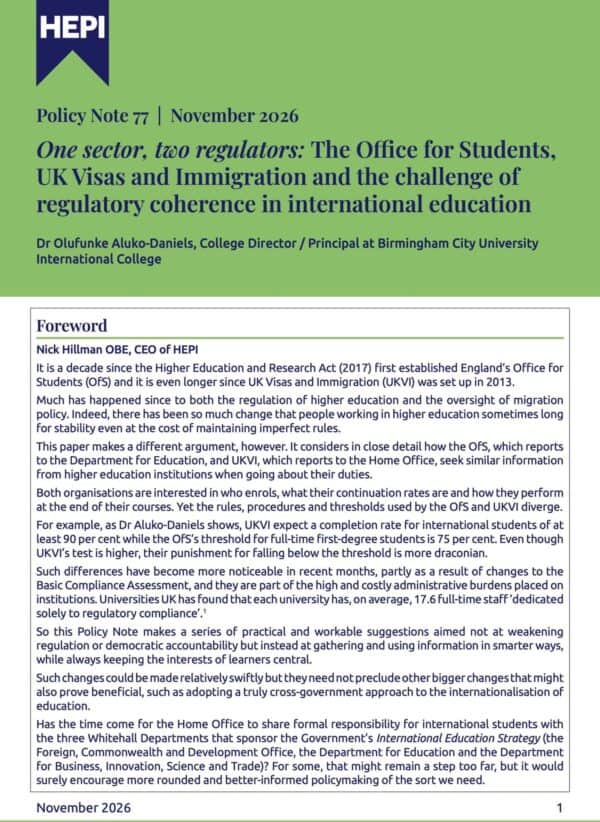
A new HEPI policy note says the Home Office must share responsibility for international students with other Departments if the Government is to hit its own target for educational exports.
A new Policy Note from the Higher Education Policy Institute (HEPI) calls for better coordination between the Office for Students (OfS) and UK Visas and Immigration (UKVI). It warns that overlapping regulatory requirements could lead to unintended consequences for both institutions and students.
Written by Dr Olufunke Aluko-Daniels, College Director and Principal at Birmingham City University International College, the paper examines how the clash between the distinct responsibilities of each regulator is influencing institutional decisions on international student recruitment. As a result, the Government will struggle to meet their own target for increasing educational exports to £40 billion by 2030.
The new Policy Note comes at a moment when international students are being increasingly drawn into wider political debates about immigration. In the paper’s Foreword, Nick Hillman OBE, CEO of HEPI, questions if the challenging environment around migration policy may be better served by a new and truly cross-governmental approach to the internationalisation of education. He suggests the time has come for the Home Office to share formal responsibility for international students with other Whitehall departments.
Regulation is also a costly area for universities at a time of financial constraint, so reform could also reduce the administrative burden. Universities UK has shown each university already has, on average, 17.6 full-time staff ‘dedicated solely to regulatory compliance.’
Key findings
- Differing course completion requirements may impact sponsorship capabilities. The Policy Note highlights course completion as a key area where differing regulatory requirements can lead to problems. From June 2027, UKVI will require Student sponsors to achieve a completion rate of at least 90%, compared with the OfS’s 75% for full-time undergraduate students. These measures serve different purposes: for the OfS completion is an educational outcome, but for UKVI the goal is to understand whether students sponsored to undertake courses see them through. Institutions, however, must respond to both requirements. And while the OfS considers contextual factors, failing to meet UKVI’s sponsorship requirements can affect an institution’s ability to recruit international students.
- Regulatory compliance measures are impacting decision-making. To ensure institutions do not become a compliance risk, they take actions that hit student opportunities. While robust scrutiny of recruitment channels is important, the more cautious approach adopted by institutions may limit market diversification, widening participation and student choice.
- Regulatory decisions can create risks for international students. The paper uses the recent example of the Bloomsbury Institute’s Student sponsor licence revocation as an example of how students lose out. Their education is put at risk, even when their educational progress may be satisfactory.
The Policy Note makes a series of practical and workable suggestions to help overcome the challenges outlined. These include clearer regulatory definitions, greater consideration of cumulative regulatory impacts, stronger coordination between the OfS and UKVI and agreed arrangements to protect students when sponsorship decisions disrupt their education.
Dr Aluko-Daniels said:
The issue is not whether we need two regulators. Both have legitimate responsibilities. The question is whether their requirements are sufficiently coordinated, particularly where decisions taken to manage institutional compliance risks may also affect student opportunity and educational continuity. Regulation does not simply measure institutional behaviour; it also shapes it.
Nick Hillman OBE, CEO of HEPI said:
Ministers and universities both want to expand the UK’s education earnings from overseas and to protect the Student visa route from abuse. Yet the current level of friction between the rules from the Office for Students and those from UKVI are jamming the system up.
As a country, we could start to share responsibility for international students across departments, rather than giving sole control to the Home Office. If this seems too big a change, then smaller incremental improvements would also help students, institutions and ministers hit their own targets while protecting the integrity of the UK’s borders.
The Policy Note recommendations call for greater coherence between the two regulators:
- Where both the Office for Students (OfS) and UKVI use completion as a measure, institutions need greater clarity on how their definitions align, including how they treat intermediate qualifications, transfers, interruptions and other recognised educational outcomes.
- There should be a formal mechanism for considering the cumulative impact of regulation on institutional behaviour, international recruitment, student experience and the UK’s wider education strategy.
- The student journey should be considered as a whole. Regulatory requirements that shape the pre-enrolment experience should form part of wider discussions about the student experience.
- Greater coherence requires more formal coordination between the OfS and UKVI where their responsibilities intersect. This need does not have to compromise their distinct statutory roles. Structured dialogue could focus on areas such as completion, interruption and student protection, supported by clearer mapping of regulatory definitions and expectations. Where action against a student sponsor could materially disrupt existing some students’ education, an agreed protocol involving UKVI, the OfS and the Department for Education could establish how educational continuity, transfer arrangements and communication with affected students might be managed.
- More regular engagement between the OfS, UKVI and the sector could help identify areas where regulatory expectations overlap, resolve emerging tensions and reduce the risk of unintended consequences for institutions and students.
Notes to editors:
- HEPI was founded in 2002 to influence the higher education debate with evidence. We are UK-wide, independent and non-partisan. We are funded by organisations and higher education institutions that wish to support vibrant policy discussions.




Comments
Add comment