New school league table for Languages
New league table celebrates the English schools with the most extensive language provision.
The Higher Education Policy Institute has compiled a new league table of schools based on official Department for Education performance data on the state of Modern Language provision across England.
The top 10 schools are:
- five independent and state Islamic faith schools (such as Madrasatul Imam Muhammad Zakariya in Bolton and Tauheedul Islam Girls’ High School in Blackburn, part of Star Academies);
- two state schools known for a long-standing specialism in languages (Hockerill Anglo-European College in Hertfordshire and the Anglo European School in Essex);
- two large selective state schools in the south-east (Dartford Grammar School and Bexley Grammar School); and
- one traditional independent Roman Catholic boarding school for girls (St Mary’s School Ascot).
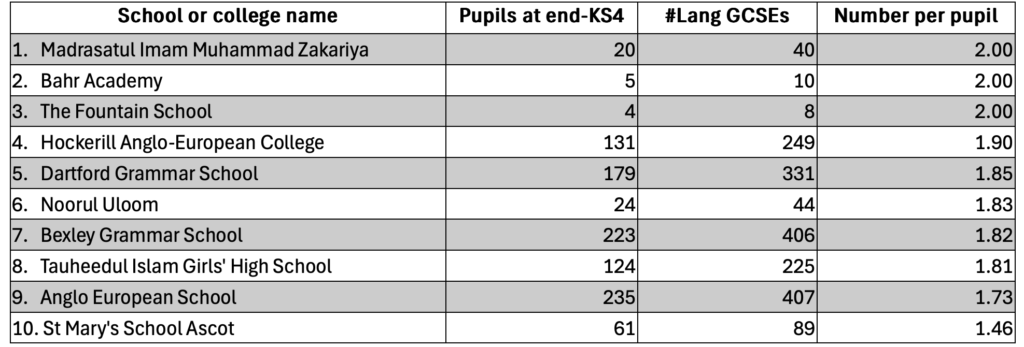
In 2025, only three schools had twice as many Modern Language GCSE entries as they had Year 11 pupils, meaning each pupil took two language GCSEs (on average). All three are small independent Islamic faith schools, where there is a high take-up of Arabic and Urdu.
At just 220 secondary schools is the number of Modern Language GCSE entries equal to or greater than the number of pupils reaching the end of Key Stage 4. In other words, at this small minority of schools there is an average of at least one Modern Language GCSE for each pupil. This is around 5% of all secondary schools in England.
The overwhelming majority of England’s secondary schools have scant language provision, at least relative to other mainstream subjects: at most schools, for example, there is under one Modern Language GCSE entry for every two pupils.
The decline in language learning explains the difficulties universities now face in filling their language courses as well as the spate of Modern Language course closures in higher education.
Until 2004, it was compulsory to learn a language at Key Stage 4 (school Years 10 and 11) but a sharp decline followed: since 2004, the number of Modern Language GCSE entries in England has fallen from over half a million to under one-third of a million (and despite some growth in the number of Key Stage 4 pupils over the same period).
While the main table excludes Classical Languages, such as Latin and Ancient Greek, a supplementary table has been compiled that includes these subjects. When they are included alongside Modern Languages, the order of schools changes somewhat – for example, Bexley Grammar School and Dartford Grammar Schools come first and second respectively, with each pupil taking an average of 2.1 GCSEs in Modern or Classical Languages. Including the Ancient Languages also boosts the performance of many traditional independent schools – for example, moving Winchester College (Rishi Sunak’s old school) up into the top 10.
Without a change of course, language learning in schools looks set to continue deteriorating, in part due to recent policy decisions:
- Some of the small minority of schools that have offered the International Baccalaureate (IB), which prioritises language learning, to their sixth-formers do notably well in the new league table for GCSEs. But the additional (Large Programme Uplift) funding provided to state schools for the IB qualification is coming to an end. Some high-performing schools, including Bexley Grammar School which appears in the top 10, have announced an intention to move away from the IB this autumn.
- There are widespread concerns that Keir Starmer’s Government ‘are squeezing languages out of the picture’ as a result of the removal of the EBacc (a school performance measure that includes languages).
- The publicly-funded Latin Excellence Programme (LEP), which began in 2022 and benefited 39 schools, ended last year.
Despite the large decline in formal language learning over recent years, there is some clear evidence that people in the UK do want to learn languages and are finding ways to do so beyond formal education. The most recent full HEPI report on the decline in languages, for example, refers to data from Duolingo showing ‘the UK ranks second globally for the proportion of learners studying more than one language. And it’s under-22s who are leading the charge, choosing Japanese, Korean and Chinese in increasing numbers.’
Nick Hillman OBE, CEO of the Higher Education Policy Institute, said:
Schools that have bravely resisted the mainstream trend of reducing language provision tend to get little kudos for it. Yet they deserve enormous praise for voluntarily opting to spend resources on protecting the pipeline of language learners.
There has been a catastrophic decline in language learning in the UK over the past 20 years and we need to shine a spotlight on the problem if it is to be arrested and reversed. Yet rather than berating those schools that have responded to the clear incentives deterring language provision, I want to celebrate those that have taken a stand. Without them, the huge pressure to close university language departments would be even greater than it already is.
Learning a language has enormous benefits for individual learners, but it also has benefits for the whole country. It enables a fuller understanding of different cultures, makes it easier for us to engage with the rest of the world and promotes international trade. Yet when any educational institution cuts or cancels their language provision, it is very hard to bring back afterwards.
Hetan Shah, Chief Executive of the British Academy, said:
This report highlights a concerning picture. There is strong evidence of the cognitive, economic and social benefits of studying a language for young people and for society more broadly. YouGov polling commissioned by the British Academy in 2023 suggests that a majority of the UK public would support making language learning compulsory at schools. Yet as the British Academy has long noted, provision of language subjects in secondary schools has been in decline, and there are signs that the recent policy changes are making a bad situation worse.
Access is unequal, with learners in disadvantaged areas often having little to no access to language learning. This has broken the pipeline, leading to cold spots emerging in higher education and devastating our linguistic capability in research. The British Academy believes that the opportunity to study languages should be equally available to all students, regardless of background or location.
Further, the languages currently on offer are often not representative of our national linguistic diversity, or of the specific diversity of the school’s locality. It is important that schools are able to recognise and provide qualifications in home, heritage and community languages in order to harness the full potential of our multilingual society.
The spreadsheet downloadable below shows:
- TABLE 1: schools ranked by the total number of Modern Language GCSE entries;
- TABLE 2 [MAIN TABLE]: schools ranked by the number of Modern Language GCSE entries per pupil in the relevant cohort; and
- TABLE 3: schools ranked by the total number of Language GCSEs per pupil, including Classical Languages.
Important notes on the data
All league tables rest on the available data and this new league table is based on trusted official school performance data. However, the data exclude certain qualifications and so schools that do not focus on regular GCSEs perform less well, even though a small minority do in fact have excellent language provision. This mainly – but not entirely – affects independent schools:
- Many independent schools teach the IGCSE rather than the GSCE and the IGCSE is excluded from Department for Education performance data. (See additional information, including on Eton College, in the Notes for Editors below.)
- The main focus of the GCSE league table is on Modern rather than Classical Languages, thereby excluding Latin and Ancient Greek, although a supplementary table with these Classical Languages is provided.
- A very few state-funded schools do not concentrate on GCSEs. For example, the Europa School in Culham, Oxfordshire, is a bilingual school focusing on the International Baccalaureate Middle Years Programme (MYP). This institution has excellent language provision despite appearing in a low position in the table.
This is the first time HEPI have compiled these data and we are open to feedback on alternative ways to consider the numbers.
Notes for Editors
- The data are taken from the official School Performance Tables for England for 2025, available from the Department for Education at https://www.compare-school-performance.service.gov.uk/download-data.
- The subjects included are: Arabic, Bengali, Chinese, French, German, Italian, Polish, Russian, Japanese, Portuguese, Turkish, Spanish, Gujarati, Modern Greek, Urdu and Punjabi. Classical languages like Latin and Ancient Greek are excluded from the main table as is every other discipline, but a supplementary table includes Classical Greek, Latin, Modern Hebrew, Other Classical Languages (such as Biblical Hebrew) and Persian (all of which are categorised separately from Modern Languages by the Department for Education).
- Sometimes, pupils are entered by their school for exams in languages they have learnt outside school (including in languages they might speak at home). These entries are included and are likely to explain why so many schools have an extremely low number of entries (sometimes just one or two).
- The main table covers nearly 4,000 schools but any school with zero GCSE entries for Modern Languages is excluded. There are close to 4,900 schools in England with pupils at the end of Key Stage 4 / Year 11 (which is when pupils generally take GCSE examinations), all of which are included in Table 3.
- The results should be treated with caution for independent schools, in particular. Some independent schools enter their pupils for IGCSEs rather than GCSEs. As IGCSE is not counted in the Government’s school performance tables, some well-known independent schools with extensive language provision come towards the bottom of the table. For these schools, including the school at the very bottom of the main table, the low performance does not accurately reflect the true level of language provision. In addition, some independent schools teach a mix of GCSE and IGCSE: for example, the relatively low performance of the most famous school in the country, Eton College, reflects that they do GCSEs in Chinese, Japanese and Russian but IGCSEs in French, German, Italian and Spanish, meaning the latter subjects are excluded from our chart. Were all Eton’s Modern Language entries to be for GCSE instead, then the school would appear near the top (and very close to Winchester College) in the table. It is also notable that, even while excluding IGCSEs, Eton’s position moves from being outside the top 3,000 schools to within the top 350 when Ancient Languages are included (as 155 Etonians took Latin GCSE and 44 took Ancient Greek in 2025).




Comments
Jonathan Alltimes says:
How much should the state fund learning languages in state schools? A third of a million or so seems more than an ample provision for the reasons proposed. Pupils may choose other subjects for developing their potential. Yes there is a question about the variety and distribution of languages. I do think the way languages are taught in schools could be better. Learning vocabulary and rules needs a different context other than the classroom and the test. For example, learning Latin and Roman history is a good combination. Languages need a context for application. So a language and a context is a powerful combination which could be developed more at university.
The league tables do not reveal the qualitative experience of how pupils are taught languages. What would think if a pupil could achieve an A grade in GCSE Latin, but had not been taught the grammar adequately for A-level? What would you think if a pupil could achieve an A grade in GCSE French or German, but had not been taught to a standard required to be ready to advance at A-level? What would you think, if A-level French and German did not require acquaintance with the literary artefacts of a culture such as their newspapers? What would you think, if you needed to pay for private tuition to patch the teaching at selective state schools?
Reply
Li Wei, Executive Dean, UCL Institute of Education says:
I welcome HEPI’s report and its efforts to draw attention to the decline in language learning in England’s school, but, more importantly, to celebrate the schools that are bucking that trend.
The urgent tasks of improving the UK’s economic growth and national security are currently making the headlines. Language learning has a vital role to play in respect to each.
As HEPI’s report highlights, there are still significant inequalities in pupils’ access to language learning. To have only around 5% of secondary schools entering, on average, at least one Modern Language GCSE per Year 11 pupil, really should be a wake-up call.
In this context, the continued limited presence of non-European world languages in the school curriculum, and lack of support for Home, Heritage and Community Languages, remain significant missed opportunities.
Tangible support from the government can make a difference, as we have seen with the Mandarin Excellence Programme (MEP) and the National Consortium for Languages Education (NCLE). The IOE is proud to host each of these, alongside our modern foreign language initial teacher education.
I am delighted to see several of our partner schools celebrated in HEPI’s league table. Provision like the MEP and NCLE and the schools topping the rankings show what can be achieved. The UK must build on those foundations.
Reply
Add comment