Being indispensable: Capabilities for a human-AI world, the ‘FUTURES’ framework
New report advises universities to act now on GenAI – and to put human competency at the centre.
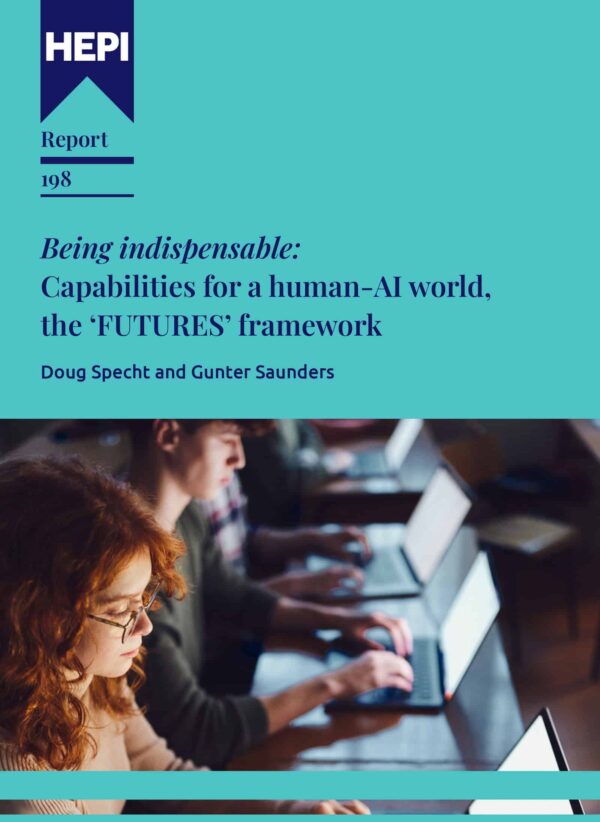
A new report from the Higher Education Policy Institute (HEPI), Being indispensable: Capabilities for a human-AI world, the ‘FUTURES’ framework, argues that universities should take more robust approaches to GenAI integration, as the technology becomes more embedded in everyday and academic life.
Written by Dr Doug Specht and Professor Gunter Saunders of the University of Westminster, the report says strengthening human competencies must be the top priority for higher education institutions in order to harness the greatest benefits from GenAI.
The authors note 75% of young people aged 13 to 18 have already used GenAI, with similar patterns visible across higher education. This rapid uptake brings major opportunities: GenAI can personalise learning, reduce staff workload and widen access to support. However, the risks are substantial. GenAI models can reflect bias within their training data, access to the most capable systems may deepen inequalities and an uncritical reliance on GenAI can weaken independence, originality and authentic learning. Concerns around environmental impact add an additional layer of complexity.
The report argues universities need a dual approach to GenAI-enabled learning. It calls for curricula that embed human-AI collaboration while ensuring that ethical reasoning, critical thinking and wellbeing remain central to academic development. New approaches must also include practical governance, staff and student training and equitable access to tools.
To support this, the authors introduce the FUTURES framework, a practical model designed to help institutions integrate GenAI effectively while strengthening the human capabilities that AI cannot replace. The framework spans seven domains:
- Fluency in AI and Digital Systems
- Understanding Self and Wellbeing
- Technology Ethics and Responsibility
- Understanding others and Social Intelligence
- Resilience and Adaptability
- Emerging Technology Awareness
- Society and Professional Engagement
The FUTURES framework offers universities a concrete way of turning high-level AI principles into day-to-day educational practice. By using FUTURES alongside tools such as Jisc’s AI Maturity Framework, institutions can design modules, assessments and professional development that deliberately build the human capabilities needed to work critically and creatively with GenAI, ensuring that technological adoption is firmly anchored in pedagogical values and student success.
Going forward, the report argues that sector bodies should provide clearer guidance on assessment in an AI-enabled environment and government should invest in capability building to ensure students and staff thrive in an AI-rich world. By adopting FUTURES, universities can strengthen human potential while navigating the opportunities and risks of AI.
Dr Doug Specht, Head of School of Media and Communication at the University of Westminster and co-author of the report, said:
GenAI is already woven into students’ everyday lives, so universities cannot afford to sit on the sidelines; we must redesign curricula, assessment and support so that human judgement, ethics and wellbeing are strengthened, not eroded, by these tools.
The FUTURES framework is our invitation to the sector to move past short‑term panic and piecemeal policies towards a coherent, human‑centred approach that prepares students to thrive as co‑workers with AI rather than competitors to it.
Professor Gunter Saunders, Director of Digital Capability Development and AI Leadership at the University of Westminster and the other co-author of the report, said:
As use of generative AI becomes commonplace, distinctly human qualities such as imagination, creativity, integrity and collaboration become even more valuable.
Universities have a responsibility to intentionally develop these capabilities so graduates can shape the future rather than simply respond to it.
Nick Hillman, HEPI’s Director, said:
The voracious appetite of universities to learn more about how best to use AI is unmatched by anything I have seen in 20 years of working on higher education policy.
Governors, managers and other staff are very eager to ensure their institutions capture the full advantages of AI. But there is a lot of confusion and uncertainty, not to mention intense funding pressures, that gets in the way.
So I expect this very practical report to be welcomed by institutions up and down the country.
Notes to editors:
- HEPI was founded in 2002 to influence the higher education debate with evidence. We are UK-wide, independent and non-partisan. We are funded by organisations and higher education institutions that wish to support vibrant policy discussions.
- The University of Westminster, originally established as London’s first polytechnic in 1838, offers a vibrant learning environment that attracts more than 21,000 students from nearly 170 nations. It continues to invest in our future with new developments, research projects and new ideas. The University ranked in the top 20 in the UK and in the top 30 in the world for international students, according to the Times Higher World University Ranking 2024.




Comments
Jonathan Alltimes says:
The best way to learn how to use generative AI is to understand how it works. “GenAI models can reflect bias within their training data…”, all AI is biased, including the datasets, the pattern searching methods, and how content is made. You can only use GenAI intelligently if you know how it works, can evaluate what it has made, and can select what to use, otherwise you are merely copying. Evaluation and selection requires prior experience of making your own content: you need a means of comparison. Can you imagine what an employer would think of a university and its degree, if a student could not make their own content without GenAI, but had been assessed as if the student is capable? I do not know how the assessment can be protected fully because of the scale of student numbers.
Reply
Kevin Brazant says:
This is a welcome contribution to the sector’s growing conversation around GenAI and human capability. Frameworks like FUTURES are useful for helping institutions move beyond reactive policy making toward more intentional capability development.
However, capability frameworks alone may not be sufficient. Many of the challenges universities face in integrating AI are not purely technical or skills-based but structural, embedded within curriculum design, assessment cultures and institutional power dynamics.
The real opportunity may lie in combining capability frameworks with deeper work on learning environments, epistemic justice and student co-creation, ensuring that human-AI collaboration strengthens agency rather than reproducing existing inequalities.
Reply
Add comment