
From investment to outcomes: Capabilities to deliver purposeful public investment in research
Building Bridges: Maximising support for public investment in science and research.
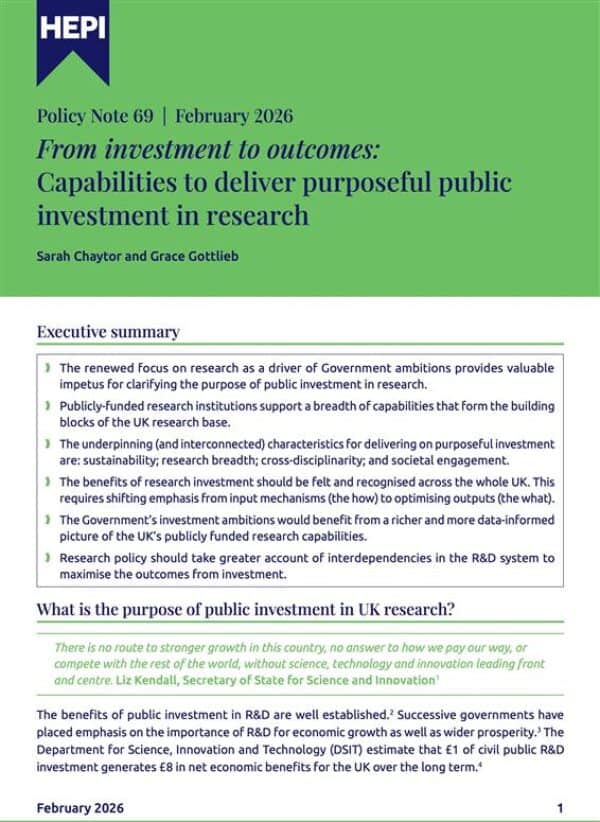
A new paper by research impact specialists at UCL, From investment to outcomes: Capabilities to deliver purposeful public investment in research (HEPI Policy Note 69), considers how to maximise the potential of public spending on research.
Sarah Chaytor, Director of Strategy and Policy at UCL and the co-author of the report, said:
As UKRI moves to a new strategy of making clearer investment choices, we need to ensure a strong understanding of the underpinning and enabling capabilities of the UK research base that can maximise progress towards desired outcomes from research.
Grace Gottlieb, Head of Research Policy at UCL and co-author of the report, said:
There is major potential to boost UK research impact by combining data on the UK research system with outcomes-focused metrics to guide R&D investment decisions.
Nick Hillman OBE, Director of HEPI, said:
No government can fulfil its promises without the world-class research that underpins UK life. The research community have built up a strong and reliable evidence base for what they do.
But the benefits of the billions of pounds of public investment in research are not always fully clear to the public. This can put the money and how it is used at risk.
We are at a critical moment that could affect future investment in research. Yet when the ecosystem fires on all cylinders, the benefits of research investment are recognised, felt and supported across the whole UK.
The new HEPI Policy Note by Sarah Chaytor and Grace Gottlieb argues that strengthening the nation’s research capabilities is essential to delivering the Government’s ambitions for economic growth and societal benefit.
There is a need for a more purposeful, data-driven and outcomes-focused approach to public investment in UK research if we are to achieve UKRI’s strategy of ‘making choices’ to prioritise areas of strength.
Universities and other publicly-funded research organisations provide the foundational capabilities that underpin the UK’s scientific strength, from world‑leading expertise and infrastructure to training future talent and enabling international collaboration.
These are, in turn, supported by four core characteristics essential for effective research investment:
- A sustainable research base, addressing long‑standing funding pressures in universities.
- Breadth in blue‑skies research across disciplines to maintain international competitiveness and respond to emerging challenges.
- Cross‑disciplinary strength to tackle complex societal problems, from climate change to health inequalities.
- Stronger societal engagement, ensuring the benefits of research are felt across communities – especially given that only 41% of the public currently feel research is relevant to their lives.
The paper argues Government ambitions require a shift in focus from inputs to outcomes, backed by richer, more integrated data on the UK’s research and innovation system to identify ‘leverage points’ where small, targeted investments could deliver disproportionately large impacts.
A systems approach is essential to understanding the interdependencies between universities, industry, government and regional ecosystems – and to ensuring that the economic, social and cultural benefits of research are shared across the whole of the UK.
Notes for Editors
- HEPI was founded in 2002 to influence the higher education debate with evidence. We are UK-wide, independent and non-partisan. We are funded by organisations and higher education institutions that wish to support vibrant policy discussions.
- Grace Gottlieb is UCL’s Head of Research Policy and Sarah Chaytor is UCL’s Director of Research Strategy & Policy. Further details about the authors can be found on the UCL website here: https://www.ucl.ac.uk/research/strategy-environment/research-policy-ucl





Comments
Jonathan Alltimes says:
There may not be a response.
Reply
Add comment