
Making Metrics Matter: A more ambitious approach to tackling racial inequity in higher education
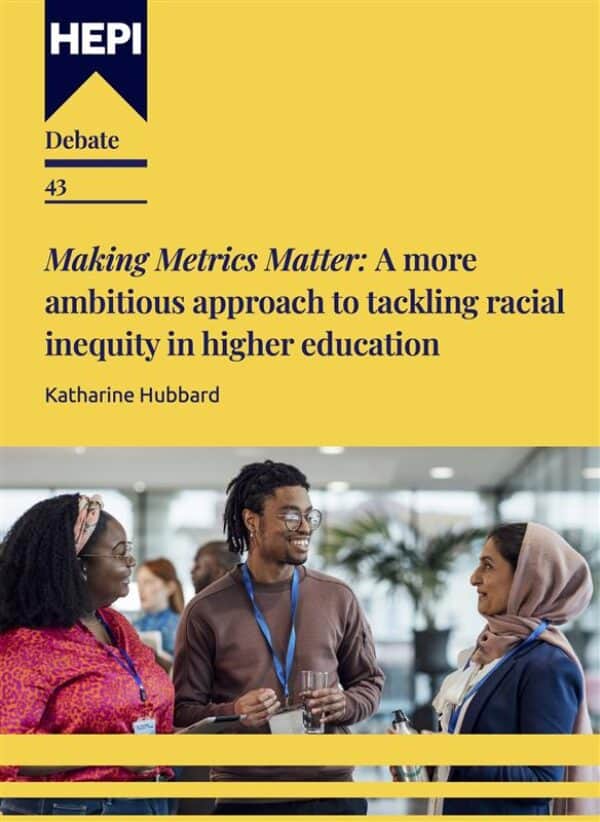
A new paper by Dr Katharine Hubbard, Making Metrics Matter: Tackling Racial Inequity in Higher Education (HEPI Debate Paper 43), argues progress towards racial equity in English higher education has been ‘notoriously slow’ and calls for structural changes to accelerate improvements.
Black and Asian students remain less likely to graduate with a First or Upper Second class degree. Black academics are severely underrepresented, particularly at professorial level, with only 1% of UK professors identifying as Black. Dr Hubbard warns that without systemic reform, these inequities will persist indefinitely.
The paper considers the current regulatory landscape, including the Equality Act (2010), Access and Participation Plans and the Teaching Excellence Framework (TEF). It finds racial equity is not positioned as a major strategic priority for institutions, allowing them to ‘get away with’ poor performance on equity while maintaining strong reputational metrics.
Using new analysis of TEF2023 outcomes, Dr Hubbard demonstrates even Gold-rated institutions can have significant racial inequities. Seven TEF Gold providers have Black awarding gaps that exceed 25 percentage points, and more than half of Gold and Silver institutions significantly under-recruit Black academics. In some cases, students could complete their degree without ever encountering a Black academic.
Dr Hubbard proposes a pragmatic model for embedding racial equity into TEF assessments. Her flag-based system identifies institutions with significant inequity in student outcomes or staff representation, and adjusts TEF ratings accordingly. Under one scenario, around one-in-five providers could see their TEF rating change due to racial inequity or underrepresentation.
The paper concludes with a call to the Office for Students and the wider sector to take bolder action. It argues that Access and Participation Plans have raised awareness but lack the reputational clout of TEF ratings. Incorporating inequity and under-representation more directly into the TEF would send a clear signal that racial disparities are unacceptable in a system that claims to champion excellence.
Nick Hillman OBE, the Director of HEPI, said:
‘England’s universities have a strong record on diversifying their student entrants, especially among people with different ethnic backgrounds. However, some institutions have done more than others, there continues to be a substantial Black degree-awarding gap and the number of Black professors continues to be very low at many places and across the sector as a whole.
‘Universities are, quite rightly, independent and autonomous, but they are also accountable to regulators, students and wider society through initiatives like the Teaching Excellence Framework. This new report considers how existing tools could be used in a smarter fashion to ensure the higher education sector fully reflects the society it serves.
‘I doubt everyone will agree with all the recommendations, but our hope is that the paper contributes to an important debate.’
Dr Hubbard, the author of the new report, said:
‘Can an institution really be considered Gold standard when it has a Black awarding gap of over 25 percentage points and students never encounter a Black academic? If racial inequity is a structural issue, we can only tackle it through changing structures. TEF is the most visible badge of quality in the English higher education sector – it’s time to make racial equity a more substantive part of the metrics that drive institutional behaviours and action.’
‘Many institutions highlighted in the new report rightly have strong reputations for widening participation in higher education. However, this analysis of student outcomes indicates that Black and Asian students are not getting the same benefits from studying at some of these institutions as their White peers in terms of student outcomes. We must ensure that going to university does not further entrench inequity in society.’
Notes for Editors
- HEPI was founded in 2002 to influence the higher education debate with evidence. We are UK-wide, independent and non-partisan. We are funded by organisations and higher education institutions that wish to support vibrant policy discussions, as well as through our own events.





Comments
Jonathan Alltimes says:
In January 2026, the OfS published the results of their statistical model explaining class of degree for the whole sector.
“We have used statistical modelling of individual-level graduate data to estimate the extent to which changes in degree classification attainment between 2010-11 to 2023-24 can be accounted for by the following graduate characteristics (explanatory variables):
• provider at which the graduate was registered
• year of graduation
• subject of study
• qualifications on entry into higher education •
• age on entry to higher education.
As in last year’s analysis, we employed a simplified model and do not include disability, ethnicity, sex and TUNDRA (tracking underrepresentation by area) as explanatory variables.”
The OfS claim their model explains most of the attainment.
Source:
https://www.officeforstudents.org.uk/media/ldfloztn/analysis-of-degree-classifications-over-time-2010-11-to-2023-24.pdf
Comments:-
Neither the power of the variables nor the interaction effects are published.
It is crucial to distinguish between the causal determinants of first class degrees and of upper second class degrees.
Qualifications on entry is a major predictor.
Of what is the year of graduation a proxy indicator?
Subject of study does matter.
Does the registered provider matter?
Reply
Add comment