
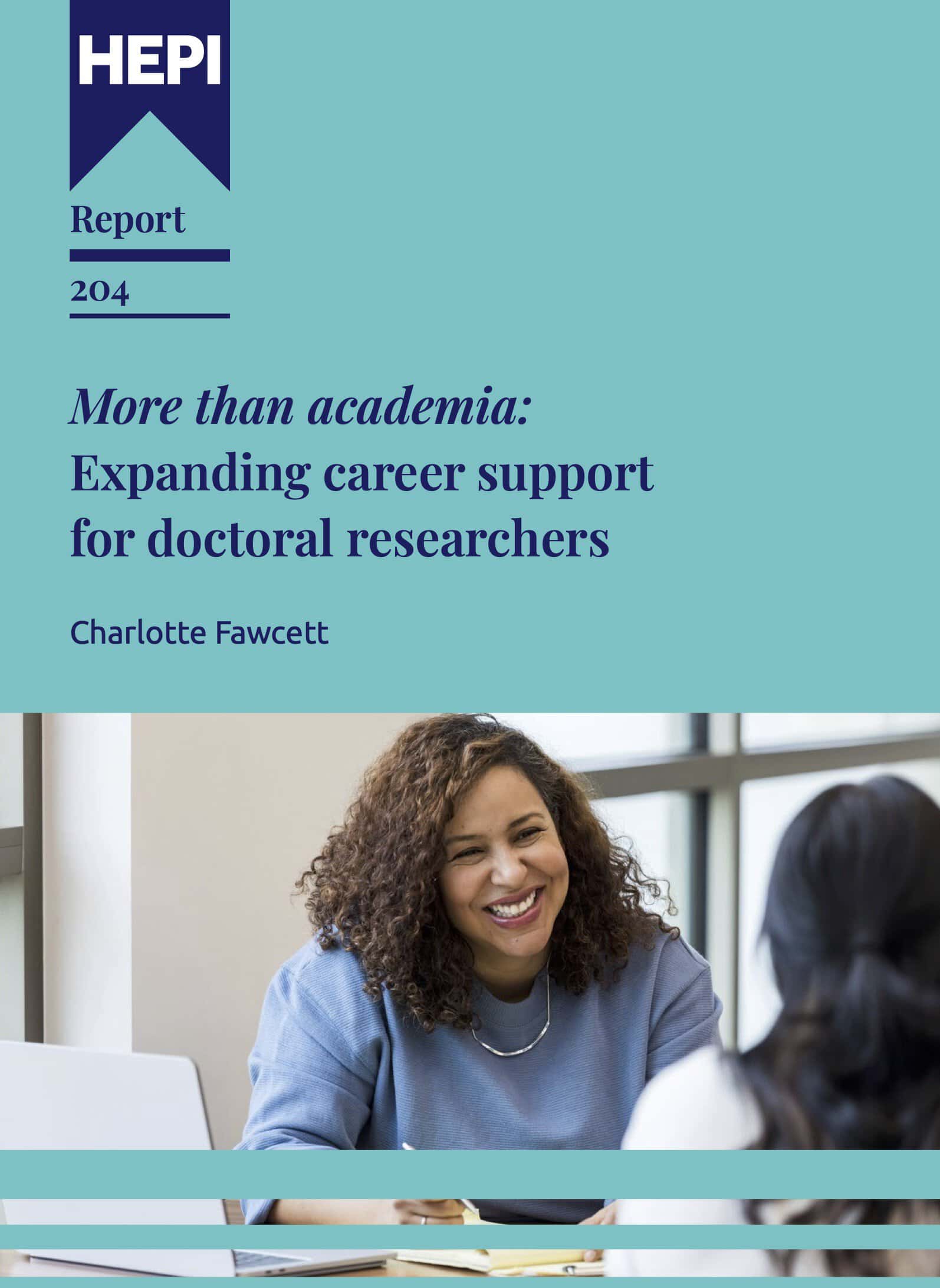
More than academia: Expanding career support for doctoral researchers
Investing in PhD careers support is an investment in the UK economy.
A new report published by the Higher Education Policy Institute (HEPI) examines careers provisions available to UK PhD students. Supporting PhD students into a wide range of careers, both academic and non-academic will benefit the UK economy, in particular the research and development sector.
The number of PhD students in the UK has continued to increase, but academic roles are not keeping pace, one of the factors driving greater post-PhD career diversity. While some progress has been made, more support is still needed to prepare PhD students for a wider range of career paths.
More Than Academia: Expanding Career Support for Doctoral Researchers (HEPI Report 204) by Dr Charlotte Fawcett shows that a third of PhD students are dissatisfied with career guidance from their supervisors. Additionally, more than a third of respondents feel that their supervisor does not make time for frank conversations about their career and only 27% think their supervisor has useful advice for careers outside of academia. Despite this, the question remains, are supervisors those best positioned to provide careers advice or is better signposting required instead?
While many PhD students continue to seek work in academia (with 46% choosing it as their first-choice sector, despite increasing competition for academic roles), students highlight the need for more information about the range of careers available to them and the career trajectories of alumni.
Although a growing number of resources have been established, both institutionally and more widely, areas for improvement in PhD careers provision remain, including tracking doctorate holders. Furthermore, perceptions that non-academic career routes equate to failure persist amongst PhD students. Given that so many PhD students later work in and lead a wide range of sectors, changing this perception of non-academic careers is of critical importance. This will ensure that PhD students are ready to pursue a range of different careers, benefiting the UK labour market.
Key recommendations:
- Opportunities to experience non-academic environments, including internships, should be advertised and funding should be provided by institutions where possible.
- Institutions should record careers events and training, and this should be made available to students virtually.
- Collaboration between institutions should be used in developing careers resources and events.
- Institutions should have dedicated postgraduate careers support. In smaller institutions, this could involve shared services. There should also be greater collaboration between PhD supervisors and postgraduate careers support.
- Training should be provided to PhD supervisors by universities to ensure that they can appropriately support students in exploring their careers and signpost them to appropriate services and resources.
- Clear separation between academic development and professional development should also be provided.
- National tracking of doctoral graduates needs to be conducted by the Higher Education Statistics Agency to provide careers insight, in addition to providing valuable information for the labour market, training reform and policy recommendations.
- PhD students should be encouraged and supported by their institutions and supervisors to access a range of academic and non-academic professional development opportunities to change student perceptions around their potential career options.
Dr Charlotte Fawcett, a policy intern at HEPI, and author of the report said:
A PhD should open doors, not narrow them. As more PhD students pursue careers beyond academia, universities and funders need to ensure they have the support, confidence, and opportunities to turn their expertise into impact across society and the labour market.
Although some resources are in place, there continue to be gaps in provision for PhD students and some feel they have failed. By equipping PhD students better and changing the mentality around PhD careers, students can find themselves in their preferred roles and benefit broader society. Ensuring that PhD students can quickly integrate into the labour market will have essential impacts on their contributions and potential.
Dr Bethan Cornell, STEM Talent Fellow at Global Talent Fund and former Deputy Principal Private Secretary to the Secretary of State for Science, Innovation and Technology, said:
Five years ago, I wrote a short policy note for HEPI drawing on the 2019 Nature PhD survey. The picture it painted was striking: most PhD students wanted academic careers, yet the majority would not end up in them. They felt well-prepared for research but much less so for anything else.
This report asks whether things have changed. In some respects, they have. Fewer students now rank academia as their first choice, and modestly more feel their programme is preparing them for non-academic routes. But the persistence of certain findings is harder to ignore than the progress.
Nick Hillman OBE, CEO of HEPI, said:
The UK’s future success will rest in part on our brightest and most highly-skilled people. So making sure PhD students can rapidly find their best-fit careers, whether that is in academia, industry or elsewhere, is critically important – and in all our interests.
We used to talk about a “leaky pipeline” as if it were a bad thing that PhD students do not all stay in academia for evermore. Yet those with doctorates bring enormous benefits to employers of all types as well as to society at large.
This important new report considers how best to ensure those with the highest qualifications go on to make the most of their potential.
Notes for Editors
- Dr Charlotte Fawcett completed her PhD at the University of Leicester in Genomic Epidemiology and Public Health Genomics, funded by the Wellcome Trust, in 2026. Her research focuses on the application of genetic epidemiology and statistical methods to better understand the causes of cardiovascular disease, with particular interest in telomere biology, Mendelian randomisation, and abdominal aortic aneurysm.
- HEPI was founded in 2002 to influence the higher education debate with evidence. We are UK-wide, independent and non-partisan. We are funded by organisations and higher education institutions that wish to support vibrant policy discussions.





Comments
Jonathan Alltimes says:
The report argues that higher education institutions should be providing better career guidance, so that the expectations of PhD students aligns with reality. I agree with the assumption that most of the respondents are likely to be research trainees in the natural sciences. We need to review the number of PhD students the State is funding. I have argued for a transition to a much smaller number of much better paid research fellowships in sector-specific research institutes. A natural science PhD student is supposed to be trained in research methods within a traditional research methodology, applied to a new set of hypotheses explaining and predicting causality. What the results of the survey indicates is a mostly an unstructured approach to training after decades of practice: research training is itself a skill. The research training is supposed to train a researcher in a way of reasoning and practice for originating new scientific knowledge specific to the domain of knowledge. The particular knowledge and research skills peculiar to the research could be of no interest to an employer, but the employer could require an employee who can conduct a scientific approach to their work. Very little demand exists for employing natural science doctors as researchers and the learned societies should be explaining the advantages of a researcher for employers. Almost all the large rate of increase for business enterprise R&D in the last 10 years or so has been in software development. One recommendation I would make is to introduce research trainees to an intense set of work simulation exercises each term from a variety of sectors, which is something the psychology department and business school could organize with the other departments.
Reply
Add comment