
Preparing for populism
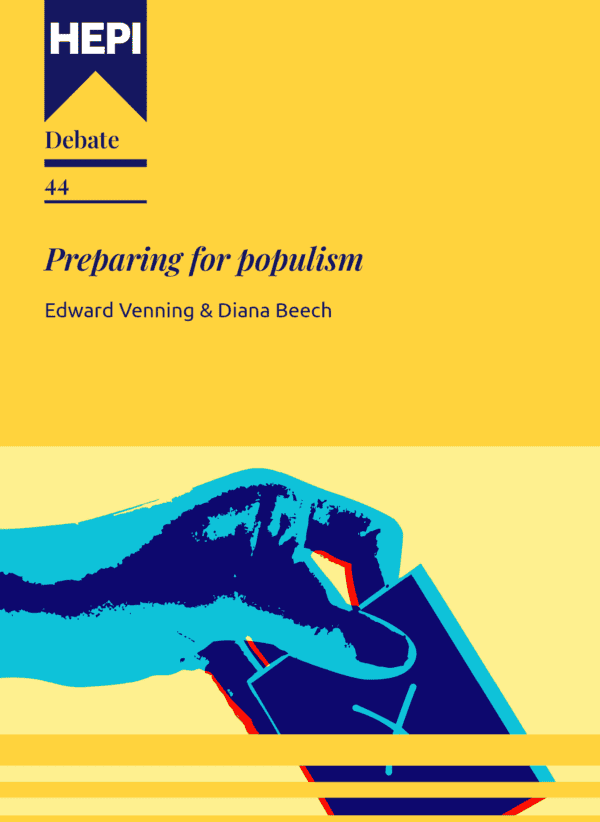
Prepare for populism: Universities need to rebuild their legitimacy with all major parties and the public as they head into a tougher political era.
In Preparing for Populism (HEPI Debate Paper 44), Professor Diana Beech and Edward Venning show that public patience with universities is thin as populist sentiment rises. The report argues the higher education sector’s biggest problem is not money but trust. Universities have fallen into a complex, dull and defensive public debate, focused on economic contributions and graduate earnings. The risk is that this looks selfish, tone-deaf and insular at a moment of peril.
The authors encourage universities to engage across the political spectrum, including with parties sceptical of higher education, most notably Reform UK. They argue this is different to endorsement: it is, rather, democratic realism and pluralism at work.
The report offers a three-part framework for reconnecting universities with political sentiment:
- Instrumental legitimacy: doing the core roles of teaching and research well and explaining them clearly.
- Relational legitimacy: connecting to the need for national renewal, grounded in an appeal to common sense.
- Moral legitimacy: playing by the rules while helping shape better ones.
Professor Diana Beech, Director of the Finsbury Institute at City St George’s, University of London, and co-author of the new Depate Paper, said:
This report is a call to act early and act together. Most politicians agree universities, like other public institutions, are not keeping their side of the social contract. Populism is a symptom not a cause of this.
Above all, universities need a new political posture. Universities cannot engage only with traditional parties. They need to be credible with the full range of democratic opinion, including so-called populists. That is how autonomy is earned and protected.
Edward Venning, Partner at Six Ravens Consulting and co-author of the new Depate Paper, said:
Public support is a moving target. Society changes its norms from time to time. Then a legitimacy gap opens up and social confidence frays.
Universities are using arguments that do not fit the popular mood in a low-growth economy. Legitimacy is built through behaviour, relationships and governance that the public can respect and understand.
If universities change tack, they can lead a broader renewal of trust in public institutions. This will get them the funding they deserve. If not, the sector’s structural problems could easily become much worse.
Key proposals
The new Debate Paper argues legitimacy is not a given. Institutions earn it through what they do, how they act and how they connect with others. In social science, this is called ‘legitimacy management’, but the idea is simple. Universities must work for public support in a structured way to uphold their side of the social contract with the British people.
The report recommends a reset that is collective, not piecemeal. It proposes:
- A core offer with universal reach by reframing advanced learning as a necessity to participate fully in advanced society.
- A new intellectual project to provide the knowledge base and capabilities the UK needs to be independent and strong.
- A coalition for legitimacy, so universities and sector bodies act together. This includes political advisory panels for regulators to strengthen credibility across party lines.
- More alignment between university and national attitudes. This includes a legitimacy observatory to track public trust and gaps between university culture and wider public attitudes.
- New benchmarks for quality and public value, developed with the public in mind.
Notes for editors
- Edward Venning is Managing Partner at Six Ravens Consulting LLP, from where he helps universities with strategy, delivery and communication. Previous work for HEPI includes Size is Everything: What small, specialist and practice-based providers tell us about the higher education sector (HEPI Report 160) and Down with the World-Class University: How our business models damage universal higher education(HEPI Debate Paper 38). Diana Beech is Director of the Finsbury Institute, the new public policy hub at City St George’s, University of London, and Professor and Assistant Vice-President of Policy and Government Affairs. Her last report for HEPI was, Universities are boxed in: Is there a way out? (HEPI Debate Paper 40), authored with Professor André Spicer. Diana is also an Independent Governor and Vice-Chair of the Board at the University of Worcester.
- HEPI was founded in 2002 to influence the higher education debate with evidence. We are UK-wide, independent and non-partisan. We are funded by organisations and higher education institutions that wish to support vibrant policy discussions.





Comments
Gavin Moodie says:
Thanx for this interesting paper.
I found intriguing the authors’ instrumental benefits of higher education after education:
i. Intellectual property;
ii. Open innovation;
iii. Employability;
iv. Economic contribution (pp. 18-19).
I wonder whether this over homogenises the sector. I happen to believe that (almost) all ‘universities manage important knowledge in various fields and industries . . . through research and teaching (p. 18), but is that the authors’ view?
Reply
Jonathan Alltimes says:
Yes I agree, higher education is more than likely to face a larger budget cut in real terms for teaching and research from 2030 than it has since 2019-20. City St George will be able smooth the cash flow rollercoaster with its endowments and investments, as will other universities with endowments and investments: that is a norm. The sector will need to rationalise faster than it thought, not only because of the cap on International student visas and the international student levy will restrict the norms of higher education. The authors of the report do not understand that competing government budgets from 2028 are going to squeeze higher education funding more than expected, even before a change of government: another norm. Inflation will also be higher. I doubt Reform UK will agree to be co-opted into the political apparatus you propose, as it will restrict their norm of freedom of political control to cut the higher education budget further. The universities accepted the terms of the offered through Universities UK and embodied in the Higher Education and Research Act, in exchange for money and bureacratic enterprises, the guild for the colleges of the communities of study gave away much of its norms for autonomy and independence (Were there any vitiating factors?). Higher education did not deliver the economic growth, the productivity, and the employment because it never could, that is the norm of the private sector. Successive governments had unrealistic expectations of what higher education could do as a substitute for the norm of successive feeble industrial policies of 80 years, except for the Big Bang of the City of London enabled by telecommunications, in particular the TAT-8 transatlantic optical cable. A list government expenditure programmes does not explain how policies are most likely to occur in terms of (normal) historical processes, whether economic growth, productivity, employment or something else.
Reply
Stephen Graham says:
This is such a welcome paper, particularly for its calls to engage meaningfully with all political parties, for its encouragement to ‘behave differently’ in relation to wider society and for its proposal for universities to build platforms for pluralistic political debates. If universities managed even some of these things I believe it would improve both their standing and their substance.
But I would characterise things a little differently, thinking of that last point, substance, in particular.
Whilst the paper does include important calls to action such as those mentioned above its emphasis is largley on perception, on ‘managing standing’, on ‘story structure’. This is fine and needed. But without a substantive change in who we are and how orientate our thinking I fear we will continue to marginalise ourselves.
It is telling to me in this regard that the paper frames the debate around populism, and describes university policy makers and advocates as centrists.
In my experience, there is an actual excluded social ‘middle’ which barely gets a look in in universities, at the least ones I know; most university leaders, academics and even students would at most be left-of-centre (and more typically farther left; https://open.substack.com/pub/unsafescience/p/truth-trust-and-the-case-for-viewpoint?utm_source=share&utm_medium=android&r=5xbn30 – includes data on the ‘massive’ skew to the left of US faculty)..
In positioning itself (by implication) as a centrist call to broaden out to populist concerns and constituencies the paper does a welcome thing but also misleads as to the felt centre of gravity of many or most HEIs (at least in Anglophone countries) and also skews where the target for broadening needs to be, at least to my mind.
If universities really want to complicate and mitigate polarisation (which they themselves are perhaps the largest social agent of), it would probably be more effective and achievable just to focus on that excluded middle I mentioned above; I can at least imagine a world where academics are able to move or to open enough to consider adopting a centrist perspective. I can’t imagine those academics engaging with Reform and the people that support them with anything else in mind than attempting to prove that they are wrong.
Thanks again for a hugely stimulating and important paper.
Reply
Ben Nangle says:
HEPI’s Preparing for Populism is frankly a profoundly unhelpful document that mistakes capitulation for strategy. Its central recommendation, that universities should actively court Reform UK and adjacent “populist” forces, is dressed in the language of democratic pluralism but in reality represents institutional appeasement of a political tendency that is not sceptical of universities in the way one might be sceptical of a public body’s governance, but is ideologically hostile to the social functions universities exist to perform. Research, critical inquiry, expertise, and the transmission of complex knowledge are not incidental irritants to the far right populism of reactionary projects like Reform, but rather they are its targets.
The report’s framing, that universities suffer primarily from a legitimacy deficit rather than a funding crisis, a culture war assault, or a political environment deliberately constructed to undermine public institutions, is a political act that conveniently locates the problem inside universities rather than in the forces attacking them. The proposal for a “legitimacy observatory” to track gaps between “university culture and wider public attitudes” is particularly revealing. It treats the manufactured anti-intellectualism of the contemporary right as a neutral data point to be managed rather than a coordinated political project to be named and resisted.
The authors should also be more careful about their own political positioning. The repeated invocation of “common sense” and “national renewal” as the register in which universities must learn to speak are not neutral descriptors of popular sentiment, they are the organising vocabulary of the British populist right, terms whose current political valence is inseparable from the movements that have made them central. That these phrases appear alongside the explicit and singular nomination of Reform UK as the party universities must engage, not the Greens, not independents, not the various left formations that also harbour scepticism of elite institutions, suggests a partisanship that sits awkwardly alongside claims to pluralism. One does not have to attribute bad faith to note that a report urging universities to speak the language of “common sense” and “national renewal” while specifically identifying Reform UK as the political interlocutor they have neglected reads, whatever the intention, as a document with a political direction of travel.
The authors invoke “democratic realism” to justify engagement with parties that have shown no reciprocal interest in democratic norms when inconvenient. There is a historical record on what institutional accommodation of the far right produces, and it is not pluralism. Public institutions that recalibrate their public legitimacy in response to fascist populism have never earned protection through appeasement, as any remotely serious analysis would be aware of. What the report actually proposes, stripped of its framework language, is that universities become legible to and unthreatening for political forces whose power depends on keeping their constituents suspicious of exactly the kind of thinking universities produce. That is not autonomy earned. It is autonomy surrendered in advance to those who care nothing for higher education, and never will.
Reply
Add comment