Scaling Opportunities
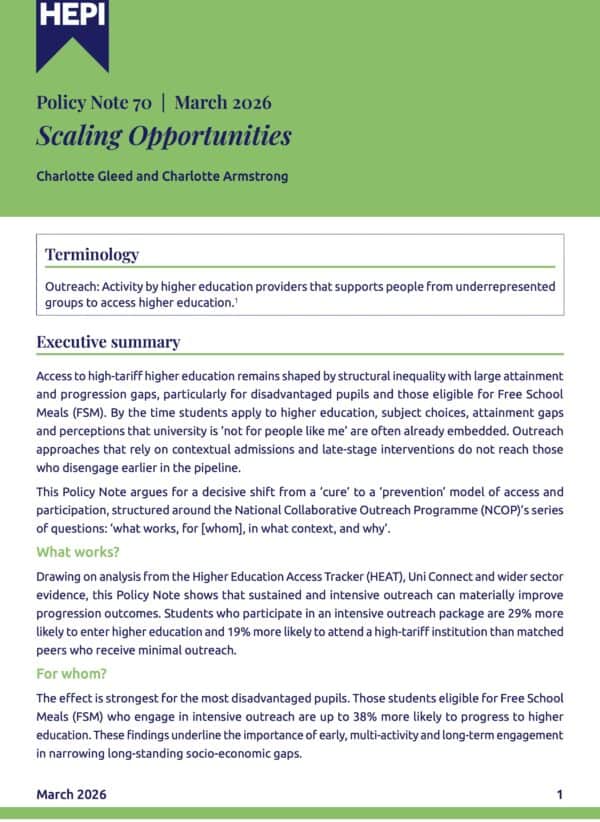
New HEPI Policy Note calls for sustained and intensive outreach to tackle persistent higher education access gaps.
It argues that sustained and intensive outreach programmes are among the most effective tools to widen access to higher education institutions, and calls for earlier, better coordinated and more rigorously evaluated interventions.
Scaling Opportunities (HEPI Policy Note 70), by Charlotte Gleed and Charlotte Armstrong, examines the structural inequalities that shape progression to higher education and asks higher education institutions to think about ‘what works, for whom, in what context, and why’ when conducting outreach. Drawing on analysis from the Higher Education Access Tracker (HEAT), Uni Connect and other sector evidence, the report makes the case for moving from late-stage adjustments to long-term, preventative engagement.
Despite decades of widening participation work, significant attainment and progression gaps remain. The Policy Note argues that sustained and intensive outreach can shift these outcomes. Analysis from HEAT shows:
- Students who participate in an intensive outreach package are 29% more likely to enter higher education than matched peers who received minimal outreach.
- Participants in intensive outreach are 19% more likely to enter a high-tariff higher education institution.
- Among students eligible for Free School Meals, those who engage in intensive outreach are up to 38% more likely to progress to higher education than similar disadvantaged peers who receive minimal outreach.
The particularly strong impact for students eligible for Free School Meals underlines the potential of sustained engagement to narrow long-standing socio-economic gaps in progression. The authors argue that interventions must begin before Key Stage 4 attainment gaps are entrenched and before subject choices restrict future options.
Recommendations
The Policy Note calls for a shift from a ‘cure’ to a ‘prevention’ approach to access and participation and recommends:
- Expanding and scaling sustained contact programmes spanning pre- and post-16 outreach, beginning engagement between Years 7 and 9 at the latest and maintaining support through to sixth form.
- Greater collaboration between higher education providers, local authorities and national programmes to target cold spots and maximise value for money.
- Recognition of access and participation as a national responsibility, supported by stable, multi-year funding for collaborative schemes such as Uni Connect.
- Stronger and more rigorous evaluation of widening participation interventions to establish clearer causal links between outreach and progression outcomes.
While sustained and intensive intervention programmes demonstrate the promise of long-term engagement, the report warns that high costs, logistical barriers and limited high-quality evaluation evidence are constraining scale. Funding reductions for outreach schemes such as UniConnect risks weakening partnerships at precisely the moment when the evidence points to their effectiveness – particularly for the most disadvantaged students.
Charlotte Gleed, former HEPI Intern and co-author of the Policy Note said:
In November 2017, the Schools Liaison Officer from Sidney Sussex College, Cambridge came to my state comprehensive school in Wolverhampton. At the time, I was in Year 10 studying for two GCSEs I was due to sit a year early: History and Religious Studies. The woman, whose name I wish I could remember, gave me the 2017/18 Cambridge University prospectus and a slimmer brochure of Sidney Sussex College. Those two booklets became my visualisation tool. An ambition had been lit within – an ambition I previously did not know existed. Little did I know as a 14-year-old with dreams of attending a selective higher education institution but in a school with limited knowledge about the Oxbridge system, outreach would make an instrumental change.
Scaling Opportunities aims to highlight the importance of sustained and intensive outreach. It is essential that young people from traditionally underrepresented backgrounds not only have contact with high tariff universities throughout their secondary education, but that this contact is not limited to Year 11 or Sixth Form. It is too late by this stage. Planting the seed of possibility early is crucial to ensure these young people stand the best chance of making an informed but also competitive application to selective higher education institutions across the UK.
Scaling Opportunities is a fresh take on the most pressing issues in access to higher education today. Our recommendations are aspirational but rooted in evidence-based research to provoke conversations about meaningful change in the landscape of progression to higher education. Access is a cornerstone of the admissions policies at higher education institutions. Scaling Opportunities reasserts the importance of this principle.
Charlotte Armstrong, Policy Manager at HEPI and co-author of the Policy Note said:
Too often, access to higher education is treated as a problem to fix at the point of application – but by then, it is already too late for many capable young people. Sustained, early outreach can significantly shift outcomes, particularly for the most disadvantaged, making progression to higher education far more likely. But if these approaches are to be scaled, the sector must strengthen how it evaluates them, building a more robust evidence base to guide action and maximise impact.
Notes for editors
- HEPI was founded in 2002 to influence the higher education debate with evidence. We are UK-wide, independent and non-partisan. We are funded by organisations and higher education institutions that wish to support vibrant policy discussions, as well as through our own events. HEPI is a company limited by guarantee and a registered charity.




Comments
Add comment