The state of higher education at the start of the 2026/27 academic year: A personal take on what universities need to get right
As my social media feed has recently filled up with parents posting pictures of children returning to school for the new academic year, as the autumn party conference season gets underway and as Universities UK gear up for their own Annual Conference (taking place next week in Nottingham), it seems the perfect moment to take stock on how UK higher education is faring – and what it can do to own its own future.
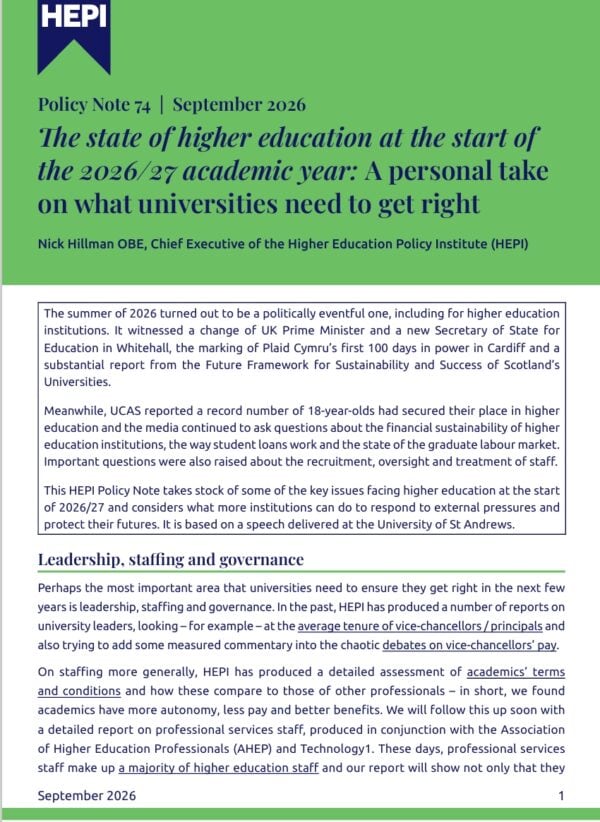
So HEPI is today publishing the thoughts of its CEO, Nick Hillman OBE, in a new Policy Note titled ‘The state of higher education at the start of the 2026/27 academic year: A personal take on what universities need to get right‘.
As the paper says at the start:
The summer of 2026 turned out to be a politically eventful one, including for higher education institutions. It witnessed a change of UK Prime Minister and a new Secretary of State for Education in Whitehall, the marking of Plaid Cymru’s first 100 days in power in Cardiff and a substantial report from the Future Framework for Sustainability and Success of Scotland’s Universities.
Meanwhile, UCAS reported a record number of 18-year-olds had secured their place in higher education and the media continued to ask questions about the financial sustainability of higher education institutions, the way student loans work and the state of the graduate labour market. Important questions were also raised about the recruitment, oversight and treatment of staff.
This HEPI Policy Note takes stock of some of the key issues facing higher education at the start of 2026/27 and considers what more institutions can do to respond to external pressures and protect their futures. It is based on a speech delivered at the University of St Andrews.



Comments
Jonathan Alltimes says:
Where should we stand to get a sense of perspective on higher education? The traditional purpose of the academic guild was to preserve and to teach alternative knowledge independent and autonomous of the State, the Church, and business. That knowledge is definitely rare on the shelves, as higher education has become almost completely dependent on State subsidies and produced unsustainable growth, the Church bureaucracy which was a once a traditional intellectual foil against which to dispute has rusted, and higher education has become a bricolage of many unsustainable bureaucratic enterprises. The missing piece of the puzzle is the precarious situation of the State finances and the absence of sufficient economic growth for the past 15 years. The British State bet at the same table on the sciences as the USA following the Baye-Dohl Act, but it did not understand the differences between us and the Americans: the advice of the University of Cambridge misdirected us to the function of the universities. It was the leadership, senior academic administrators, and senior managers who have brought the enterprises to this point, most of whom have retired and so do not have to bear the consequences of their decisions, but to be fair they respond to the choices of the State although they were also feeding the policies. After 26 years of State interventions, there are still no major new industries emerging on the horizon with which to feed economic growth, taxes, and subsidies. When standing inside the wood, one may appreciate some beautiful species, even some successful clumps, copses, and groves, but when walking through there is a lot of weak wood struggling for light we often ignore and when standing outside we can see its shape and situation. What fed British education? Do not be surprised by what follows.
Reply
Dr John Milliken says:
Universities do not just need to adapt. Higher education needs to behave like a system
Nick Hillman’s latest HEPI Policy Note offers a timely stocktake of the pressures facing higher education as the 2026/27 academic year begins. Leadership, governance, funding, institutional failure, internationalisation, demographic change, institutional scale and artificial intelligence all feature prominently.
Each matters. But taken together, they suggest a bigger question.
Are we still trying to solve system-level problems one institution at a time?
Much of higher education policy continues to assume that individual universities should respond independently to changing markets, financial pressures and student demand. Institutions recruit, compete, expand, contract, internationalise and increasingly consider mergers or collaboration.
Yet the pressures Hillman describes are interconnected. Funding affects staffing. Staffing affects student experience. Demography affects recruitment. Recruitment affects institutional viability. Financial weakness encourages expansion into new markets. Expansion creates organisational complexity. AI changes both what universities teach and how they operate.
These are not independent variables. They form a system.
From institutional strategy to system capability
Hillman is surely right to begin with leadership, staffing and governance. Universities facing profound uncertainty require capable leadership and effective oversight.
But good governance should involve more than ensuring that an individual institution survives.
It should also ask a more uncomfortable question:
What does this institution contribute that the wider educational system would struggle to replace?
For decades, institutional strategy has understandably emphasised competitive advantage. Universities identify markets, recruit students, build reputations and seek income.
That logic has produced considerable innovation. But it can also produce duplication, institutional imitation and expansion into areas in which comparative advantage is weak.
The alternative is not central planning.
It is system awareness.
Universities need to understand not only their own strengths but their position within a wider educational ecology of universities, further education colleges, schools, employers, professional bodies, communities and increasingly digital providers.
The strategic question therefore changes from “How do we grow?” to “Where can we add distinctive value?”
Bigger is not necessarily better
Hillman usefully challenges the increasingly fashionable assumption that scale automatically produces resilience.
His discussion of American institutions is particularly revealing. Different strategies – campus expansion, geographical expansion, networked provision and rapid online growth – all promised new income. Yet in the cases examined, each created difficulties of its own.
Growth can strengthen an institution.
It can also magnify its weaknesses.
A university that lacks a clear sense of purpose does not necessarily solve that problem by becoming larger. It may simply become a larger organisation lacking a clear sense of purpose.
The coming restructuring of UK higher education therefore should not be reduced to a choice between survival, merger or closure.
There is a much wider continuum.
Institutions can share professional services, jointly deliver programmes, establish regional alliances, pool specialist facilities, recognise one another’s provision, develop common digital infrastructure and deliberately specialise while relying upon partners for complementary expertise.
In other sectors we would call much of this organisational design.
In universities, we still too often call it collaboration and treat it as an optional extra.
Demography does not necessarily mean contraction
The demographic argument illustrates the problem particularly well.
A declining population of 18-year-olds can easily be translated into a prediction of fewer students and therefore fewer universities.
Hillman rightly explains why that conclusion is not inevitable. Participation can increase among groups currently underserved by higher education; mature participation can change; and public policy can alter patterns of demand.
But perhaps we need to go further.
The conventional university model remains extraordinarily dependent upon a particular educational journey:
school → university → employment.
That pathway will remain important, but longer working lives, technological change and recurrent occupational transition make it increasingly inadequate as the organising principle for tertiary education.
If individuals repeatedly return to education over careers lasting perhaps 50 years, the question ceases to be how many 18-year-olds universities can recruit.
It becomes:
How easily can people move into, through and back into education throughout their lives?
That implies shorter qualifications, stackable learning, recognition of previous learning, stronger further/higher education relationships and genuine permeability between education and employment.
Lifelong learning cannot simply mean offering the traditional university product to older customers.
It requires redesigning the educational architecture.
AI makes the same point
Hillman reports that generative AI use among full-time undergraduate students is now virtually ubiquitous.
The initial institutional response has understandably concentrated on academic integrity, assessment and regulation.
But AI may eventually challenge something deeper: the organisation of knowledge itself.
If information can increasingly be generated, summarised and interrogated instantly, universities cannot defend their value primarily by transmitting information.
Their value will increasingly lie in helping students develop judgement: knowing what questions to ask, what evidence to trust, how competing claims should be evaluated and when apparently persuasive answers are wrong.
That makes the student experience more important, not less.
It also places experienced academics, practitioners and mentors at the centre of education rather than at its margins.
At precisely the moment when universities face severe financial pressure, therefore, they should be very cautious about treating accumulated academic experience simply as a cost to be removed.
Knowledge that disappears from one payroll does not automatically reappear somewhere else in the system.
Universities as an educational ecosystem
Hillman’s Policy Note concludes by arguing that universities should remain true to themselves while engaging more deeply with society.
That is surely right.
But perhaps the two ideas should be joined.
Universities may be better able to remain true to themselves if they stop trying to be everything to everyone.
A healthy higher education system does not require identical institutions competing across identical markets.
It requires differentiated institutions connected sufficiently well that their differences become complementary rather than isolating.
Some will excel in research.
Some in professional formation.
Some in widening participation.
Some in regional development.
Some in online education.
Some in specialist disciplines.
Some will do several of these exceptionally well.
The objective should not be institutional uniformity. Nor should it be survival at any cost.
It should be to create an educational system in which knowledge, people, learners and opportunities can move more easily to where they create the greatest value.
The pressures Nick Hillman describes are real, and the next few years may well be as turbulent as he predicts.
But turbulence does not necessarily require every university to build a bigger boat.
Sometimes the better answer is to build a better-connected fleet.
Reply
Add comment