
‘We believe this is the way to do it’: Exploring the City St George’s merger
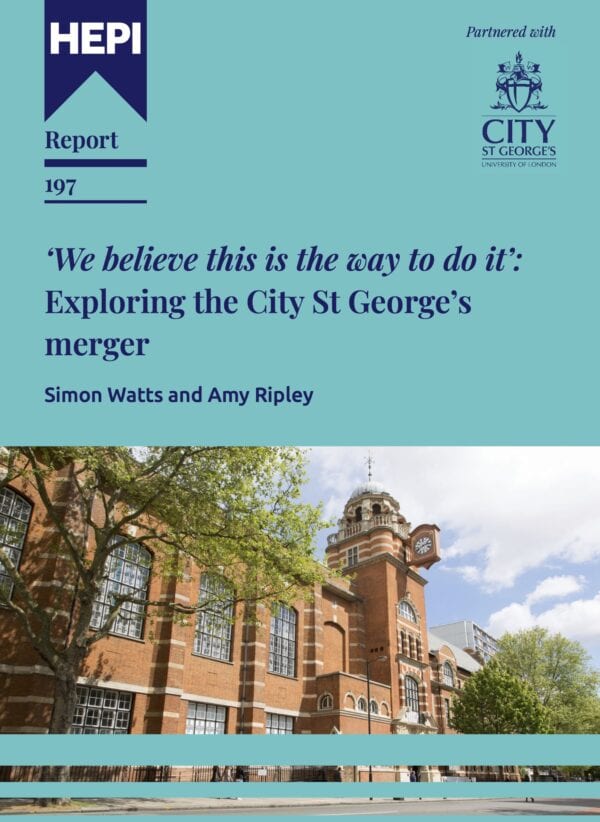
City St George’s: HEPI report sets out practical insights and recommendations from a landmark university merger.
A new HEPI report, ‘We believe this is the way to do it’: Exploring the City St George’s Merger (HEPI Report 197), offers a detailed examination of the UK’s most significant university merger in more than a decade, drawing out practical recommendations for sector leaders considering similar structural reforms.
Based on in‑depth interviews with senior leaders who guided the process, the report offers rare real-world guidance from an unusually large and high-stakes merger, including:
- The critical importance of clear governance and phased milestones
- The need for robust due diligence and shared financial planning
- The reality that integrating cultures takes time, empathy and transparency
- The value of investing early in professional change management
- The need to support students’ unions through highly visible change
- The importance of anchoring decisions in academic purpose even during operational pressure
The HEPI report provides a valuable contribution to a mergers playbook, capturing early insights from a rare institutional transformation. For senior leaders weighing options such as shared services, deeper partnerships or full mergers, the report highlights what must be in place long before legal consolidation.
City St George’s Deputy President (Operations) Helen Watson said:
‘There is no mergers playbook for universities. We were designing the plane, building it and flying it at the same time. What has kept us aligned is clarity of purpose and a shared commitment to creating something stronger together.’
A strategic fit with complementary strengths
The merger has been underpinned by a strong strategic rationale recognised by leaders from both legacy institutions.
City St George’s President, Professor Sir Anthony Finkelstein, said the new institution is well placed to respond to sector challenges and opportunities:
‘The merger is timely, given the pressures faced by our universities and the NHS. It will generate educational and research benefits, as well as advantages of scale, which will enable City St George’s to have a major impact on society, not least in healthcare.’
Christine Swabey, former Chair of St George’s Council and now Deputy Chair of Council at City St George’s, highlighted the breadth created by unifying the two institutions:
‘Between us, we covered pretty much all the relevant professional disciplines within the healthcare and medical science sector. I thought that was extremely exciting and it also meant there was a real opportunity to preserve all that was good about St George’s.’
The new School of Health & Medical Sciences forms the centrepiece of the merger, bringing together legacy expertise across a wide range of clinical and allied health disciplines to create a true ‘health powerhouse’ for students, researchers, and the NHS.
Professor Elisabeth Hill, Deputy President and Provost, said the merger fundamentally enhances the academic environment for students and staff:
‘There was a lot of synergy between the two institutions. By merging, we could build degrees and other opportunities for students to learn in a multidisciplinary health and medical environment that would better map the workplaces students move into after graduation.’
The enlarged institution has a broader research base, greater opportunities for interdisciplinary funding and a larger student pipeline.
Building a shared community and culture
Professor Hill also acknowledged that integration is a long and difficult journey:
‘Academics understood the vision and strategy but feared short-term disruption, asking: “Will I still teach my course? What about my department? And my research?”‘
She noted that for all staff
‘even if you get the rationale, it doesn’t take away how you feel about the risk to you and your job security.’
The University’s Director of Change, Natasha Bennett, says the merger offers lessons for the rest of the higher education sector:
‘It’s important to distinguish between “integration” and “integrated”. We are integrating, and this will by necessity be a long process.’
‘There may be some institutional learning about when the process of integrating could and should realistically start and how these expectations should be shared.’
As a consequence of these observations, staff across City St George’s are working closely to provide clarity, reduce uncertainty and ensure people feel supported.
Looking ahead
The new report concludes that City St George’s shows how strategic consolidation, when aligned with civic and workforce need, can offer a route to greater resilience at a time of sustained pressure on the higher education system.
While the full benefits of the merger will take time to materialise, the experience provides a practical blueprint for policymakers and institutional leaders considering similar structural responses to the challenges facing UK higher education.
Note for Editors
HEPI was founded in 2002 to influence the higher education debate with evidence. We are UK-wide, independent and non-partisan. We are funded by organisations and higher education institutions that wish to support vibrant policy discussions.






Comments
Jonathan Alltimes says:
And a shed load of cash from investments and endowments with which to fund the re-organisation, maintenance and building projects.
Reply
Add comment