What UK university AI policies actually do: A study of 96 institutions
Many universities still have no easily accessible AI policy.
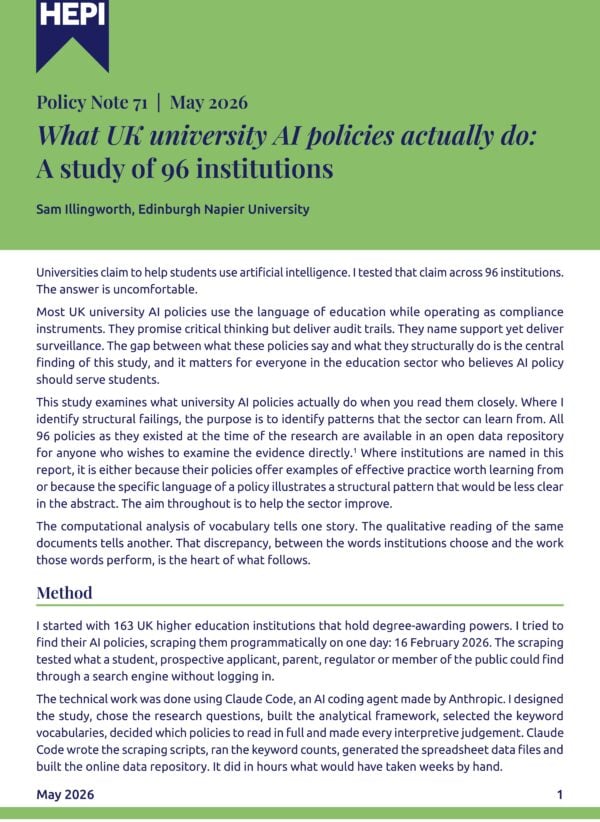
Two-in-five UK universities have no AI policy that a student, parent or regulator can easily find online, according to What UK University AI Policies Actually Do: A Study of 96 Institutions (HEPI Policy Note 71) by Professor Sam Illingworth.
The paper also argues that most of the 96 policies that are publicly accessible use the language of learning but actually operate as detection-and-discipline frameworks.
A computational count of 77 keywords across all 96 policies suggests 86% of the policies were education-dominant. However, a close reading by the author of a subset (19) of the policies found close to half (eight) had been misclassified, with educational vocabulary being used to dress detection-and-discipline architectures.
Key findings:
- 41% of UK degree-awarding institutions have no publicly accessible AI policy. Some sit behind login walls and some return broken URLs, while many cannot be found through a search engine at all.
- The sector has no shared approach. 163 institutions have 163 separate responses to the same challenge, with framing that ranges from ‘educative, not punitive’ to language that treats non-declaration of AI use as evidence of concealment. A student transferring from one institution to another may find policies that differ in fundamental orientation, not only in detail.
- A policy’s location predicts its function more accurately than the language used. Policies hosted within academic misconduct frameworks enforce. Policies hosted within learning and teaching frameworks educate. Vocabulary alone does not move the needle.
- No policy in the sample states ‘we trust students’. The dominant model is conditional trust: students are trusted only if they declare their use, retain evidence and submit to verification.
Professor Sam Illingworth, the author of the new Policy Note, said:
Universities are supposed to develop critical thinkers. If an institution’s own AI policy cannot model critical thinking about AI, if it resorts to compliance while claiming to educate, then the policy contradicts the mission. The deficit model does not require punitive language to reproduce itself. It requires only the assumption that students cannot be trusted to think.
Nick Hillman OBE, CEO of the Higher Education Policy Institute, said:
Every university in the world is wrestling with how to respond to AI. The technological developments of the last few years are causing huge changes for academics, students and managers.
This report assesses the state of play on guidance for students, nearly all of whom now regularly use AI. It argues some universities still need to hone their response to AI into something that is pedagogically sound and genuinely helpful to students.
The report identifies four exemplars in the AI policies of the University of Stirling, Canterbury Christ Church University, Arts University Plymouth and Durham University (for the Common Awards Partnership). These span all four major institution types (Russell Group, other pre-92, post-92 and specialist). They demonstrate AI policy can extend trust, develop critical literacy and address risk through focusing on assessment design rather than detection.
The report sets out five principles for a student-centred AI policy:
- location determines framing;
- trust should be the default;
- student voice should shape the policy;
- critical literacy should replace tool proficiency; and
- policies must be publicly accessible.
HEPI’s other recent output on AI includes the HEPI / Kortext Student Generative AI Survey 2026 (HEPI Report 199) by Rose Stephenson and Charlotte Armstrong, Being indispensable: Capabilities for a human-AI world, the ‘FUTURES’ framework (HEPI Report 198) by Dr Doug Specht and Professor Gunter Saunders and a collection of essays collated by Dr Giles Carden and Josh Freeman (eds), AI and the Future of Universities (HEPI Report 193).
Notes
- Professor Sam Illingworth is Professor of Creative Pedagogies at Edinburgh Napier University and co-author with Rachel Forsyth of GenAI in Higher Education (2026). He writes the Slow AI newsletter on critical AI literacy at https://theslowai.substack.com/
- All 96 scraped policies, the keyword vocabularies, the qualitative coding framework and the framing ratios for each institution are available at https://github.com/sam-illingworth/uk-university-ai-policies
- HEPI was founded in 2002 to influence the higher education debate with evidence. We are UK-wide, independent and non-partisan. We are funded by organisations and higher education institutions that wish to support vibrant policy discussions, as well as through our own events. HEPI is a company limited by guarantee and a registered charity.




Comments
Jonathan Alltimes says:
The report is on the right track.
Students need a hinterland of experience from which they can know how to interrogate AI. When using sources, how do they know the truth in terms of their subject discipline? Such that the source is incorporated in their own action knowledge, within the situation of reproducing knowledge.
Reply
Add comment