
Making sense of Ministerial Statements on Duty of Care
This blog was kindly authored by Dr Robert Abrahart, Lead Campaigner at ForThe100.
Three ministerial statements
Over three years, three different education ministers have set out three different versions of the government’s position on the duty of care universities owe their students. Robert Halfon did so during the first parliamentary debate on a statutory duty of care in June 2023. Janet Daby provided a broader formulation in response to a written parliamentary question in January 2025. Josh MacAlister returned to the subject when responding to the second parliamentary debate in January 2026.
The Department for Education maintains that these explanations are entirely compatible. Perhaps they are, but understanding how they fit together is something of a legal jigsaw. Put them alongside one another and a surprisingly coherent picture begins to emerge – though it also reveals where the department’s latest account has become confused.
The first statement
On 5 June 2023, Robert Halfon, then Minister for Skills, Apprenticeships and Higher Education, responded to the first parliamentary debate on a statutory duty of care for students. That debate followed the government’s January 2023 response to Parliamentary Petition 622847, which had said that higher education providers already had a ‘general duty of care’ towards their students.
Halfon went further in explaining what the government meant. He told MPs that the government’s view was that a general duty of care ‘already exists in common law as part of the law of negligence’. He said this meant that higher education providers must deliver educational and pastoral services to the standard of an ordinarily competent institution.
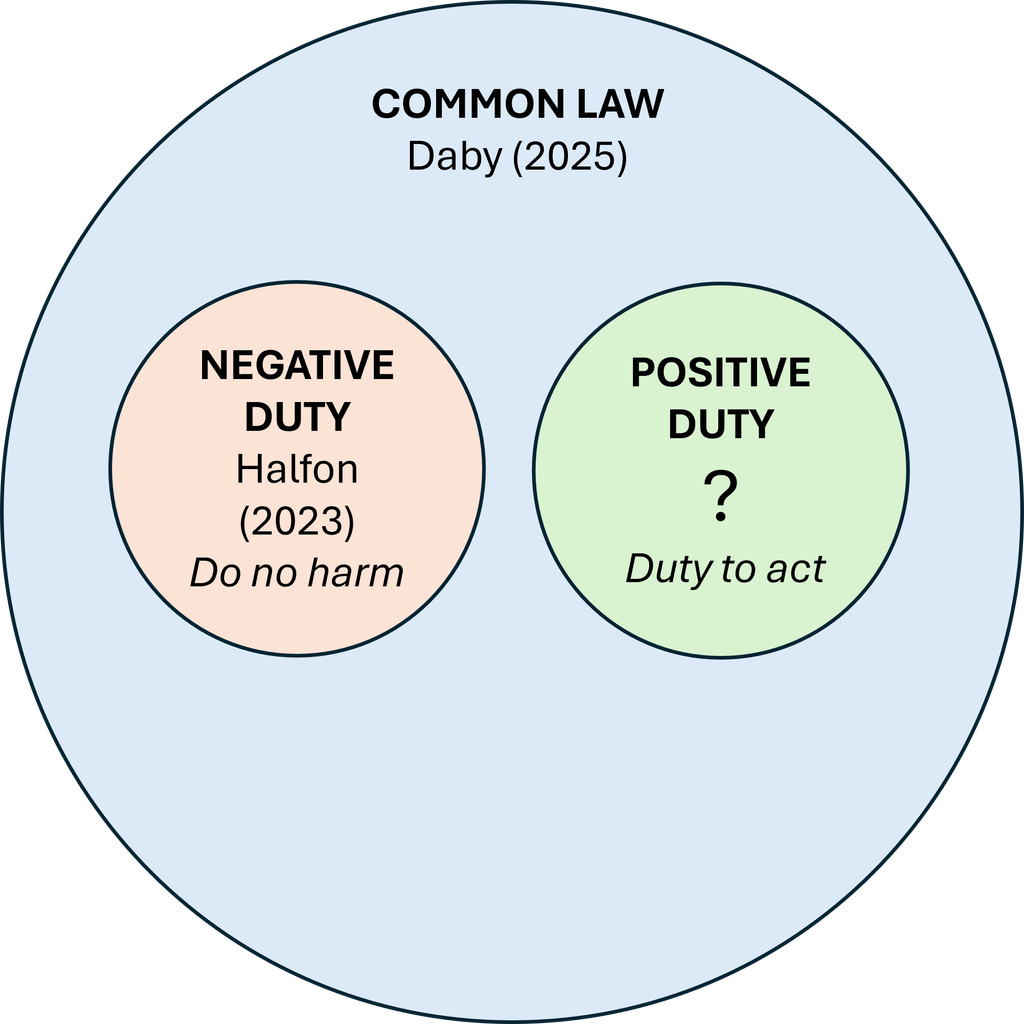
That is important. The duty Halfon described was expressly a common-law duty. It can perhaps be understood most simply as a negative duty: a duty not to act carelessly and cause foreseeable harm. In ordinary language, a negative duty says ‘don’t do this’ – or, more simply, ‘do no harm’.
But that does not answer every duty-of-care question. Sometimes a responsibility to act already exists and the issue is whether it has been carried out with reasonable care and skill. More difficult again is the situation in which no responsibility to act has yet been established, but it is argued that the university should nevertheless have intervened. The common law is generally much more reluctant to impose liability for omissions, and ordinarily there is an important difference between carelessly creating a danger and failing to protect somebody from a danger that you did not create.
The second statement
On 8 January 2025, Janet Daby, then Minister for Children and Families, responded to two linked parliamentary written questions from James Naish MP. One asked what steps the government was taking to clarify the duty of care owed by higher education providers to their students and ensure such standards were met; the other asked whether the Secretary of State would meet representatives of ForThe100 to discuss the issue.
Her answer included a markedly different formulation of the department’s position. Daby said that:
a duty of care in HE may arise in certain circumstances.
Whether those circumstances existed, she said, was a matter for the courts, based on the facts and context of the particular case and the application of accepted common-law principles.
I previously described this as a shift towards greater legal clarity. A year later, her answer deserves to be revisited. Daby was not apparently describing another duty sitting alongside Halfon’s general duty. Daby’s statement was much broader: it described the overarching common-law framework within which particular duties of care may arise.
This matters particularly when the duty in question is positive rather than negative. In ordinary language, a positive duty says ‘do this’: it requires action rather than restraint. Such duties can arise where established common-law principles recognise a responsibility to act.
Taken together, Halfon and Daby therefore provide the beginnings of a coherent picture. Halfon identifies the negative ‘do no harm’ duty; Daby provides the wider common-law framework within which that and other duties may arise. Put visually, Halfon’s duty sits within Daby’s broader common-law framework.
The third statement
On 13 January 2026, Josh MacAlister, then Minister for Children and Families, responded to the second parliamentary debate on a statutory duty of care for students. Like Halfon before him, MacAlister began by explaining what the government believed higher education providers already owed their students.
He said that higher education providers have a ‘general duty of care’ to deliver educational and pastoral services to the standard of an ordinarily competent institution and that, in carrying out those duties, they are expected to act reasonably. In doing so, MacAlister appeared to return directly to the general duty described by Halfon in 2023.
But he then added something new. MacAlister said:
In addition to general and common-law duties, universities also have explicit statutory obligations.
That formulation is difficult to reconcile with what came before. Halfon had expressly described the general duty as one that ‘already exists in common law as part of the law of negligence’. Yet MacAlister’s phrase ‘general and common-law duties’ appears to separate the general duty from common-law duties, as though they were two distinct categories.
Perhaps that was not what he intended, but the distinction matters. If the government’s general duty is a common-law duty, as Halfon said, then it sits within the wider common-law framework described by Daby. It does not sit alongside it.
MacAlister’s formulation suggests a rather different relationship.
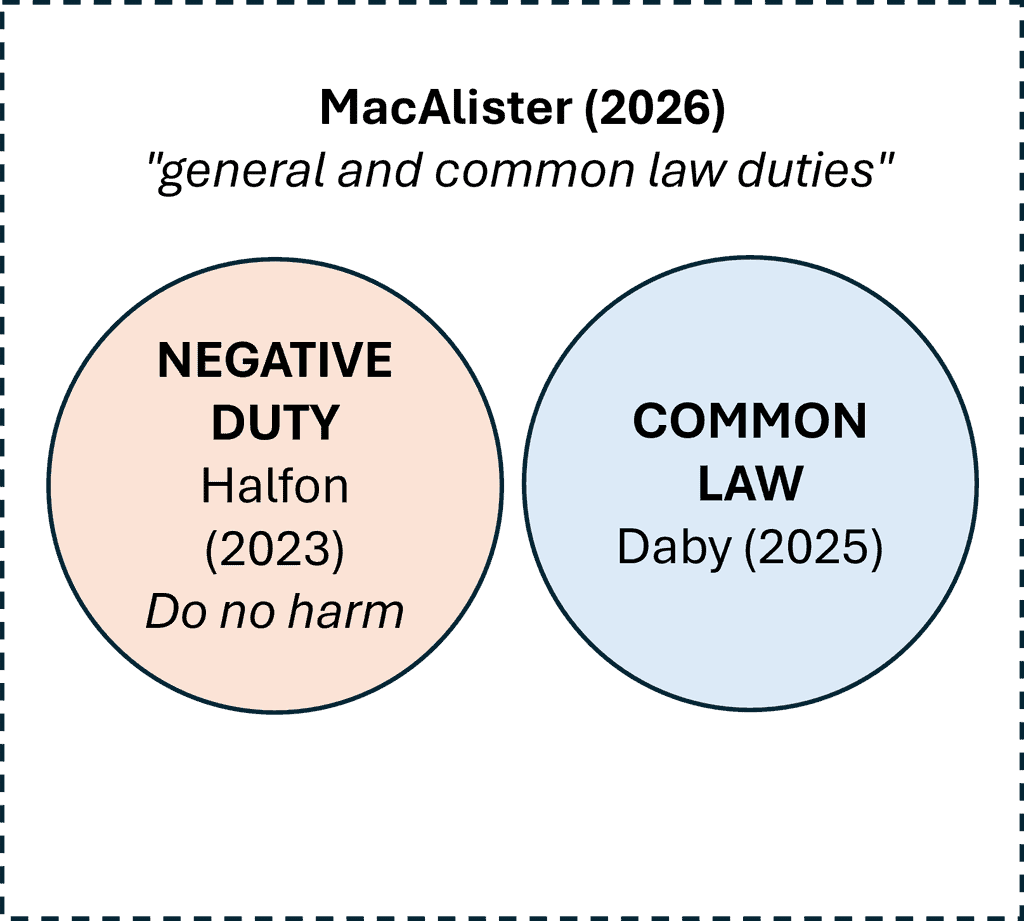
By referring to ‘general and common-law duties’, his words appear to pull the general duty out of the common-law framework and place the two alongside one another. But that cannot easily be squared with Halfon’s earlier statement that the general duty itself ‘already exists in common law as part of the law of negligence’.
The distinction is more than semantic. If universities and students are to understand what legal duties already exist, they need to know where those duties come from and how their scope is determined. On the government’s own earlier account, the general duty is not a separate category of obligation: it is one particular duty within the wider common law.
Read this way, the three statements can largely be reconciled. Halfon identifies a negative duty; Daby explains the broader common-law framework; and MacAlister appears to separate concepts that properly belong one within the other.
Who should sort this out?
What remains unresolved is when a university has a positive duty to act. None of these ministerial statements provides an equivalent account of that duty. Instead, the question is left to the courts, applying common-law principles to individual cases.
That may be an accurate description of how the common law develops, but it is also a policy choice. Courts decide cases after events have occurred, through litigation that can take years and require considerable financial and personal resources.
Parliament has another option: it can make law prospectively, defining responsibilities before they have to be discovered through litigation. That would also do something that three successive ministerial statements have not: bring these responsibilities together within a clear legal framework, providing greater certainty for universities, students and the courts alike.
Nor would legislation remove the courts from the picture. Parliament can define the duty in advance; the courts would still determine whether that duty had been breached in the circumstances of an individual case.
For now, however, the government has chosen to leave critical decisions about the legal protection of students to the judiciary. The existence, scope and breach of any positive duty must therefore continue to be determined through individual cases before the courts.





Comments
Jonathan Alltimes says:
The issue here is the abuse of trust and respect by employees of the university towards students. Students are particularly vulnerable as academic judgements are non-justiciable.
Someone could write direct to the Minister to ask for clarification and then publish the response or a member of the Houses of Parliament could ask a parliamentary question. The arguments against a positive duty are well documented.
What social structure is the student agreeing to participate in?
What is the student?
What causes the existence of the academy within the legal person of the state-licenced and semi-autonomous university is the purpose of independent knowledge and its transmission for an occupation. Students are agreeing to join and participate in the norms of the academic and legal structure for social knowledge domains. The student is a unique person learning the norms of a social knowledge domain and is analogous to an apprentice, but not in the modern meaning as an employee learning a trade. The common law is codified through cases discovering pre-existing intrinsic rules. The enactment of a positive duty means the inventing of a new extrinsic rule, in this case, one controlling the relationship between the invented legal person of the university and the real person of the student. The rule can only apply if one assumes it can be used to measure the quality of the relationship, in which case, why is it not already intrinsic to the social relationship and been discovered? It is because fundamental norms are assumed to exist for controlling the quality of the relationship between students and the university before the other norms. To enact a positive duty of care, means the university should not be trusted, but the legal person of the university can continue after the decay of its social knowledge domains, as it owns assets, which can lead to mergers and closures. Why would you trust someone who did not care about you unless told to care?
Reply
Robert Abrahart says:
Thanks Jonathan. Your suggestion of seeking clarification through ministerial correspondence or a written parliamentary question is, in many ways, how we got to this point. The Department for Education has repeatedly been asked to clarify its position, through both Ministers and officials, but obtaining a clear and consistent explanation has proved remarkably difficult, which is precisely why I wrote this article.
I have taken what three Ministers have actually said, fitted those statements together and published the resulting picture for everyone to see. Given the difficulty of achieving meaningful engagement through the usual channels, drawing attention to the problem publicly and inviting a response seemed the obvious next step.
On your point that the arguments against a positive duty are well documented, that question was the subject of a piece published yesterday on our ForThe100 website:
https://www.forthe100.org.uk/blog/what-are-they-arguing-against
Reply
Add comment