
Mixed messages on higher education: thoughts after the Conservative Party Conference 2026
This blog was authored by Charlotte Armstrong, Policy Manager at HEPI.
HEPI’s third and final appearance during this year’s party conference season was at the Conservative Party Conference – you can read our earlier write-ups of what happened at the Reform event here and Labour’s one here. As a non-partisan think tank, we generally try to run events at the annual conferences for both the governing party and the Official Opposition while keeping an eye on, and sometimes attending, some of the others too.
In the run-up to the Conservative event in Birmingham this year, there was lots of talk about the party’s apparent resurgence. Even in Liverpool the week before, there had been discussion as to whether Labour should refocus their attacks on the Tories and leave Reform to their own problems. But despite the build-up, at the Conservative event itself the mood was fairly quiet and the large conference venue was noticeably empty for many of the sessions.
The only protesters in evidence were from Save British Farming, who innovatively made their point from within the secure zone rather than by shouting from the outside. This meant that rather than dodging leaflets and placards, soundtracked by Steve Bray, the only thing I dodged on my approach into Birmingham’s ICC was some secondary school students on a Geography trip trying to survey the police on duty outside the venue.
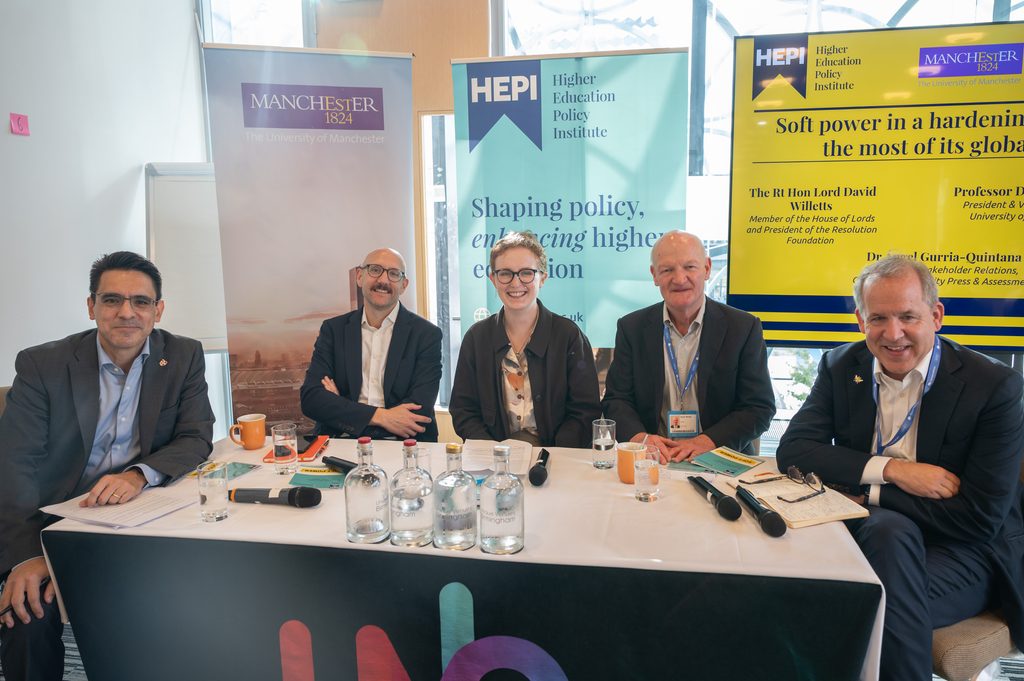
HEPI’s party conference events generally occur outside the secure zone, to encourage local higher education staff and students not in possession of an expensive conference pass to engage. Our first event was on Soft Power, building on our recent 2026 Soft-Power Index report. We heard from Jamie Arrowsmith (Director of UUK International), Ángel Gurria-Quintana (Director of Stakeholder Relations at Cambridge University Press and Assessment), Professor Duncan Ivison (President and Vice-Chancellor at the University of Manchester) and the former Minister for Universities and Science, the Rt Hon. the Lord Willetts.
The panel provided real balance, with Ángel speaking with pride and passion about his father’s time as a Chevening scholar in Leeds in 1973 and 1974 – he subsequently rose to serve as Secretary of Finance and of Foreign Affairs in Mexico, as well as Secretary-General of the OECD – Ángel noted how his family was a perfect example of the UK’s soft power. It was his father’s experience in the UK that led to Ángel being educated in an English international school, and which influenced his decision to enrol for his postgraduate education in the UK.
In his remarks, Jamie focused in part on the tightening up of the Basic Compliance Assessments and how this was driving a wedge between the Government’s rhetoric on expanding educational exports and the reality on the ground inside institutions. Meanwhile, David Willetts recognised both the soft-power benefits of educating so many people from overseas but also the need for universities to respond to the concerns of local politicians on the pressures on housing in some parts of the country.
Duncan spoke about his experiences growing up in Canada and his time working in senior higher education roles in Australia and made the case that the UK could – but is currently failing to – make the most of the opportunities offered, given key competitor countries are currently making themselves less open to the most ambitious students from around the world.
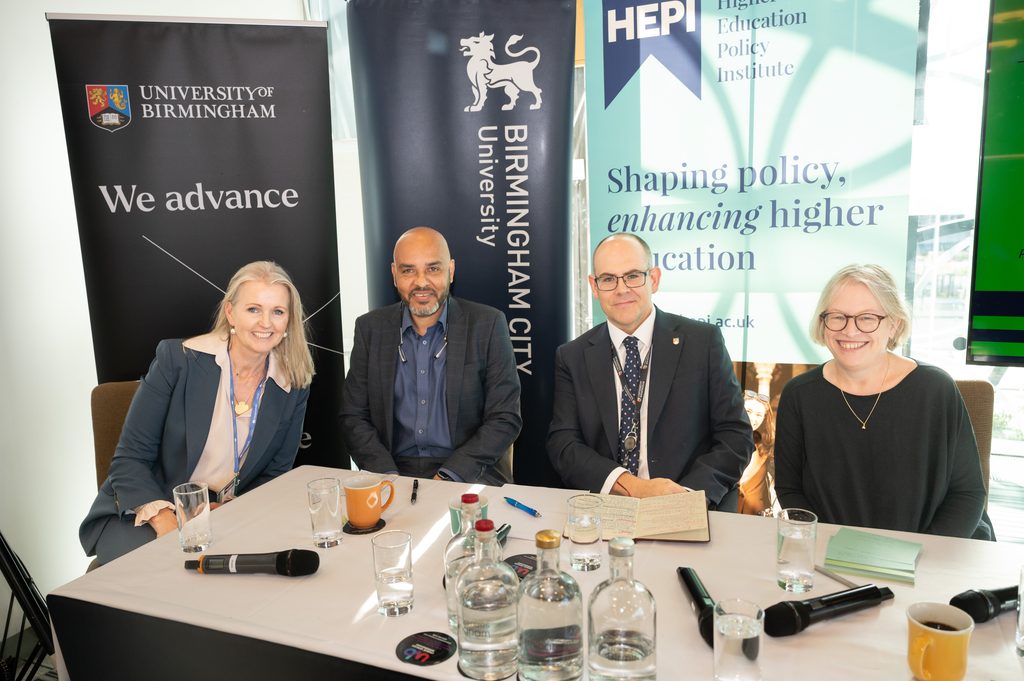
HEPI’s second event was a Higher Education Question Time, where the speakers, Professor Julie Sanders (Vice-Chancellor and Principal of Royal Holloway), Professor David Mba (Vice-Chancellor of Birmingham City University), Professor Nick Vaughan-Williams (Provost and Vice-Principal of the University of Birmingham) and Baroness Cash (Shadow Minister for Education and Women and Equalities), gamely signed up to be asked anything.
The most striking moment perhaps came from a question from Ruben Persey from the Union of Jewish Students about the rise of antisemitic attacks on campus and what vice-chancellors and others could do to keep their Jewish students safe at a time of heightened tension. The panellists recognised the severity of this issue, the importance of all students feeling like they truly belong to their institutions. The university leaders spoke about the greater levels of engagement they were undertaking with Jewish student groups.
The conversation was also especially animated when the idea of differential fees and the Russell Group’s recent positioning was raised. There was little enthusiasm for the idea of different fees by institutional type from either David Mba or Nick Vaughan-Williams. Even the most objective observer would have been left with the sense that those who want differential fees have more work to do preparing the ground.
Some attendees were pleasantly surprised by the positive messaging from the Shadow Minister, Joanne Cash. She emphasised how keen she is to ensure Baroness Smith, the Minister for Skills, receives appropriate parliamentary scrutiny across the despatch box in the House of Lords. As well as noting the vital and broad economic and societal contributions made by higher education institutions, Baroness Cash was less relaxed than some Conservative voices have sometimes sounded on the risk of university closures.
Across the Conservative Conference as a whole, there weren’t as many events on higher education as there had been in Liverpool the previous week but, after getting lost multiple times, I managed to find my way to a backroom at the farthest reaches of the venue to speak at a More in Common/UCL Policy Institute event. Entitled ‘Shared Institutions: the role of universities in local and national life’, it began with More in Common presenting some interesting data on public attitudes towards higher education and universities. It offered a nice change of pace for a sector that has recently been under fire from media and politicians alike: when compared to other institutions, universities are thought of remarkably well.
The public, we were told, is not particularly concerned about free-speech debates on campus, and negative perceptions of higher education institutions tend to be more strongly associated with employment outcomes than with culture wars. Interestingly, while the research role of institutions was described as a topic that ‘rarely came up unprompted’ in focus groups with the general public, it is also one of the areas where people feel most positive towards and about higher education institutions. Perhaps there is something for the sector to consider in the future, not least as part of Universities UK’s current work on how the sector is perceived.
Rebecca Smith MP, who has recently joined Laura Trott and Saqib Bhatti on the Shadow Education team, urged higher education institutions to publicise their civic engagement better, though some present felt their existing contribution (and the efforts they go to promote it) was perhaps already greater than parliamentarians tend to recognise.
I spoke at the event about the importance of listening and reaching out to communities as part of universities’ civic engagement work. The More in Common polling shows non-graduates are less likely than graduates to say that universities have a positive impact on the country and on local areas (although over 50 per cent say they do on both counts). Universities shouldn’t be telling people that they’re wrong for thinking that – non-graduates are forming their opinions based on their own lived experience. Instead, they need to reach out to cold spots and communities where fewer people have historically gone on to higher education to ensure that they feel the benefits of these institutions, even if residents never actually step through the doors and sit in their lecture halls. The UPP Foundation has done some really interesting work using the case study of Doncaster to explore this issue.
As I sat on the train back from Birmingham, I was grateful for the engagement we had seen with HEPI’s work but was also left with the sense that the Conservative Party is sending somewhat mixed messages about our sector. Real recognition of the contribution universities make was on show in Birmingham, a city rammed full of higher education institutions with different missions, but quickfire attacks on both institutions and international students were present in view, and the party apparently remains committed to big cuts in the number of student places. If the Conservative Party moves closer to power in the future, that tension will need to be resolved if we are to understand what the Party really think of higher education.




Comments
Add comment