
Collaboration or bust? What should universities do?
This blog by Nick Hillman OBE, HEPI’s CEO, is based on a speech delivered to senior managers and governors at the University of Winchester.
I began my career as a History teacher, then passed through Whitehall as a higher education policy wonk before alighting at HEPI. Along the way, I have served as a governor of multiple education institutions, including infant and secondary schools and two universities as well as the Slough-based National Foundation for Educational Research. The schools and universities that I have served as a governor have experienced some fearsomely successful collaborations – the University of Manchester, for example, resulted from the merger of UMIST and the Victoria University of Manchester over 20 years ago. Today, I am the governor of an independent school that has built up a family of 11 schools around the world and also of a local grammar school that is part of a multi-academy trust that already includes six schools.
Successful institutional partnerships are not easy, neither pre-ordained nor guaranteed. That is why, in a recent HEPI Policy Note, I argued that institutions need multiple jigsaw pieces to be in place to succeed in transnational education, including:
- entrepreneurial leaders with spare bandwith;
- trusted in-country partners;
- access to capital;
- a global reputation for quality;
- a clear understanding of, and a plan to deal with, cultural differences;
- an ability to weather storms and conflicts;
- an educational ethos that is transferable to another jurisdiction; and
- patience.
Despite such hurdles, the variable geography in place across our university system is continuing to change at pace – in contrast, perhaps, to public perceptions of higher education as a slow-moving beast.
Recent and current initiatives include:
- the merger of the University of Greenwich and the University of Kent into LASE (the London and South East University Group);
- the tie-up between Cranfield University and King’s College London;
- a new local ‘strategic alliance’ between Scotland’s Rural College, Queen Margaret University and Edinburgh Napier University;
- various joint initiatives for new medical schools, including the Pears Cumbria School of Medicine between Imperial College London and the University of Cumbria and the Black Country Medical School partnership between the University of Wolverhampton and Aston Medical School;
- the purchase of Lincoln Bishop University by Global University Systems, a multi-national for-profit chain; and
- the London Interdisciplinary School joining emlyon [sic] Business School as part of an ‘ambition to build a Global Management & Tech University.’
On the other hand, the history of UK higher education is littered with examples of mergers and collaborations that did not get far off the drawing board. Examples from England include attempted university tie-ups in the south between Solent and Southampton, in the Midlands between Birmingham and Nottingham and in the north between Lancaster and Liverpool.
I know of one former Cabinet Minister who used to ask in private why no British county had yet copied the state-by-state model seen in the United States. A truly regional university that brought together different institutions with different campuses boasting different strengths is surely not beyond the realm of possibility, even if the journey towards it remains quite hard to map in practice.
Other initiatives, including some transnational projects by UK universities and UK schools, have flopped too, costing millions of pounds and doing little to spread education while creating an opportunity cost and various headaches back at base. Meanwhile, questions have been asked about the extensive franchise arrangements made by a range of newer universities.
So institutions scoping out options for future partnerships need to tread carefully. To help think this through, I want to focus on the main alternative approaches on offer, based on two sources that seem to contradict one another. Both are based on what is happening in the United States, where they are ahead of us in redrawing the provision of higher education.
Big is beautiful
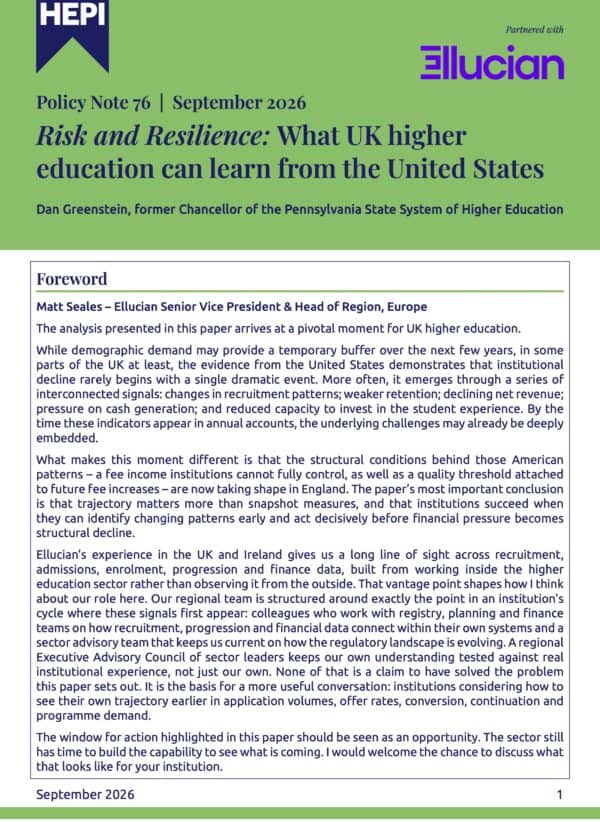
The first approach is summed up by the old idea that ‘big is beautiful’. It is outlined in the HEPI / Ellucian Policy Note, Risk and Resilience: What UK higher education can learn from the United States, written by Dr Dan Greenstein, formerly the Chancellor of Pennsylvania’s State System of Higher Education among other high-profile roles.
Dr Greenstein’s lessons from the US are all about the importance of building revenue. His paper begins by arguing that, in the US higher education sector, where something like 800 institutions have closed in just six years, two variables alone have determined success and failure:
The first is whether … [public support for teaching] holds its value – that is, it is indexed to inflation. The second is whether the institution can respond by raising its price, recruiting more students, or changing the credentials it offers.
Let’s take those points in turn. In England, tuition fees and loans for home undergraduates have not held their value since the Coalition Government introduced £9,000 fees back in 2012 (and despite the current inflation-linked rises).
Recruiting more students was nonetheless an option for most institutions in the years afterwards, thanks to the removal of student number caps in the mid-2010s and a more liberal migration system in the early 2020s.
Expanding recruitment is, however, no longer so easy for most institutions: high-tariff universities have sucked up more of the available UK applicants while tougher migration rules have made recruitment from overseas harder. The percentage of school leavers enrolling in higher education is flat or falling and a substantial reduction in the number of 18-year-olds is hoving into view (and has just arrived in Scotland).
Dr Greenstein notes UK universities have (even) less room for manoeuvre than US institutions:
They carry private-sector exposure at public-sector speed.
So he concludes revenue matters above all else:
Every American case of an institution or system pulling out of a deteriorating trajectory involved it acting on revenue, not costs alone. … That is why the American systems that went furthest in consolidating their operations, sharing back-office functions across their campuses more comprehensively than anyone else in the data, are also among the most financially distressed. They executed. The execution was real, and technically impressive. It never touched the variable driving the decline.
On this argument, recovery has to come from increasing revenue: austerity bolsters efficiency but does not deliver growth. This could be said to imply financially distressed institutions should undertake franchising and transnational education at scale, and also seek to make the most of the new opportunities offered by England’s incoming Lifelong Learning Entitlement too.
This is the strategy followed by some UK universities. As Tom Richmond wrote in a recent HEPI report:
BPP University saw its student numbers increase by 421 per cent from 2015/16 to 2024/25, the University of Law increased by 1,811 per cent and Arden University increased by 3,217 per cent. Meanwhile, Regent College London, a smaller provider, expanded by 1,408 per cent (from 510 to 7,180 students). Canterbury Christ Church University appears to have achieved its stunning growth from 12,450 to 34,655 students (+278 per cent) through franchising partnerships, as did Buckinghamshire New University and Bath Spa University …
Market obsessed
But another piece of evidence from the United States, a book called Capitalizing on College: How higher education went from mission driven to market obsessed by Joshua Travis Brown, appears to hold different lessons. It looks at various case studies of US higher education institutions which have expanded their enrolments in four different ways. All four strategies sought to build revenue. But the problem is none of them worked.
The first route focused on increasing traditional residential enrolments. Yet the institutions following this path found they had to offer discounts to fill their spaces and, in the end, their previous financial challenges returned. As I recounted in my review of his book, Joshua Travis Brown argues that, except at the very top of the tree, ‘tradition cannot compete in the market.’
The second route focused on taking higher education to the learners, whether in shopping malls, conference hotels or even military bases. This initially worked but delivered quality concerns and competition wiped out the early benefits:
enrolments cratered, and the excess revenues … evaporated.
The third approach, focused on new markets such as transnational education. But excessive complexity and rising costs meant the early benefits eventually disappeared.
The final approach of selling mass online education led the institution in question to lose touch with its original values.
These two conflicting pictures are based on actual experiences: one suggests growth in student numbers is the only sensible strategy for a hard-pressed institution; the other suggests this will come back to bite you on the bum.
The risks of franchising, for example, include cannibalising existing campus provision and, besides, Ministers are gunning for franchising at the moment. Transnational education is, in contrast, the flavour of the month in Whitehall, as it seems to allow an increase in educational exports without directly impacting on the migration numbers. But it is very hard to do well and profitably – by which I mean delivering a comparable experience to those at the mothership institution – even for large, old and prestigious universities with deep pockets.
Where to go next?
There are nonetheless two areas where more growth might be easier to find. The first is the Lifelong Learning Entitlement. Demand for this is uncertain and it could yet prove to be the dampest of damp squibs but it is being built on top of existing systems and will not entail institutions having to do anything half as complicated as building a new campus abroad or climbing in bed with a franchisee that risks a hard-fought reputation. Is the Lifelong Learning Entitlement, therefore, a route to new and expanded markets for individual institutions operating on their own or in collaboration with other providers and employers?
The second is investigating the scope for reaching further into those sections of society that remain hugely underserved by higher education. We still have an official target from Keir Starmer’s day of getting two-thirds of people through some form of higher education. Yet we all know that higher education participation varies significantly by age. It also varies significantly by socio-economic status. And by sex: 10 years after we hit Tony Blair’s target of 50% participation in higher education by those aged under 30, we are still nowhere near hitting it for boys.
So we should not entirely take our eye off more traditional activity. If we as a sector were to play our hand right, then it is not even completely inevitable that a reduction in 18-year-olds much mean a reduction in students. (It didn’t in the 1990s.)
On Wednesday, 25 November 2026, HEPI will be hosting a webinar with Ellucian on ‘Big is beautiful? What should the future shape and size of the higher education sector look like?’, which will cover many of the themes covered in this blog and feature both of the US authors named above, Dan Greenstein and Joshua Travis Brown, as well as Professor Linda Merrick CBE, the Principal of the Royal Northern College of Music and Chair of Conservatoires UK, and Professor Dame Sally Mapstone DBE FRSE, Principal and Vice-Chancellor of the University of St Andrews and HEPI’s Chair. Find out more and register for a free place here.





Comments
Add comment