
Strong support for ethical reform of university governance
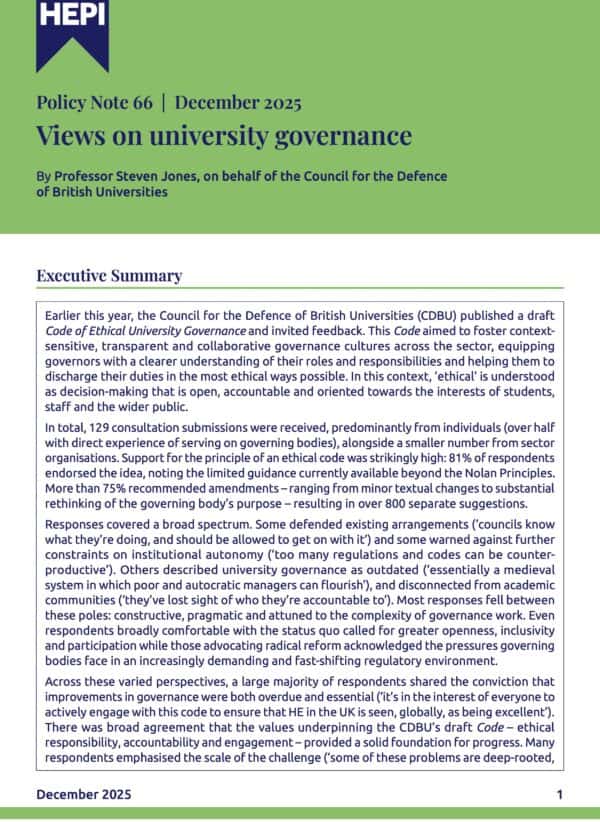
New research suggests there is strong backing for a university governance Code that addresses power imbalances and over-financialisation.
A new HEPI Policy Note summarises responses to the draft Code of Ethical University Governance from the Council for the Defence of British Universities (CDBU) and finds a striking consensus. Of the 129 submissions received, 81% endorse the principle of an ethical code.
Respondents strongly welcome the focus in the draft Code on tackling power imbalances and over-familiarity between senior managers and governors. ‘Current governance structures are too vulnerable to autocratic management styles’, noted one submission.
A revised CDBU Code – which will be launched at an event in Westminster on Thursday, 4 December 2025 – suggests ways in which cliques and in-groups can be avoided, and calls for clearer mechanisms to protect some governors being excluded from key discussions.
Several respondents emphasised that more transparent governor recruitment processes would strengthen trust and help governors ‘command the confidence of staff and students.’ The amended Code responds by requiring nominations committees to be independent from the main board and recommending that all lay governor vacancies are advertised publicly.
Many submissions raise concerns about the over-financialisation of governance, with educational, research and community considerations reportedly taking second place to cost savings. As one respondent put it, ‘the governing body must always govern the university in light of it being a university and not some other kind of organisation.’
The revised Code expects governing bodies to balance budgetary issues against institutional mission, educational purpose and public responsibility, remaining cognisant of their institution’s charitable status where relevant.
Professor Steven Jones of the University of Manchester is the main author of the Code as well as the author of the new HEPI Policy Note. He said:
No one doubts the commitment of time and energy that being a university governor involves. It is a demanding and thankless job. But my research over the last few years suggests many find the hierarchies and structures of governance to be a hindrance, and leave their role frustrated at not having made a positive impact. Too often, they are busy navigating complex processes and power dynamics when they want to be engaging with campus communities and understanding what makes universities tick.
This Code tackles these structural problems. It calls for a clearer separation between governance and management, and greater transparency in decision-making. Crucially, because it is built on academic research involving interviews with governors themselves – not drafted by board Chairs – it offers a genuinely different perspective on how university governance could work.
The final version of the Code of Ethical University Governance, revised in light of consultation feedback, will be made available on the CDBU website. A tracked-changes version showing key modifications is also available.
Nick Hillman OBE, the Director of HEPI and a former / current governor of two universities, said:
Good governance serves as a rock that secure the foundations of our higher education institutions. Conversely, when governance goes bad, it can infect a whole institution.
So it is brilliant to see such a vibrant, consultative and important debate taking place on how to ensure governance is inclusive, representative and, above all, effective.
I hope governors and managers will engage with this important new work from the CDBU and Professor Jones as well as with some other impending HEPI research on the role of student governors.
Notes for Editors
- The Higher Education Policy Institute (www.hepi.ac.uk) was founded in 2002 to influence the higher education debate with evidence. HEPI is UK-wide, independent and non-partisan. HEPI is funded by organisations and higher education institutions that wish to support vibrant policy discussions, as well as through events. HEPI is a company limited by guarantee and a registered charity.
- The Council for the Defence of British Universities (www.cdbu.org.uk) is a group of concerned individuals inside and outside universities who are worried about the long-term direction of higher education policy. The CDBU’s founding members included former presidents of the British Academy, the Royal Society of London, the Royal Society of Edinburgh and the Learned Society of Wales, as well as Nobel laureates, former principals and vice-chancellors and members of the House of Lords.




Comments
Jonathan Alltimes says:
Universities are the outer transactional form responsible for the common ownership of assets and its legal rights and duties. All universities except one are now bureacratic enterprises, so are hierarchies of common rule-bound control, as they have abandoned the college of the community of study, which has made their purpose focused on commercial and financial interests to the detriment of the functions of the guild and charity and the protective function of the college: look at the 100 plus financial crisies we know about. They have replaced the college with delegated financial control. I am not optimistic about a reversal, as the interests of the administrators are at odds with the faculty, in which academic management and the leadership have acquiesced.
Reply
Add comment