
Rethinking student voice: how can higher education design effective student governance?
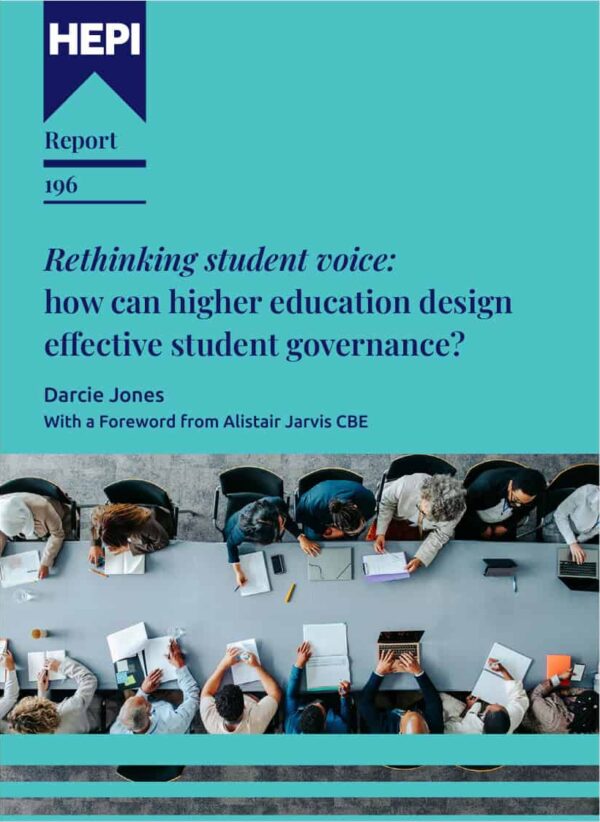
A new report from the Higher Education Policy Institute examines how student governors frequently feel marginalised in institutional oversight, and offers actionable reforms to ensure legitimacy, inclusion and real influence.
The report Rethinking Student Voice: How higher education must design effective student governance (HEPI Report 195), written by Darcie Jones, argues that, despite students being central stakeholders in higher education, many governing boards still fail to make space for their voices – structurally, culturally and procedurally. The evidence points to a gap between representation and real influence.
Key findings
- Student governors often face invisible barriers: opaque jargon, unwritten practices and exclusive social norms that inhibit meaningful contribution.
- The development of student governors is often overlooked, including little acknowledgement of their development needs.
- Student voice in higher education governance has strong potential to develop, with increasing opportunities for inclusion on key committees and for ensuring student insights are shared transparently and have meaningful influence.
- Higher education governing boards are often demographically narrow and unreflective of the student body, reinforcing students’ sense of outsider status.
However, among these barriers, examples of good practice highlight the positive effects of engaging with student governors. One example shows Hartpury University’s transition from a further education college to a college and a university in 2018 was driven by student governance. This process was inspired by a student governor who, motivated by pride in the institution, wanted to earn a ‘Hartpury degree’ rather than one validated by another institution.
Darcie Jones, HEPI intern and author of this report, said:
Student governors deserve more than a symbolic seat. They must be empowered with clarity, training and access so they can fully engage in decisions that shape their institutions. Without reform, boards risk performing inclusion rather than practising it.
In a Foreword to the report, Alistair Jarvis CBE, Chief Executive of Advance HE, writes:
The benefits of having students on boards are clear. They provide unparalleled expertise in current student experience, ask questions that enhance board understanding in ways that strengthen governance effectiveness and bring perspectives grounded in contemporary student needs rather than historical assumptions.
We are also witnessing welcome diversification in student governors – moving beyond students’ union presidents to include additional governors appointed, such as international students, postgraduates and mature students, reflecting the changing face of higher education itself.
Recommendations for change
- Accessible governance culture: Board papers should use plain language, briefings should unpack complex processes and unwritten norms and expectations must be surfaced and explained.
- Recruitment, induction and training: Higher education providers should undergo transparent recruitment processes for student governors, including collaborating with students’ unions to ensure informed recruitment and aligned training targets.
- Development: Boards should facilitate ongoing development to support the needs of all governors, including using frameworks such as the Governor Apprenticeship Programme to create measurable interventions. Mentoring opportunities between experienced governors and students should also be facilitated and encouraged, ensuring supportive, not supervisory, relationships.
- Diversity and inclusion: Institutions should set measurable targets to increase board diversity (ethnicity, socio-economic status, disability, age) and embed structured support for the development of underrepresented members with mentorship and networks.
- Institutional ears: Institutions should ensure representation of diverse student bodies,. Boards should engage in exercises such as speed-networking and link-schemes to enable governors to engage with a wide variety of student perspectives.
- Remuneration: Institutions should explore the remuneration of higher education governors to aid diversification and access to governance roles.
Though focused on students, a large number of these recommendations are applicable to all governors – promoting accessibility, inclusion and transparency across the board to strengthen decision-making and governance processes.
Context and urgency
Financial pressures across the sector are intensifying, making board-level decisions ever more consequential. This report underscores that student perspectives should not be sidelined in the decisions that affect them directly – from fee setting to strategic priorities.
Notes for editors
- Darcie Jones was an intern at HEPI in the summer of 2025. She previously served two terms as a Sabbatical Officer (Vice President Education) at the University of Plymouth Students’ Union after completing a BA (Hons) in History. During this time, she also served two years as a student governor for the University of Plymouth.
- HEPI was founded in 2002 to influence the higher education debate with evidence. We are UK-wide, independent and non-partisan. We are funded by organisations and higher education institutions that wish to support vibrant policy discussions, as well as through our own events.





Comments
Add comment