
Assessing potential manifesto commitments on higher education funding in Wales
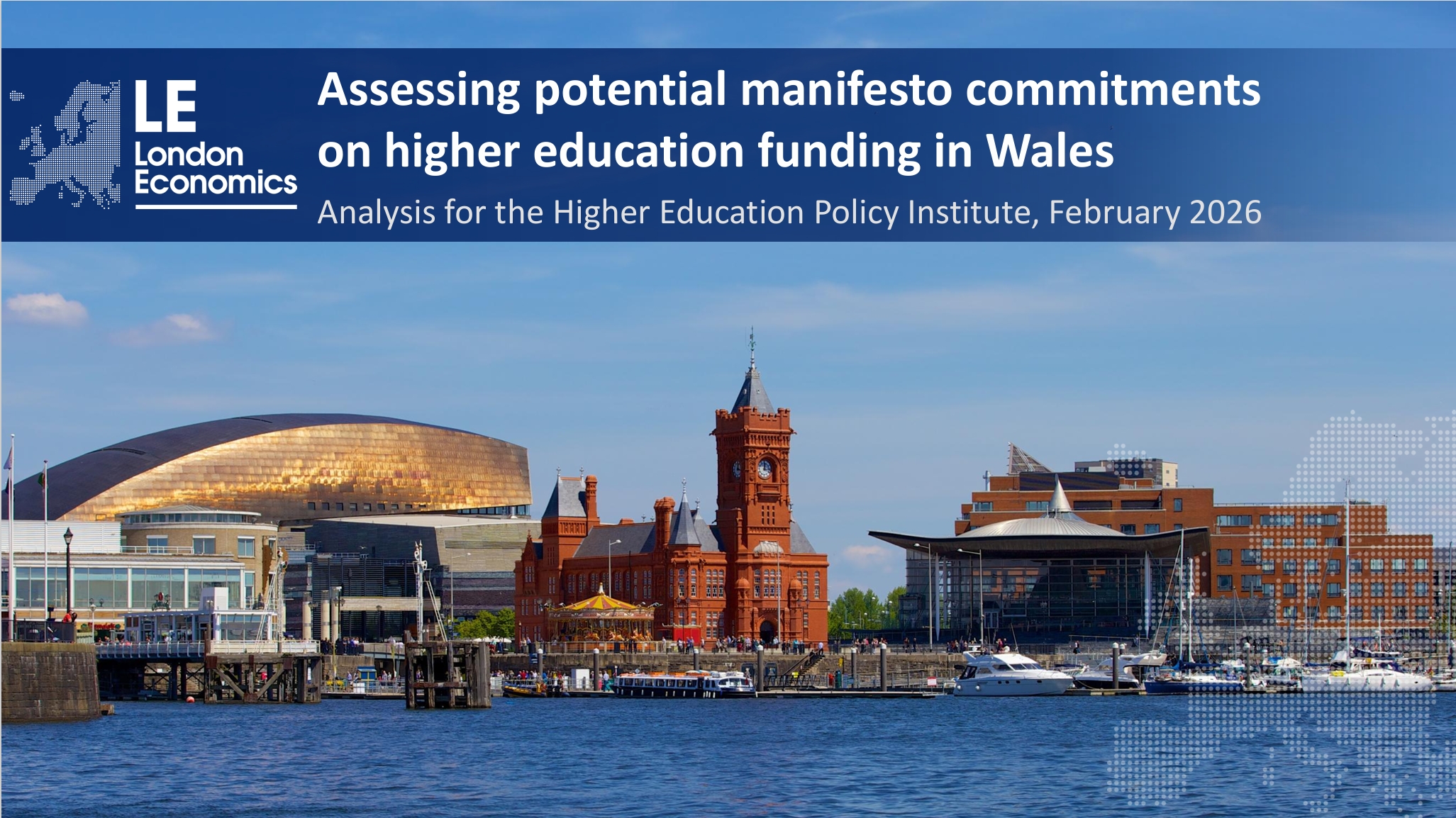
The Higher Education Policy Institute (HEPI) and London Economics have published modelling on proposed reforms for higher education funding in Wales in the run up to the Senedd elections on 7 May 2026.
London Economics was commissioned by HEPI to assess the impact of specific policy options for Welsh political parties ahead of the 2026 Senedd elections, including:
- keeping Plan 2 student loans (which Wales kept when England moved to Plan 5);
- reducing maintenance grants for Welsh students studying elsewhere in the UK; and
- removing loan interest rates and extending the loan repayment period to 45 years.
While it is not possible to know exactly what the different political parties’ manifestos will say yet, these three options are respectively based on the policies of: i) the current Labour administration; ii) documents from Plaid Cymru; and iii) statements by Reform UK. These three political parties have led the opinion polls in Wales for most of the past two years.
The analysis is outlined in a new report, Assessing potential manifesto commitments on higher education funding in Wales, which focuses on the 2025/26 cohort of first-year Welsh-domiciled undergraduate students. The modelling assesses a range of metrics, including spending on student loans; student loan debt on graduation; and expected lifetime loan repayments.
Plaid Cymru’s proposal of lowering maintenance grants for Welsh students who go to study in the rest of the UK would reduce the Exchequer cost of the funding system by £26 million per cohort, and increase the cost for students / graduates studying in the rest of the UK by the same amount.
These students would be worse-off due to the reduction in maintenance grant funding but, post-graduation, only high-income graduates would face increased loan repayments, while low- to middle-income graduates would be unaffected by the proposals.
Under Reform UK’s proposals of abolishing loan interest rates and introducing a 45-year repayment term, the Exchequer costs would increase very substantially, by £322 million per cohort (more than 80% higher than under the current system). The cost to students / graduates would fall by the same sum. This is due to the costly elimination of loan interest rates: the extension of the loan repayment period has little impact, so does not offset the additional costs.
Middle- and high-income graduates would benefit from much lower total repayments; however, low-earning graduates would make slightly total higher repayments.
The new report emphasises that it remains unclear how much practical room for manoeuvre any political party will have after the Senedd elections, as the Welsh Government is constrained in its student support policy by budgetary limits imposed by the UK-wide Treasury. These limits dictate that the cost of student loans in any of the devolved nations, including Wales, should be ‘comparable’ or less than in England, if the costs are to be funded by the UK Government.
Nick Hillman OBE, HEPI’s Director, said:
All four parts of the UK have moved further away from one another when it comes to funding undergraduate students, thanks to devolution. Now, it seems this process of differentiation may continue.
Until recently, many people argued the Welsh funding settlement for higher education should be copied in other parts of the UK. But Wales kept Plan 2 student loans when England moved to Plan 5 loans and the Welsh settlement is now being questioned from many sides even in Wales itself. Some change is possible and, increasingly, probable.
Yet the main political parties in Wales have been reluctant to set out a clear pitch, making it difficult to model the future while limiting voters’ knowledge. However, Plaid Cymru do have a proposal to encourage more Welsh students to stay in Wales while Reform UK have also said enough to allow some modelling to occur.
Maike Halterbeck, Partner at London Economics, said:
While it is unclear whether any of the political parties will end up making specific pledges on higher education funding during the Senedd elections, the current – relatively generous – undergraduate funding system in Wales is becoming increasingly fiscally unsustainable. With rising pressure on the Welsh Government from HM Treasury to reduce the costs of Welsh student loans, something will need to give. A substantial forthcoming reform of the system is becoming more and more likely.
In lieu of any official manifestos, which are still to be published, both Plaid Cymru and Reform have made explicit statements on higher education funding in the past, and this is what we have modelled here. Their proposed changes to the system are substantially different from each other, with Plaid Cymru focusing on maintenance support and Reform UK focusing on student loan repayment terms. However, given the current fiscal pressures, both parties may be severely limited in their ability to implement these proposals in practice if elected.
In the run up to May’s elections, the HEPI blog will be running a ‘Wales Week’ in the first week of March and a ‘Scotland Week’ in the following week: during this period, the HEPI blog will feature a new piece each day that looks ahead to the Senedd and Scottish Parliament elections. Sign up to receive these blogs direct to your inbox at the bottom of our homepage at https://www.hepi.ac.uk.
Notes for Editors
- HEPI was founded in 2002 to influence the higher education debate with evidence. We are UK-wide, independent and non-partisan. We are funded by organisations and higher education institutions that wish to support vibrant policy discussions.
- London Economics is one of Europe’s leading specialist economics and policy consultancies. With a dedicated division of professional economists specialising in education and labour markets, we have unparalleled experience across the education sector. As a result of our independence and the quality of our analysis, we are considered sector experts and often deliver economic insight to key policy makers and stakeholders. For more information, visit www.londoneconomics.co.uk.




Comments
Jonathan Alltimes says:
All governments should use the payback method for student loans and it has the following conditions:-
Does not account for the time value of money or discount rate;
Does not account for risks;
Does not account for the cost of financing;
Does not include a rate of interest;
Does not include opportunity costs;
Does not include comparative investments;
Does not include a progressive tax.
A £60,000 loan over 30 years would require a payment of £2,000 a year, which is 8.4% of the full-time National Living Wage. Repayments would commence when earnings exceed a full-time salary for the National Living Wage, adjusted for the Consumer Price Index Housing. The balance between the provision of higher education and further education needs to be adjusted, which is the direction of the government.
Reply
Add comment