
WEEKEND READING: Why England cannot afford to lose its international Modern Languages Teachers
This blog was kindly authored by Juliette Claro, senior lecturer in Education at St Mary’s University. Co-founder and co -chair of the UCET Special Interest Group for Supporting International Trainee Teachers and the Association for Language Learning Special Interest Group for Creativity in the MFL classroom.
England’s Modern Languages (ML) teacher supply is at a critical juncture. Despite decades of concern about the domestic pipeline, the system is now facing additional challenges. International trainee teachers are often native speakers or fluent in the language they teach, and frequently have extensive teaching experience in their home countries or internationally. But in 2025-2026 many have struggled to secure roles in schools.
The complexity and costs of the visa sponsorship for schools make up one aspect of the puzzle, but international languages trainee teachers have also fallen into a perfect storm of curriculum changes and financial pressures on schools. At precisely the moment when schools need subject specialists most, the system is making it harder for them to stay (Claro, 2025) resulting in more pressure on Initial Teacher Education providers to justify their employment rates post-graduation.
The reasons why international ML trainees are finding it increasingly difficult to enter the profession after completing their training in England are complex. All of them are intrinsically linked with the status of languages in the current curriculum landscape in England, the ever-changing immigration rules and a lack of national strategy to secure language specialists and linguists in the future economy.
As we are start a new academic year, let’s reflect on the challenges our international teachers faced in 2025-2026 and explore the potential solutions for the new academic year for the international students who secured places on the teacher training courses before the government changes in bursary funding.
The cost and administrative burden of visa sponsorship
The first barrier for international trainee teachers to secure a job is financial. For a school to sponsor a Skilled Worker visa, the average cost is around £2,000 per teacher, once the Immigration Skills Charge, Certificate of Sponsorship and legal/administrative costs are factored in. Despite being cheaper than some recruitment agency fees, for many schools operating under severe budget pressures this is still unaffordable.
But this sits uneasily alongside the reality that England does not have a domestic workforce capable of meeting the demand. The DfE Initial Teacher Training Census data consistently shows that ML recruitment targets have been missed for more than a decade, and National Foundation for Education Research (NFER) analysis confirms that languages remain one of the subjects with the most acute and persistent shortages. The improvement in recruitment predicted for 2026-2027 is not necessarily related to the fact that posts have been filled, but rather to a change in Languages provisions in schools, as explored later in this article.
In April 2026, the All-Party Parliamentary Group (APPG) hosted a roundtable discussion at the Houses of Parliament with our UCET SIG members. Facilitated by Darren Paffey, Labour MP for Southampton, and Baroness Coussins, the session explored the situation with sector leaders from Initial Teacher Education providers, Headteachers, International trainees and Early Career Teachers. Supported by professional associations such as the Association for Language Learning and the Institute of Physics, the group called for a three‑year visa for shortage subject teachers, which would align with the Initial Teacher Training Core Content Framework (ITTECF, DfE, 2024). The current immigration legislation is simply not fit for purpose and unethical for trainee teachers who come to train in UK universities at extreme costs but struggle to secure a job once they graduate.
Members of the UCET Special Interest Group in Supporting International Trainee Teachers reported a number of international trainee teachers being turned down for Early Career Teacherroles in schools because of their immigration status with non-specialists were prioritised over them to avoid the visa sponsorship burden. To support school leaders navigating the visa sponsorship, the Department for Education offered a webinar on 2 July to clarify the process with schools. Even though the webinar came late in the recruitment cycle, there is hope from the SIG members that this may support future recruitment of international trainees and ease pressures on ITE providers’ job conversion rates. However, without financial support to schools, international PGCE students will continue to struggle to secure the Skilled Worker Visa on their first post in a market already saturated with international Early Career Teacherstrying to secure their second year and a potential sponsorship.
A saturated job market for international Early Career Teachersplumbing future recruitment for ITE providers
The second challenge lies in the shifting labour market. International trainees who completed their PGCE in the summer of 2026 entered a job marketsaturated with international Early Career Teachers who graduated the summer before and who were also looking for jobs. Many of these visa holders Early Career Teachershold Graduate Visas (which are free for schools, but expire after 24 months). Most were offered one‑year contracts in September 2025, yet their renewal remains uncertain as schools cannot afford the costs associated with sponsoring Skilled Worker Visas, despite having invested significantly in their induction and development. The result is a churn of highly skilled linguists who wish to teach in English schools and build sustainable careers, but are prevented from doing so by current immigration rules.
The impact of changes to EBacc accountability, shift in Languages offer and demographics
With the EBacc ambition no longer requiring schools to encourage between 70 to 90% of pupils to study a language, the rising and unfunded costs linked to pensions, and inflation pay awards, and the recent fall in numbers of students entering secondary schools many school leaders had no choice but to restructure their curriculum offer and staffing. Despite the recent changes in Progress 8 measures, where languages are still required to meet the Ofsted dashboard criteria, some schools opted to reduce their languages offer to mitigate financial pressures. As shown in the latest Teacher Tapp 2026 for Schools Week. 29 per cent of respondents to the survey reported cutting down on language provision in their school setting.
The 2026 GCSE provisional entries are already showing a decrease in entries in French GCSE with a small rise in Spanish and German. As HEPI’s CEO Nick Hillman highlights in his report in July 2026, the top of the league tables for languages provision in English schools are in faith, selective or independent settings. This risks reinforcing the notion that Languages are an elite subject. The review of Languages provisions in schools will only worsen the future pool of linguists willing to study languages at higher education and consequently enrol in teacher training courses in the future.
As schools are trying to keep their books in order by cutting languages hours in their curriculum or by reducing their languages provision, the employment of ML PGCE graduates becomes more precarious. This disproportionately affected international trainees this year, who were already disadvantaged due to visa sponsorship costs. Members of the UCET Special Interest Group for Supporting International Teachers reported a noticeable fall in ML recruitment this year, mirroring the DfE and Gatsby Foundation’s latest data, ML job advertisements and recruitment were at their lowest levels in decades in spring 2026.
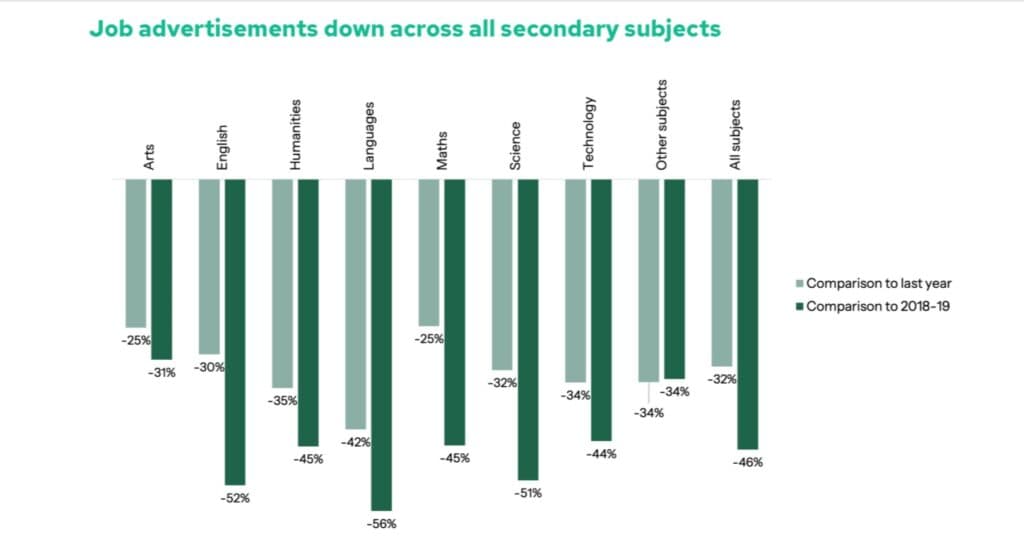
While the ethical dilemmas surrounding the growing number of PGCE graduates entering the new academic year without employment cannot be ignored, Initial Teacher Education providers are increasingly having to explain the reasons behind falling employment rates. Although Ofsted (2020) acknowledges that completion and employment figures are not reliable indicators of Initial Teacher Education quality, employment outcomes nonetheless remain central to future recruitment and to the public reputation of providers. In a turbulent and overstretched education sector, applicants may misinterpret a decline in job‑conversion rates as evidence of weaker provision, rather than recognising it as a symptom of wider systemic instability
A shrinking higher‑education pipeline
The British Academy Report on Inequalities in higher education offer across England highlights significant regional inequalities or ‘cold spots’ in access to language study, with many areas offering limited or no post‑16 provision. In 2025, 6,858 students took A‑level French, 8,325 in Spanish and only 2,224 in German. Even if every one of those students chose to study languages at university, there is a chance that they would have struggled to secure a place on existing courses across the country. University language departments have closed at an alarming rate over the last five years. As the new 2028–29 curriculum approaches and the pipeline of domestic languages teachers is shrinking, the question becomes unavoidable: where will the future domestic workforce of linguists come from if we continue to undervalue the expertise of our international workforce?
Why international teachers matter
As an international educator myself, I appreciate the contribution international teachers make through linguistic authenticity, cultural and grammatical expertise, creative and engaging pedagogies, but also supporting the diversity of pupils in English schools to feel represented. The Association for Language Learning Creativity in ML SIG has found that teachers teaching out of their subject specialism may feel less confident using authentic resources or designing creative, culturally rich lessons. Languages have the highest number of teachers teaching outside of their specialism (based on DfE data wehere teachers record on census having an A Level or degree in their subject(s) of specialism). This highlights the urgent need for more specialist languages teachers.
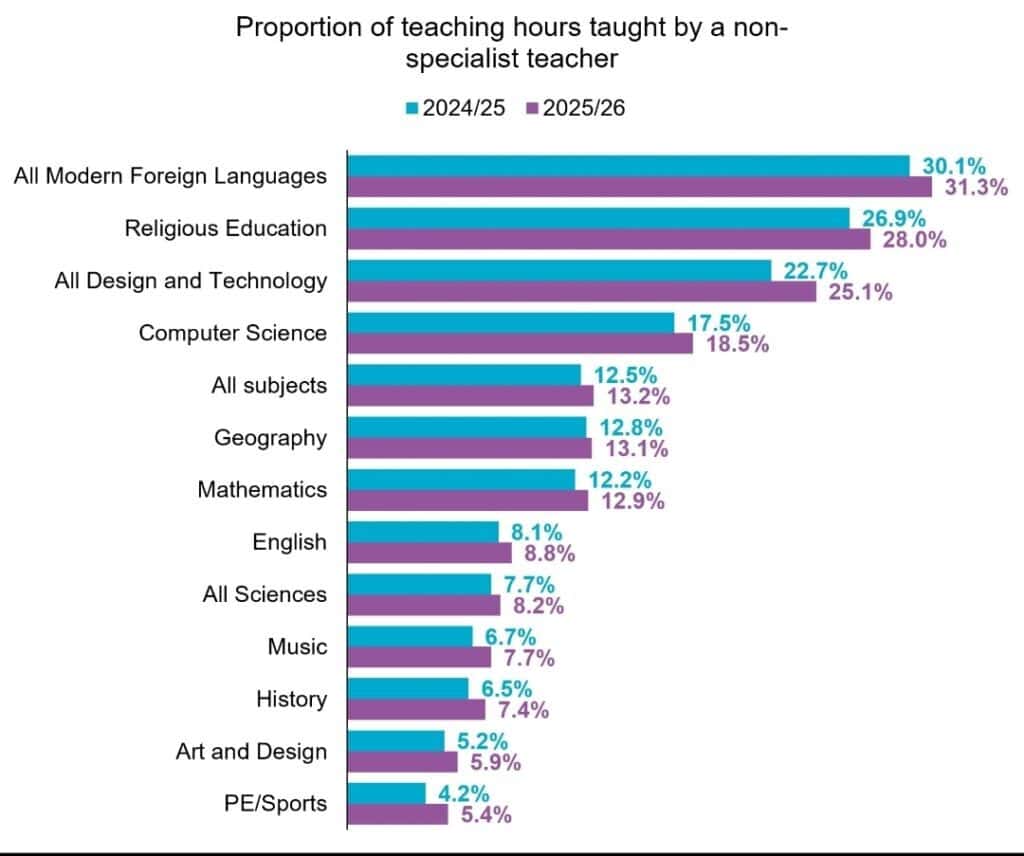
Whichever way we choose to look at this data, international teachers bring precisely the expertise that students need. Yet, as Panford (2026) warns in Languages, Society and Policies, we must guard against interest convergence. International teachers, especially international teachers of colour, should not just be welcomed in the country only when it is convenient and filling a gap in shortages. Although offers are related to demand, recognising the expertise and identities of international teachers as an integrated part of the teaching workforce is essential. International teachers deserve to be valued, to be financially and administratively supported and integrated as full members of the profession.
A system at a crossroads
Without international teachers, England will struggling to secure the future of Modern Languages in our schools. As numbers of A Level students in languages decline year on year, and universities close their languages and cultures courses, it is becoming increasingly difficult to study languages post-16 in English universities. As Stefan Collini reminds us of the dire financial state of UK Universities, the financial decisions to cut non-profitable languages courses in universities will inevitably impact the next generation of languages teachers in England in the next 10 years. If we are serious about fostering a love of languages in English schools, the recruitment of international specialist teachers becomes an essential key to that long-term strategy.
Breaking the cycle of languages being an elitist subject requires bold thinking and decision-making from our leaders. Recognising immigration as a force rather than a challenge would be the start of a truly inclusive society where internationals are valued and integrated from training to employment. Learning from other countries’ approaches international teacher recruitment may help us solve this puzzle.
Recommendations:
- Support schools to recruit, sponsor and retain international teachers. The future of languages in England depends on it.
- Consider a Three-year visa for internationals to align with the ITTECF (DfE, 2024)
- Consider a 10-year strategy to engage and motivate young people to study languages at GCSE and beyond





Comments
Jonathan Alltimes says:
Why does it matter from the perspective of the English national interest?
What you are describing is the waxing and waning of ministerial priorities since the 1990 Harris Report recommended compulsory modern foreign language teaching in the National Curriculum. Governments no longer agree that modern foreign language acquisition is economically essential to the same extent as they did in the past since the 1947 Scarborough Report and the response to war, in particular for maintaining networks. The universities and the (grammar) schools had a good fifty year or do run led by the pro-European project of the Nuffield Foundation, the University of Kent, and Middlesex University. Scarborough and Hayter did not envision the extent of language provision made compulsory in the comprehensive schools. I agree there should be some sort of MFL provision, but I do not agree MFL should be compulsory, in particular if pupils are not progressing in their command of English and Mathematics (schools will choose to specialise). The Academies have made the National Curriculum of less significance. The mechanics and finance of recruitment are repeatedly strengthening the accretion of ministerial priorities for employing British teachers in relation to a changing curriculum and school autonomy in which MFL is a lower priority. No doubt representations have already been made to ministers. One could try consulting the original government reports to see if their arguments have stood the test of time.
Reply
Vincent Everett says:
We need to step away from the idea that language learning is only valid with the added intellectual heft of essays (in English) and literature or linguistics. The academic study of the language. And recognise that language learning is something normal, enjoyable and popular. British young people are avid users of Duolingo. And learning other languages should be a pleasureable and exciting part of the experience of growing up and finding out about the world. We have a system that puts obstacles in the way of language learning at every turn. Unfair grading at GCSE. Lack of mainstream language learning pathways post-16. There are things we can do to remedy this rather than amplifying the narrative of “failure” or using it to push pet project solutions.
Reply
Replies
Vincent Everett says:
This is an excellent article by someone close enough to the situation to really understand what is going on.
Reply
Add comment