Language GCSEs in English schools: a postcode lottery?
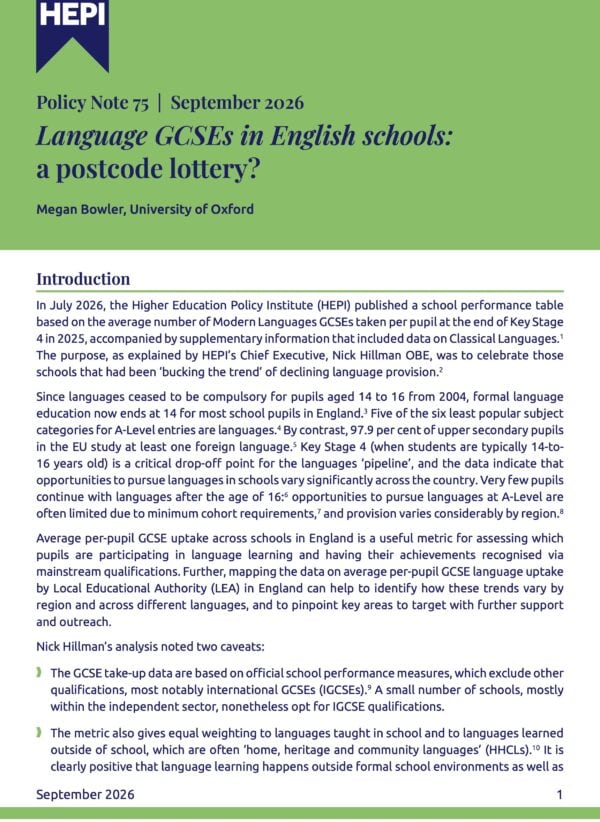
Reversing the “death spiral” in language learning: New report highlights severely unequal participation in language GCSEs.
A new Policy Note from the Higher Education Policy Institute (HEPI), Language GCSEs in English schools: a postcode lottery? (HEPI Policy Note 75) by Megan Bowler shows participation in language subjects at GCSE varies considerably across England after years of decline:
- overall, just 4.2% of non-selective state schools have an average of one language GCSE entry per pupil;
- the best performing Local Education Authorities (LEA) for language learning is Hammersmith & Fulham, which has an average of 0.86 language GCSE entries per pupil, while the worst area on the mainland is Blackpool (0.24); and
- provision of GCSE German is now scarce in mainstream state schools – seven LEAs now have no GCSE entries for German at all.
Megan Bowler’s analysis provides evidence that language education, language choices and formal recognition of progress are far from equitable. The uptake of languages at GCSE varies considerably school by school due to different internal policies, and participation is strongly impacted by socio-economic, geographical and academic barriers.
- Languages fare better in London, where the per-pupil GCSE entry average is 0.69; the average drops to 0.42 in the South West and the North East.
- Just 7.9% of schools and only 4.2% of comprehensive schools have an average of at least one language entry per pupil at GCSE.
- Grammar schools have an average of one language GCSE entry per student, which is more than double the average for comprehensive schools (0.48).
- GCSE participation in French, Spanish and German, which are the three main languages taught in schools, correlates strongly with socio-economic advantage. The average number of entries per pupil across these three languages is 0.36 in schools with the highest proportion of pupils eligible for Free School Meals (Quintile 5), compared to 0.57 in those with the lowest (Quintile 1).
- The inequalities at GCSE are even starker for German and classical languages: only 30% of comprehensive schools entered any pupils for German, and just 5.6% entered any pupils for Latin.
- Over one-fifth (21.6%) of school pupils have a first language other than English (EAL, ‘English as an Additional Language’), but pupils’ existing multilingualism continues to be under-recognised in formal qualifications.
The HEPI Policy Note argues that low undergraduate enrolments for language degrees should be seen as a consequence of these limited and unequal opportunities to gain exposure to languages at school, rather than as an indication of true demand.
Beyond schools that practise academic selection, those state-funded schools which still do relatively well in terms of language provision against the national trend tend to be: academies with a high expectation culture for all pupils; faith schools; schools which had a language specialism within the discontinued ‘specialist schools programme’; and schools that offer the International Baccalaureate (IB) Diploma (though the IB is now being defunded).
Boosting language participation would require some national policy fixes, including:
- facilitating the recruitment of language teachers from abroad;
- ensuring equitable exam marking so that pupils are assured they will not underperform in languages relative to other subjects; and
- considering a flexible stepped qualification pathway in addition to GCSEs.
However, a more localised approach is vital to address the specific needs and challenges faced within each Local Education Authority, and to target areas with the lowest participation with additional investment and outreach.
Megan Bowler, the author of the Policy Note, said:
For many pupils, language education ends before it has really begun. Yet engaging with language, communication and culture is a worthwhile educational experience for all pupils, regardless of how far they progress with it. Studying a language helps to develop oracy, critical thinking and an empathetic awareness of other cultures and perspectives.
This ‘linguistic mindset’ is going to become even more valuable in the age of AI – yet the opportunities to develop these modes of thinking, and for pupils to have their existing skills recognised, are patchy and unequal.
Rather than making irreversible cuts to teaching and research, the higher education sector should adapt by expanding opportunities for students to study languages from scratch and alongside other subjects. Universities should likewise consider how they can mobilise their staff, students and expertise to revitalise the languages pipeline in local schools through outreach and mentoring schemes, and to promote the value of languages in the community.
Nick Hillman, the CEO of HEPI, said:
When it comes to young people understanding the world, the biggest crisis facing our education system is the appallingly low take up of languages. We lag far behind every other European country.
Tony Blair’s Government stopped languages being compulsory for GCSE-aged pupils in England around 20 years ago, and school-based language provision has been in a death spiral ever since. Initiatives designed to halt the decline have not done their job.
However, there are some redoubts that have held out and they deserve to be celebrated, as this new report does. Moreover, in public policy terms, the decline in language learning could be relatively straightforward and inexpensive to reverse, if only we could find the will.
Just last week, one newspaper reported that the new Secretary of State for Education, Lucy Powell, thinks ‘vocational qualifications could help save modern foreign languages’. While there is confusion over what this might mean, a new focus on language learning would be welcome.
Notes for Editors
- The Higher Education Policy Institute (HEPI) aims to shape the higher education policy debate with evidence. UK-wide, independent and non-partisan, it is funded by organisations and universities that wish to see a vibrant higher education debate.
- Megan Bowler is a DPhil student and Lecturer in Classics at the University of Oxford. She is the author of two earlier HEPI papers: The Languages Crisis: Arresting Decline (HEPI Report 192, 2025); and A Languages Crisis? (HEPI Report 123, 2020).




Comments
Add comment