
Partnership Accountability and Institutional Resilience: The University of Wolverhampton approach
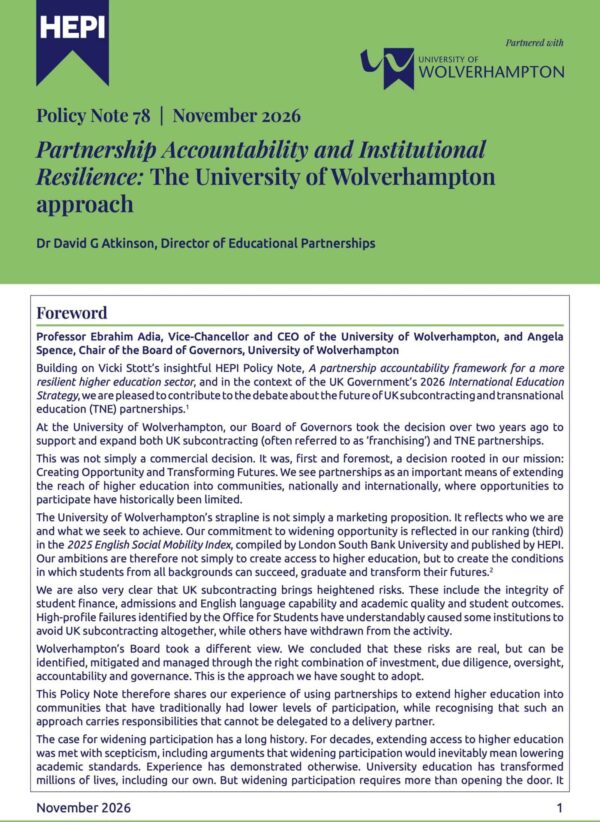
A Policy Note on Higher Education Partnerships: how they can deliver fair access to higher education, whilst protecting policy, public funds and student outcomes.
A new HEPI Policy Note from Dr David Atkinson, Director of Educational Partnerships at the University of Wolverhampton, sets out how well-managed higher education partnerships can be an essential part of delivering fair access, widening provision to people who can benefit from higher education.
The Policy Note, Partnership Accountability and Institutional Resilience: The University of Wolverhampton Approach, outlines how universities can manage the risks associated with UK subcontracting and transnational education (TNE) through strong institutional governance, investment and oversight.
There has been a huge growth in TNE partnerships and the number of franchised students in recent years, with regulation and oversight struggling to keep pace:
- Department for Education (DfE) figures show franchised student numbers rose from 50,430 in 2018/19 to 135,850 in 2022/23 – an increase of 169%.
- The National Audit Office’s January 2024 investigation into student finance for study at franchised higher education providers identified systemic weaknesses. In 2022/23, franchised provision accounted for 53% by value of the £4.1 million in fraud detected by the Student Loans Company (SLC), although students at franchised providers represented only 6.5% of SLC-funded students.
For the University of Wolverhampton, partnership provision is an important means of extending higher education into communities where opportunities are historically limited. Whilst not assuming regulation alone can solve the problem, its approach seeks to balance that commitment whilst managing risk, with clear institutional responsibility for students, standards and outcomes. The paper makes the case for ‘ambitious widening participation underpinned by strong accountability, investment and governance.’
Drawing on the University’s own Partnership Framework, it sets out an integrated approach covering the whole life of a partnership, from initial assessment and due diligence through to monitoring, intervention and, where necessary, closure. Specific measures include:
- New partners can only operate initially with one course, one site and one intake, with a maximum of 200 students.
- Partnership contracts incorporate performance requirements covering continuation, completion and progression. The University monitors performance against agreed institutional KPIs throughout the partnership lifecycle and uses it to inform decisions on growth, enhanced monitoring, and intervention.
- University-led Prepare for Foundation (PFF) Assessment Days across partner locations. The university requires potential students to attend in person and complete identity and proof-of-address checks, a written assessment and a structured assessment of capability, motivation, communication and engagement.
- The University monitors attendance and engagement through University-led processes, with University-led Registry audits testing the accuracy of partner attendance data. Partner students are included in University module and end-of-semester surveys, while partners provide biannual assurance reporting covering areas including Virtual Learning Environment (VLE) audits, teaching observations, continuous monitoring and improvement, marking and moderation and student feedback.
- Teaching, learning and assessment operate through the University’s VLE environment, including compulsory plagiarism detection. University module leadership provides scrutiny of Partner marking and moderation.
- Partner teaching staff must complete mandatory University training and receive approval to teach. This training includes specific requirements relating to artificial intelligence and academic misconduct, ensuring that partner staff are equipped to identify, prevent and respond to emerging risks to academic integrity.
- Partner students are registered on the University’s student records system and use its online learning platform to access teaching materials, learning activities and assessments. They also receive University email accounts and secure access to these systems. This gives the University access to attendance, engagement and assessment information and enables direct communication with students.
The approach is coordinated through a dedicated Educational Partnership Unit, with specialist University teams retaining responsibility for areas within their expertise. The University’s Board of Governors retains ultimate responsibility for ensuring partnerships are governed effectively and associated risks are managed in line with the University’s regulatory obligations and risk appetite.
Professor Ebrahim Adia, Vice-Chancellor and CEO of the University of Wolverhampton, said:
Fair access to higher education is at the heart of our mission. Partnerships are an essential part of delivering that ambition, widening provision and creating opportunities for people who can benefit from higher education, but who might otherwise face barriers to participating.
But widening participation is about much more than opening the door. We have a responsibility to create the conditions in which students can succeed, with the academic and pastoral support they need and with public funds, standards and student outcomes protected.
Partnership provision brings risks, and we should be open about those. The University of Wolverhampton Partnership Framework recognises the risks and seeks to mitigate through the right investment, due diligence, oversight and accountability.
We do not claim to have all the answers and solutions, and we recognise we will have partnership failings along the way. This report is published in the spirit of sharing practice, encouraging discussion, receiving feedback and helping to improve the sector’s approach to sub-contracting.
Rose Stephenson, Director of Policy and Strategy at the Higher Education Policy Institute, said:
Franchised provision of higher education in England has been criticised for poor-quality teaching, unfavourable student outcomes and, in the most extreme cases, fraudulent use of public money. However, franchised provision can also reach students historically underserved by the higher education sector. This paper shows that rigorous oversight, monitoring and governance by a lead provider can ensure that delivery partners uphold high-quality provision. This not only facilitates the access some students need but also safeguards the outcomes they deserve.
Notes for Editors
- The University of Wolverhampton’s Partnership Control, Compliance and Assurance Framework brings together governance, risk management, compliance monitoring and institutional oversight across the partnership lifecycle, with assurance provided to the Board of Governors and Audit & Risk Committee. New partnerships are subject to controls including a maximum of 200 students, one course, one site and one intake. Safeguards include a minimum £200,000 step-in deposit per partnership per campus, student-number controls and financial protection arrangements.
- HEPI was founded in 2002 to influence the higher education debate with evidence. We are UK-wide, independent and non-partisan. We are funded by organisations and higher education institutions that wish to support vibrant policy discussions, as well as through our own events. HEPI is a company limited by guarantee and a register




Comments
Add comment