
Subject to change: Differing trends in degree classification at the subject level
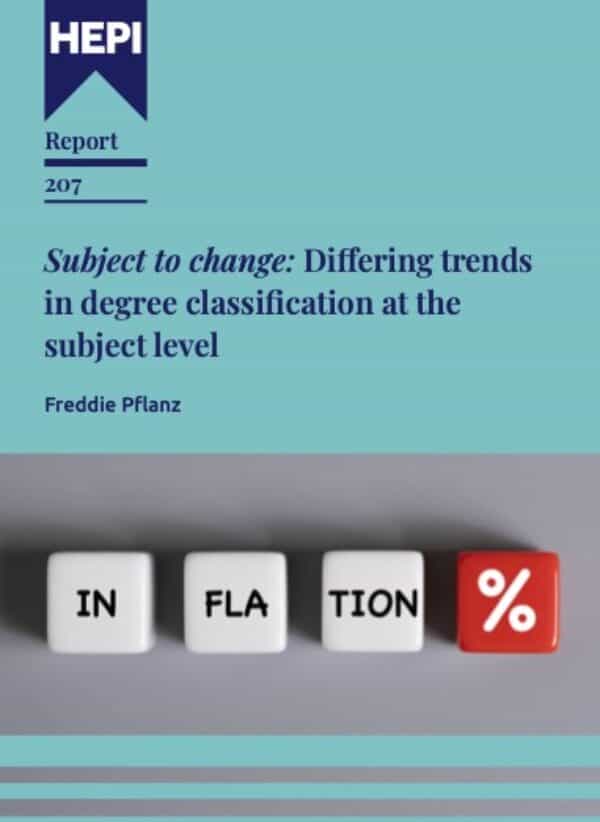
Ten-year analysis finds striking differences in grade inflation across subject areas.
Subject to Change: Differing Trends in Degree Classification at the Subject Level, authored by Freddie Pflanz, examines the national picture in degree classification trends by subject between 2015-2025. The analysis, using data from the Higher Education Statistics Agency (HESA), finds striking variation between subjects.
- Classification rises are taking place across the board. Between 2015-2025 the share of Firsts rose from 20.6% to 27.8% and the share of those receiving Firsts or 2:1s rose from 67.0% to 73.4%.
- However, the picture is not equal. Subjects in, Applied Sciences, Creative Arts and Computing saw increases in top classifications (Firsts and 2:1s) of over 10 percentage points.
- Comparatively, the rise in top classifications in highly quantitative Science subjects saw increases of under 3 percentage points. Traditional Humanities subjects such as History, Philosophy and Languages have seen slightly above-average increases in Firsts but low increases in combined Firsts and 2:1s. Medical Sciences were the only subject area to see a decrease in Firsts and 2:1s.
- On the whole, subjects which have had the greatest increase in the shares of Firsts and combined Firsts and 2:1s have tended to be those which started with lower shares in 2014/15, meaning there is now less variation.
- Regardless, this could create lasting disadvantages for students purely on account of their subject choices, and lead to negative perceptions of certain subjects.
- Top grades at A-Level, where assessment is largely by in-person examination, did not rise as quickly as top degree classifications from 2015 to 2025.
Furthermore, the report argues that this variation cannot be entirely explained by factors such as student attainment, teaching quality and assessment accuracy improving more in some subjects than in others. Instead, some of it is likely due to greater grade inflation in these subjects. Some students are being rewarded, and others penalised simply on account of the subject they chose to study.
The report identifies assessment methods as a cause. The subjects which have seen the lowest increases in top classifications have retained an emphasis on traditional in-person examinations. For example, core modules in Mathematics and Physics at Russell Group universities will typically have at least 90% of the mark determined by in-person examinations.
The report makes a series of recommendations to ensure students choosing subjects with lower levels of grade inflation aren’t disadvantaged, and to pre-empt perceptions of ‘soft’ subjects:
- Strengthen the external examiner system.
- Higher education providers should take steps to ensure comparability of assessment methods across different subjects within the same provider.
- Higher education providers, in conjunction with subject-specific academic and professional bodies, should take steps to ensure comparability of content and assessment methods within the same subject at different providers.
- Regulators and providers should introduce tests taken by a sample of finalists studying the same subject at different providers in order to monitor standards in the same subject across different providers.
- Providers and sector bodies should continue to implement the measures they have already taken to address these issues and ensure that they are applied equally across different subjects.
Freddie Pflanz, report author, master’s student and former HEPI intern said:
Undergraduate students deserve to receive equal recognition for the quality of their work regardless of the subject they chose to study. This report shows that this has unfortunately not always been the case over the last ten years. Not only does this have a direct and unfair impact on the individual students affected, but it has the potential to exacerbate broader issues within the higher education system. In an era in which public trust in higher education is being called into question and graduates face a tough job market, it is more important than ever to safeguard the integrity of the degree classification system as a marker of the quality of UK higher education.
Notes to editors:
- HEPI was founded in 2002 to influence the higher education debate with evidence. We are UK-wide, independent and non-partisan. We are funded by organisations and higher education institutions that wish to support vibrant policy discussions, as well as through our own events. HEPI is a company limited by guarantee and a registered charity.
- Freddie Pflanz is a master’s student in Philosophy at New College, University of Oxford. He previously completed his undergraduate degree in Philosophy, Politics and Economics, also at New College. He completed this report while he was an intern at HEPI in the summer of 2026.




Comments
Add comment