2026 Soft Power Index
The US and UK lead the world in soft power: ‘The HEPI Soft-Power Index – 10th edition’ shows far more world leaders were educated in America and Britain than in other countries.
HEPI and Cambridge University Press and Assessment is publishing The 2026 Soft-Power Index: 10th Anniversary edition (HEPI Report 206) by Nick Hillman OBE, which looks at where today’s VVIPs (Very Very Important People) were educated. Over the 10 years since the annual Index began, the United States has overtaken the UK and then built up a substantial and enduring lead over all other countries: in 2026, 66 world leaders were educated in the US while 60 were educated in the UK;France remains in third place, having educated 29 world leaders, while Russia follows in fourth place, having educated 12 serving world leaders; andAustralia and India tie for fifth place, having educated eight world leaders apiece. When looking at the results by institution, rather than just by country, the top three are: Harvard University; the University of Oxford; and the Royal Military Academy Sandhurst.
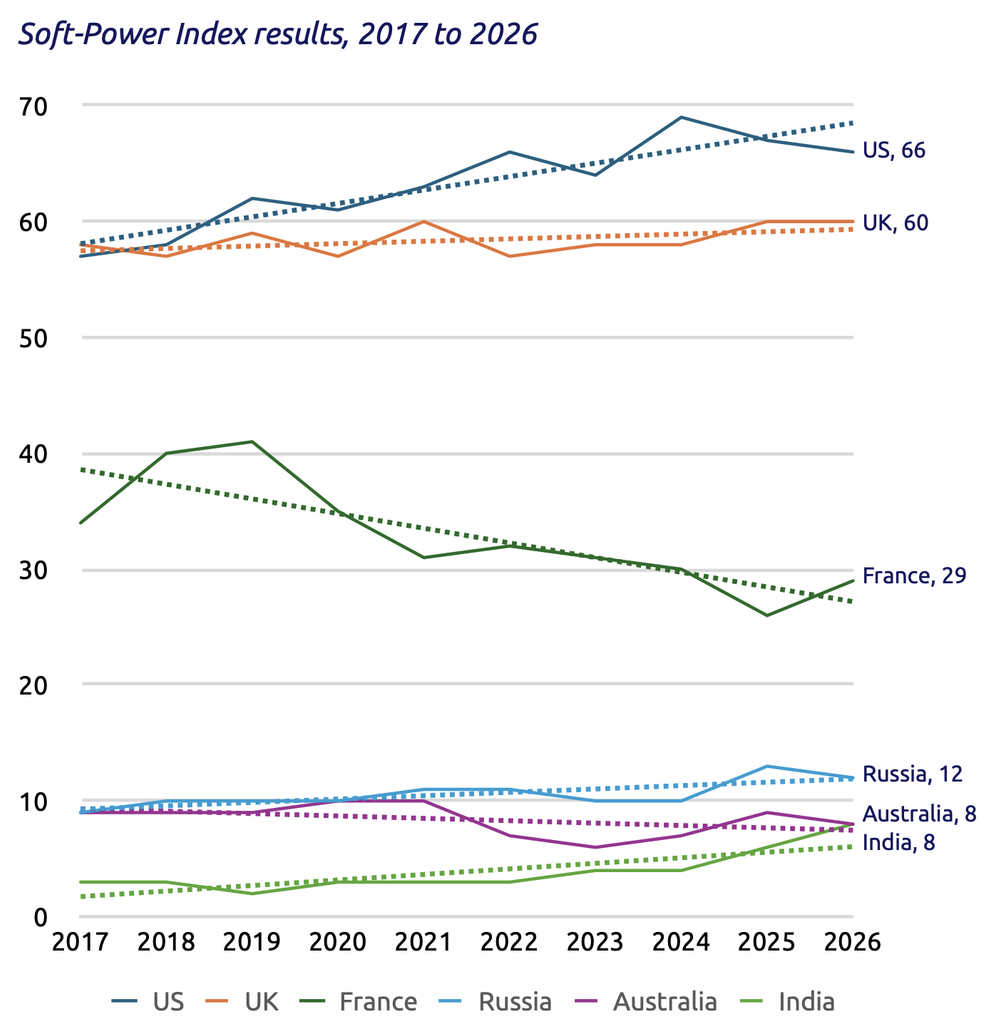
The Soft-Power Index has come to be widely regarded as a useful proxy for measuring different countries’ level of influence and the impact of the Index has gradually grown over the past decade. It is regularly cited in official reports, including England’s Post-16 Education and Skills white paper (October 2025) and the UK Government’s International Education Strategy (January 2026) and has also been influential with officials in the UK’s Foreign, Commonwealth and Development Office as well as overseas.
The new Report quotes a Chevening Scholar, Naimat Zafary, who was on the last British evacuation flight from Kabul as the Taliban re-took control and who will be speaking at one of HEPI’s events at the Labour Party Conference in Liverpool on Monday, 28 September 2026:
I have seen firsthand how hard power shatters lives. But the alternative soft-power of education possesses a quiet, enduring power to heal. And the healing that this may and can bring about is what is needed most in such societies and communities.
To mark the 10th anniversary, the Index is being published as a full HEPI Report for the first time. This includes a look at the history of international students in the UK, from the arrival of the first one – Emo of Friesland at the University of Oxford in ‘around 1190’ – to the current tightening up of the rules on international students through tougher Basic Compliance Assessments, a shorter Graduate Route visa and, in England, an impending International Student Levy.
Nick Hillman, CEO of HEPI and the author of the new Report, said:
International students come here, contribute to our economy and society and then tend to go home again with warm and enduring thoughts about the UK. The benefits fan out over many decades, with many former students at UK universities rising to the very top of their own home nations – including 60 current world leaders.
Policymakers are always keen to publicise Britain’s place in the world, but the reckless restrictions on international students currently being applied via the Home Office under the tougher Basic Compliance Assessments are not fit-for-purpose and are already doing real damage that will show up in years to come.
The Prime Minister saw the benefits of hosting international students up close in Greater Manchester when he was the Mayor, but the same benefits exist all over the country.
Francesca Woodward, Global Managing Director for English at Cambridge University Press & Assessment, said:
Anyone serious about soft power needs to get serious about universities. Successful higher education projects global influence.
HEPI’s Soft Power Index offers a fascinating snapshot of where world leaders studied, and an indication of the lasting impact of universities’ internationalism.
After a decade, we can see the shifting balance of soft power and global higher education. The UK’s ability to punch above its weight is striking in its resilience. Policymakers would be wise to nurture and support the country’s outward-looking universities.
Notes for Editors:
- The author of the new Report, Nick Hillman OBE, has been the Chief Executive of the Higher Education Policy Institute (HEPI) since January 2014.
- The Higher Education Policy Institute (HEPI) aims to shape the higher education policy debate with evidence. UK-wide, independent and non-partisan, it is funded by organisations and universities that wish to see a vibrant higher education debate. HEPI is hosting a series of events at the Labour and Conservative party conferences, including on the topic of soft power. Further details can be obtained on the HEPI website at https://www.hepi.ac.uk/events/
- The Report has been sponsored by Cambridge University Press and Assessment, which spreads knowledge, sparks curiosity and aids understanding around the world through qualifications, assessments, academic publications and original research.
- For further important background information on the current tightening up of the Basic Compliance Assessments, see Jack Grove, ‘V-cs seek answers over “late surge” in UK student visa refusals: Growing numbers of institutions expected to have breached new compliance rules, endangering future recruitment prospects’, Times Higher Education, 23 September 2026


Comments
Jonathan Alltimes says:
How likely is soft power?
The soft power causal model: country-specific higher education causes country-specific values to be followed by students from other countries which causes the country of the higher education to influence the country of the international student. What are the causal processes in higher education for country-specific values to be valued by international students?
The ideas of Joseph Nye are themselves a model of political control using a theory of economic rationality. Its theoretical power can be tested by whether any country has been able to control other countries with their purely moral authority about their values so that the other country agrees with the values which determine the agreed outcomes. The model assumes scope for value choices in the home country.
Our English national civic values were eventually codified as rules in the Declaration of Right of 1689, after three constitutional wars and numerous conflicts since 1066. The USA subscribed to those civic values among others in its Declaration of Independence of 1776. The codification assumes a cultural heritage within which the values were selected. Cultural heritage is not abstract, it is lived in the lives of people. We call these non-codified traditions of truth, modes of life. If these modes of life are rejected, so will be the values. It is the traditions in higher education which must be followed before the values, as shown in the person of the academic. If the academic is rejected, so is the tradition. As a model, are the traditions of English academics and students and their relationship to each other followed by international students? The traditions must be distinct ftom those of the international students. The intellectual turmoil in higher education is a consequence of a rejection of our traditions and a conformation to other traditions separate from our English civic values.
Soft power is unlikely, except among countries which follow the same traditions of truth and civic values.
Reply
Add comment