
A partnership accountability framework for a more resilient higher education sector
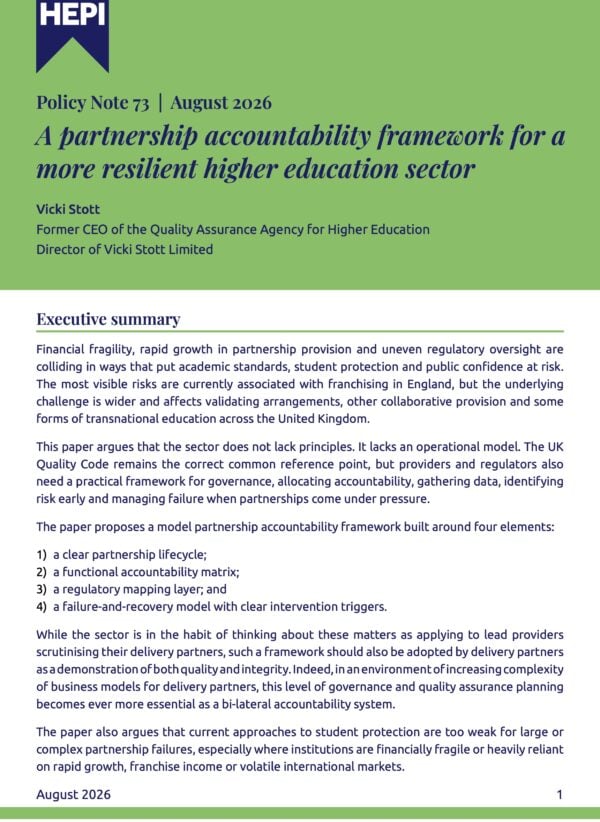
New HEPI paper calls for a partnership accountability framework to protect students and standards.
A new HEPI Policy Note by Vicki Stott, A partnership accountability framework for a more resilient higher education sector (HEPI Policy Note 73), warns that rapid growth in franchised and other partnership provision is colliding with financial fragility and uneven regulation, putting academic standards, student protection, and public confidence at risk.
The author notes that the most visible problems have centred on franchised provision in England, where student numbers have more than doubled in recent years and where a high proportion of detected Student Loans Company fraud has occurred, but stresses that the underlying challenges extend across validation arrangements, other forms of collaborative provision and some transnational education. While partnerships remain vital for widening participation, local access and specialist delivery, the paper concludes that the sector has tolerated too much ambiguity about who is accountable for key decisions, what data are needed to manage risk and how students will be protected if partnerships fail.
The paper argues that the UK does not lack principles for managing partnerships but lacks an operational model that can cope with a harsher financial and regulatory environment. It proposes a practical partnership accountability framework built around four elements:
- a clear lifecycle for partnerships;
- a functional accountability matrix;
- a regulatory mapping layer; and
- a failure‑and‑recovery model with clear triggers for intervention.
The proposed framework should be sector‑owned and adaptable, rooted in the 2024 UK Quality Code for Higher Education but going beyond existing guidance by specifying how institutions should allocate responsibilities, gather and use data, and plan for failure and recovery. It calls on providers, regulators and sector bodies across all four UK nations to strengthen operational use of the Quality Code in partnership settings, sharpen risk‑based oversight and reform the way higher‑risk franchising and data are handled.
Stott asserts that partnership governance can no longer be treated as a niche technical concern delegated to quality teams but must be seen as integral to institutional resilience and public trust. It suggests that, unless the sector adopts a more concrete and consistent approach, governments and regulators are likely to respond with more detailed, externally imposed controls on partnerships.
Vicki Stott, Former CEO of the Quality Assurance Agency for Higher Education, Director of Vicki Stott Limited and author of this report, said:
In a harsher financial and regulatory climate, partnership governance is no longer a niche technical concern – it is part of the sector’s front‑line duty of care to students, standards and public trust. This paper argues for a sector-owned framework to enable providers translate guidance into operational discipline, so that growth through partnerships strengthens resilience instead of amplifying risk.
Rose Stephenson, Director of Policy and Strategy at HEPI said:
Partnerships of many forms are playing an increasing role in higher education. This new way of working brings challenges for governance, accountability and student protection. As partnership models become more complex, the sector needs practical solutions rather than another round of abstract principles.
This paper advances the debate by sketching a future framework for institutions to strengthen oversight, manage risk, and protect academic standards. It shows how universities can take the lead in improving partnership governance, rather than waiting for further regulatory intervention.
Notes to editors
- The Higher Education Policy Institute was founded in 2002 to influence the higher education debate with evidence. HEPI is UK-wide, independent and non-partisan. HEPI is funded by organisations and higher education institutions that wish to support vibrant policy discussions, as well as through events. HEPI is a company limited by guarantee and a registered charity.





Comments
Jonathan Alltimes says:
What is the evidence of promise keeping by higher education and for individual universities, providers, franchisers, and franchisees?
A franchise is effectively a transfer of the reputation for quality of an output from the franchisor to the franchisee through a licence to use the operational model for making and selling the output. Students subscribe to the reputation for quality of the franchisor, while assuming the quality of operations matches the franchisor. What are the published general standards for all franchise operations and those specific to a particular franchise?
A franchise operation only has to match the general OfS standards for registration:
https://www.officeforstudents.org.uk/for-providers/registering-with-the-ofs/registration-with-the-ofs-a-guide/conditions-of-registration/
The general government policy is stated here:
https://www.gov.uk/government/publications/franchise-arrangements-for-higher-education-providers/franchise-arrangements-for-higher-education-providers#franchising-in-higher-education
There are no required general operational standards. The standards may only be specified in the contract licence between the franchisor and the franchisee or not.
How much is the proposed operational model likely to cost over several years, in terms of totals and unit costs? The other way of working out whether to enact or continue to sell a franchise licence is to calculate the cost of the particular operational model and then compare it with the likely operational budget.
Now the problem with the franchise model when applying it to academia is the particular academics are the operational model and not simply their way of working. The principles described are nothing to do the particulars of higher education and academia. The vague principles could in theory be ascribed to all sorts of routine commercial relationships between contractors and their subcontractors, as if the substance of the work has nothing to do with the form of its operation and the peculiarities of the specific subject are of no consequence for the quality of operations. Franchises work for standardized outputs with no variation in quality caused by the production processes or exchange between the customer and the business, as the materials or the service actions and their output designs do not vary in production caused by their interactions.
Reply
Add comment