
Demographic decline and predatory recruitment: The twin threats to English higher education into the 2040s
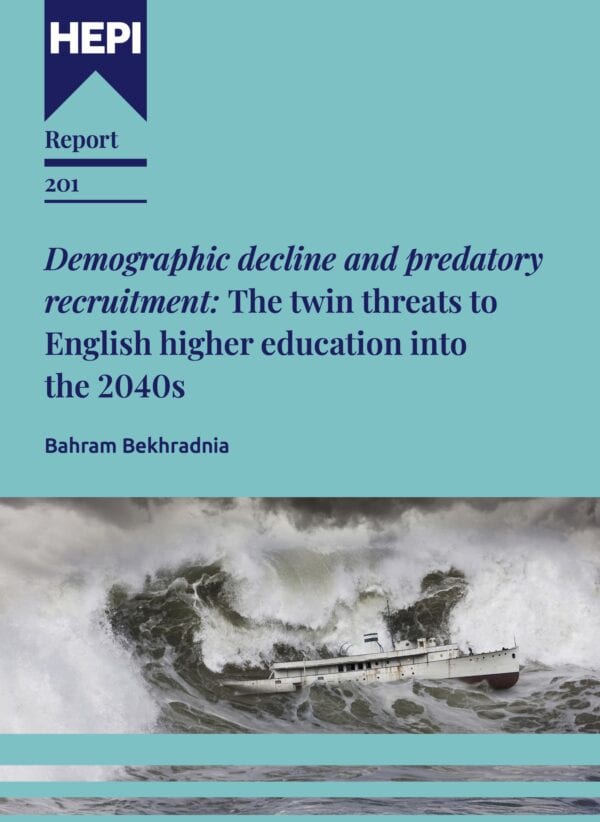
A combination of demographic decline and predatory recruitment practices puts the entire English higher education sector at risk.
This new report from the Higher Education Policy Institute (HEPI), Demographic decline and predatory recruitment: The twin threats to English higher education into the 2040s (HEPI Report 201) by Bahram Bekhradnia, shows that the young population from whom 80% of undergraduate students are recruited, will decline rapidly after 2030, and within 10 years the income universities earn from this source will, overall, decline by nearly 20%.
However, as things stand this decline will not be evenly felt. Over the past decade, the real value of the student fee has reduced by between 25% and 30%, and in response the most prestigious universities (those designated ‘higher-tariff’ by UCAS) have been recruiting students whose school achievement is lower – in some cases much lower – than they would previously have considered. In doing so they have increased their own intake but reduced the pool of students who might otherwise have attended other universities.
While the 18-year-old population was increasing (as it will continue to do for four more years), some of the non-higher-tariff universities have maintained their numbers (although many have not). However, when the demographic decline sets in after 2030, and if the higher-tariff universities continue their recent recruitment practices, the rest of the sector will face real problems. The report produces three scenarios, on all of which the non-higher-tariff universities suffer significant losses, and on two – those considered most likely – they will lose over 25% of their undergraduate student income.
That would be unsustainable and, in the words of the report ‘perfectly good universities – institutions that are doing an excellent job and adding real value for the students they recruit and the regions they serve – may fail, and a critical part of the national infrastructure will be damaged.’ The report concludes that policymakers have a choice – to allow such an outcome by letting the market alone determine the future shape of higher education or to impose a limited curb on student recruitment by the institutions concerned– mirroring student number controls implemented in the 1990s.
Key findings
- Unless the proportion of the young population opting to go to higher education increases (which there is no sign of at present – if anything the reverse), then the population decline from 2030 will mean a reduction by the late 2030s of nearly 20% in the number of students and therefore the principal income source of the majority of universities.
- In recent years, and in order to maintain their income, higher-tariff universities have increased their recruitment of students with the equivalent of three A-Levels at grade B and lower. These now represent nearly 30% of all students recruited to higher-tariff institutions – double the 15% of such students recruited in 2016.
- This recruitment has been at the expense of non-higher-tariff universities which collectively have struggled to recruit despite the young population increase.
- Put another way, 30% of all students with the equivalent of three Bs and lower at A-level now attend higher-tariff institutions – up from 22% in 2016, an increase of more than one third.
- If higher-tariff institutions were to hold their student numbers at current levels and suffer the consequences of the demographic downturn along with all other institutions, they will suffer on average a 20% reduction in home undergraduate income.
- If as on recent experience seems more likely, higher-tariff institutions seek to maintain their income by recruiting increasing numbers of lower achieving students then non-higher-tariff institutions will on average lose up to 29% of their income from home undergraduates.
Bahram Bekhradnia, President of HEPI and author of the report, said:
This analysis tells a very serious story which needs to be taken seriously by policymakers and by those who govern and run universities. HEPI’s engagement with many governing bodies around the country suggests this reality is not being taken into account as future plans are made.
The numbers are not negotiable. The forthcoming decline in the young population will almost certainly mean a decline in student numbers and therefore in income, and on certain scenarios the decline in income of the non-high-tariff universities could be in the order of 29%. That is not sustainable and would lead to the failure of multiple universities.
The higher-tariff universities cannot be blamed for seeking to protect their income, and policymakers will need to decide whether the consequences described in this report will be acceptable. The alternative is some form of student number controls imposed on individual institutions.
Nick Hillman, Director of HEPI, said:
The coming demographic drop is among the biggest of the many pressures facing higher education institutions. As many wise people have said before, “Demography is destiny”.
Every single university manager and governor needs to think about what their institution will look like, and whether it can even survive, in the coming 2030s.
In addition, policymakers need to solve one of the great mysteries of our time – what happens when a university folds.
Notes for Editors
HEPI was founded by Bahram Bekhradnia in 2002 to influence the higher education debate with evidence. We are UK-wide, independent and non-partisan. We are funded by organisations and higher education institutions that wish to support vibrant policy discussions, as well as through our own events. HEPI is a company limited by guarantee and a registered charity.





Comments
Jonathan Alltimes says:
A managed decline is inevitable, as it signalled in the 2025 ‘Post-16 education and skills’ white paper. The response of the government to the challenges including demographic is:
“Our ambition is to have a more sustainable, more specialised and more efficient sector, better aligned with the needs of the economy. By improving access, driving collaboration, fostering the conditions for excellent research and strengthening expertise, we will place the sector on a stronger footing to support growth and deliver for local economies.”
No specific measure is described to deal directly with the decline in student numbers, including funding. Given the financial constraints on the government and more inflation, we will not see a restoration of the value of tuition fees in the current parliament and it is unlikely in the next parliament. The white paper is indicating a shift towards further education, particular with its focus on collaborations, possibly preceding mergers, which is made more likely by the financial crisis of so many providers. The alternative of student number controls would be a reversal of more student choice and competition without the need to refer to the idea of a market for higher education. The removal of the control has revealed the competitiveness of providers. The weak financial position of most providers, the demographic change and the constraints of weak economic growth and inflation are most likely to speed up mergers before the 2030s at a faster rate than foreseen in the white paper.
Finishing with another quote from the white paper:
“At the provider level, we challenge providers to specialise in areas of strength within this more collaborative system, with clearer roles for teaching- and research-intensive institutions with areas of specialist advantage, and stronger access and participation.”
Reply
Gavin Moodie says:
I haven’t read the full report, but I didn’t read in the blog evidence of ‘predatory recruitment practices’. Simply admitting applicants with lower entry tariffs is not predatory, but responding naturally to falling demand.
The Government may argue that lower demand from traditional students should encourage institutions to change their offerings to recruit more actively non traditional students, which the lifelong learning entitlement is designed to encourage.
Reply
Add comment