
The invisible majority: Professional and support staff and the future of UK higher education
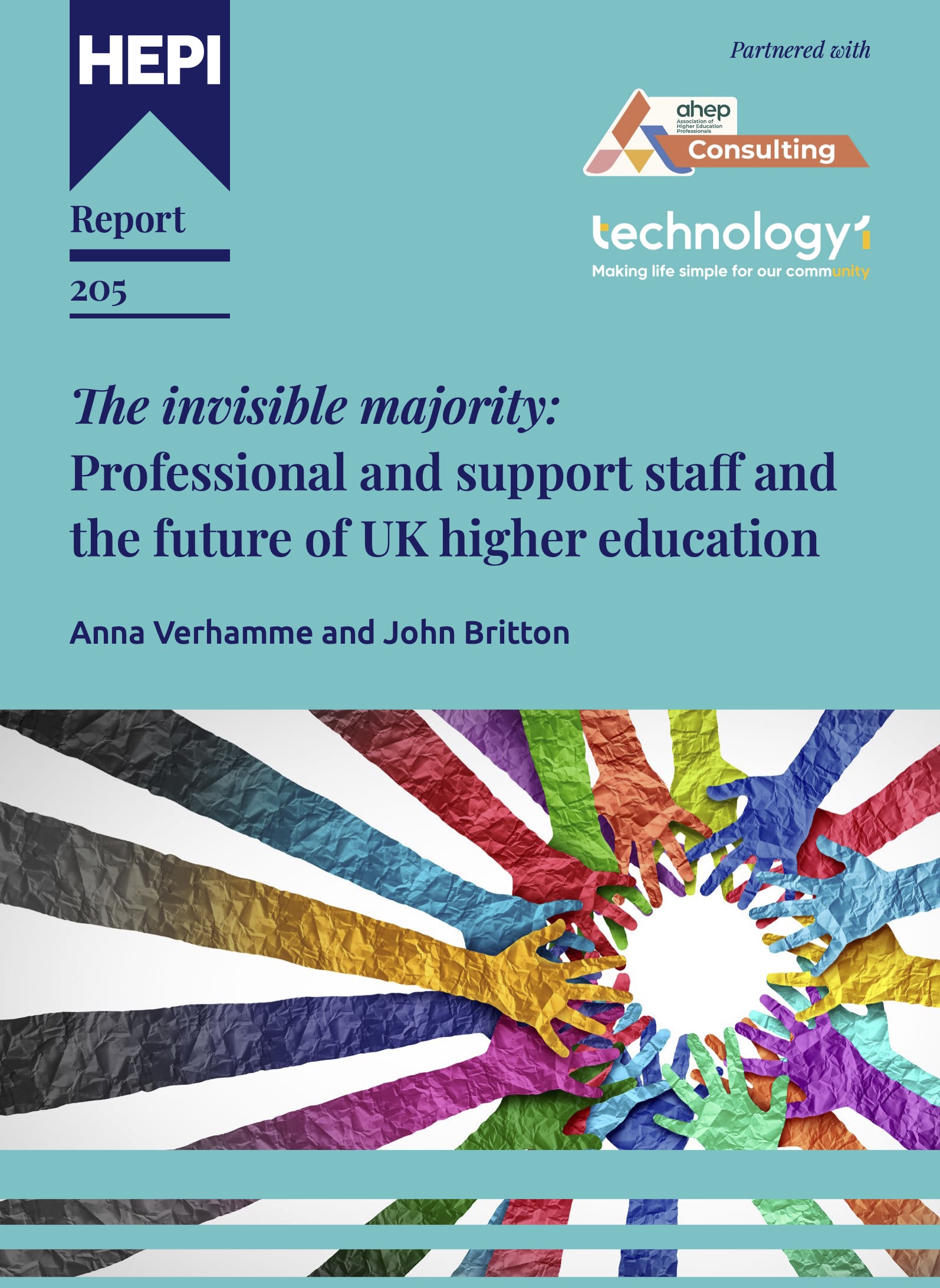
Universities are cutting the skills they need most, then paying to rebuild them.
Universities are cutting the skills and capabilities they need most, only to pay to rebuild them later, according to new research into the professional and support staff who make up the majority of the UK higher education workforce.
The invisible majority: Professional and support staff and the future of UK higher education (HEPI Report 205), published by the Higher Education Policy Institute (HEPI) in partnership with AHEP Consulting, examines the pressures facing the professional and support staff who underpin the day-to-day running of universities.
The report finds training budgets are often treated as an easy saving, while restructuring and hiring freezes can erode institutional capability. It also highlights the importance of investing in the people and processes needed to realise the full benefits of new technology, with institutions that underinvest in process redesign and training risking missing out on the efficiencies new systems can deliver.
The research was sponsored by TechnologyOne and undertaken by AHEP Consulting, the consulting arm of the Association of Higher Education Professionals, formerly the Association of University Administrators, which has supported staff in professional services roles across the sector since 1961.
Written by Anna Verhamme and John Britton, Lead Consultants with AHEP Consulting, the report draws on two surveys completed by 450 respondents between December 2025 and January 2026, analysis of 50 institutional annual reports and interviews with senior professional services leaders.
In 2023, 255,678 full-time equivalent professional and support staff made up 56% of the UK higher education workforce. They run student services, maintain buildings, administer research grants, manage compliance and operate the digital systems on which universities depend.
One respondent to the survey conducted as part of the project described the pattern identified in the report:
We have a lot of broken processes and inefficiencies. Every time we make salami-slicing cuts to staff, it gets worse … We CAN unlock that capacity, but it requires continuous improvement roles, which have been made redundant.
Another respondent highlighted the consequences of cuts to training:
Training and development budgets are easy targets for cost saving, but by not developing staff you’re not enabling more effective delivery of services.
Key report findings:
- Institutions cut training budgets as an easy saving, then find they lack the capabilities they need. Where those skills have not been developed internally, they must be bought in externally at higher cost.
- Restructuring itself is expensive, with institutions hiring consultancies to lead the work and bringing in change managers, while redesigned structures can add management layers rather than remove them.
- The full benefits of technology investment can be difficult to realise when institutions do not invest in the process redesign and training needed to make new systems work effectively. As a result, specialist staff remain essential while administrative roles expected to shrink continue to be needed.
- Two-thirds of respondents said change and uncertainty over the past five years had affected them negatively, with the burden falling hardest on the lowest pay band: 79% of staff earning below £40,000 reported negative impacts, compared with 51% of those earning £60,000 or more.
- Because lower-paid roles are disproportionately held by women and ethnic minority staff, these impacts fall on groups already facing persistent pay gaps.
- In Scotland, 81% of respondents said change and uncertainty had affected them negatively, against just under two-thirds across the UK as a whole. Universities Scotland calculated that 2025/26 allocations left 17 of the country’s 19 higher education institutions with a real-terms reduction in teaching funding, though the survey cannot establish a connection.
- Three-quarters of respondents reported work that is fragmented, reactive, deadline-driven and sustained at high intensity.
- 60% of respondents still described their day-to-day work as ‘good’ or ‘very good’, which the report warns should not be taken as reassurance: a workforce that has continued to perform under sustained pressure is not evidence that the pressure is sustainable.
- No one can see this workforce clearly, as only 125 of the 228 providers returning staff data to HESA in 2023/24 reported on all their non-academic staff, while those employed through subsidiaries and outsourced contracts do not appear at all.
The new report calls on providers to design jobs that work, implement digital systems with staff rather than to them, develop managers with the skills to lead people and run services effectively, build career frameworks with the infrastructure to support progression, and create fair and transparent reward structures.
It makes five recommendations to government and sector bodies:
- Commission an independent review of the Higher Education Role Analysis framework, the job evaluation system used by 70% of UK universities and unchanged in structure since 1995.
- Require separate gender pay gap reporting for professional services and academic staff.
- Require providers in England and Northern Ireland to report data on all their non-academic staff to HESA, as was compulsory before 2019/20.
- Create a What Works centre for higher education workforce development, funded through a mixed model drawing on sector bodies, providers and private sector partners alongside the Department for Education or the Office for Students.
- Remove the VAT barrier that makes shared services more expensive than delivering in-house.
The report concludes:
Universities are comprised of everyone who works in them. It is time to invest in all those people.
Nick Hillman, CEO of HEPI, said:
Professional services staff keep higher education institutions running. Without them institutions would not be ready for the influx of new students arriving this autumn let alone all the other roles they fulfil.
The roles professional services staff play are also ever more important, as regulatory burdens and the expectations of students, society and policymakers continue to increase. Perhaps that is why they now outnumber academic staff.
Yet professional service roles are still often performed under the radar, meaning the staff that fill them can be taken for granted. This can result in unclear career progression routes and insufficient training as well as heightened risk of redundancy.
It is time for a new and more professional approach to professional services staff – one that more fairly reflects their true worth and which delivers benefits for all.
Amanda Owen-Meehan, Consulting Director at AHEP Consulting, said:
Many respondents answered our surveys at far greater length than the questions required, and what they wrote shapes every section of this report. What they describe is a workforce holding a great deal together with very little designed around it.
Reducing the cost of professional services is reasonable in the present climate. But it is a different question from asking what the strategy depends on and how to build that within the money available. The first question produces a smaller workforce. The second produces one that can do what is asked of it. And none of this is an argument that professional services matter more than teaching and research. The two workforces succeed or fail together.
Cheryl Watson, Vice-President of Education at TechnologyOne, said:
The findings reinforce that technology investment alone is not enough to deliver lasting transformation. Universities need to invest in the people, processes and skills that enable new systems to deliver their full potential. When process redesign and training are overlooked, institutions risk missing out on the efficiencies and capacity that technology can unlock.
Professional services teams are central to making this transformation successful. They understand how services operate, manage and configure the systems that underpin them, and play a critical role in embedding new ways of working. Giving these teams the time, skills and authority to lead change is essential to turning technology investment into meaningful, lasting value for universities.
Notes for editors
- Survey One drew more than 400 responses from professional and support staff on their experience of work. Survey Two asked 50 respondents to identify unresolved challenges and areas of workforce practice that need to change. Both ran between December 2025 and January 2026.
- AHEP Consulting works to the principle of ‘of the sector, for the sector’. Its consultants have run the services they advise on, many at senior level.
- TechnologyOne is a global Software as a Service (SaaS) provider delivering enterprise solutions that simplify and transform operations. With offices across six countries, our deeply integrated SaaS platform supports over 1,300 organisations worldwide. Our solution provides deep functionality for the markets we serve, including local government and higher education in the UK. We leverage our unique domain experience and our unwavering commitment to the industries we serve by taking complete responsibility to deliver outcomes with our best-in-class SaaS ERP (Enterprise Resource Planning). With SaaS Plus, TechnologyOne takes full responsibility for the complete outcome of the solution experience, not just the software.
- HEPI was founded in 2002 to influence the higher education debate with evidence. We are UK-wide, independent and non-partisan. HEPI is a company limited by guarantee as well as a registered charity.





Comments
Jonathan Alltimes says:
Bureaucratic choices cause better conditions of employment for professional services in higher education through managerial practices. Who is the audience for the report?
The fourth institutional power causing the situation is the provider themselves and it is an endogenous cause, rather than the three exogenous sources controlling professional services work: digital complexity; regulatory intensification; and costs restructuring. The report assumes the organizations are capable of managing the causes, including themselves. The recommendations do not deal with the opposition to institutional capabilities for reorganization. The fifth institutional power causing the situation is the various speeds at which the causes are occurring and the recommendations imply a slow pace of change, so are unevenly matched to the situation. Providers have already been overtaken by events. The sixth institutional power causing the situation is the magnitude of the five other causes, of which the actual and forecast net cash surplus from higher costs and lower revenue is undoubtedly the major cause. What else can deal with that cause in one to two years other than cost efficiencies? Providers seem reluctant to raise fees for international students. (I presume providers have a management accounting system.)
Higher education is not a service which can be managed by a bureaucratic enterprise, as the whole world can now see what we have done to ours. Higher education in England employs a quarter of a million academics, my recommendation is to devolve the problems and recommendations presented here to the remnants of the college structure, which includes professional services: it is their bacon. They have a few months to implement the actions to prove they are more than a going concern. Business Process Reengineering is not the answer. There is more which could be stated about the adoption of digital technologies.
Reply
Add comment