
What do students think about single-sex spaces?
This blog was kindly authored by Professor Alice Sullivan, UCL Social Research Institute.
HEPI Policy Note 72 revealed that students’ views on access to single-sex spaces are not so different from those of the general public. When asked, ‘Do you think that biological males who identify as women should be allowed to use women’s changing rooms?’ only 31% of undergraduates said yes, while a majority (55%) said no, and the remainder (14%) said they did not know. Student views on the flipped question (‘Do you think biological females who identify as men should be allowed to use men’s changing rooms’) were only marginally more accommodating.
This might come as a surprise to university managers who have shied away from implementing legally compliant single-sex spaces and who sometimes appear fearful of what they take to be student opinion. Some students have been vocal in support of gender self-identification policies and against single-sex spaces. The National Union of Students has lobbied for trans inclusion (meaning the inclusion of biological men who identify as women in female spaces and sports). Student protests against academics who oppose the view that ‘trans women are women’ have received significant news coverage.
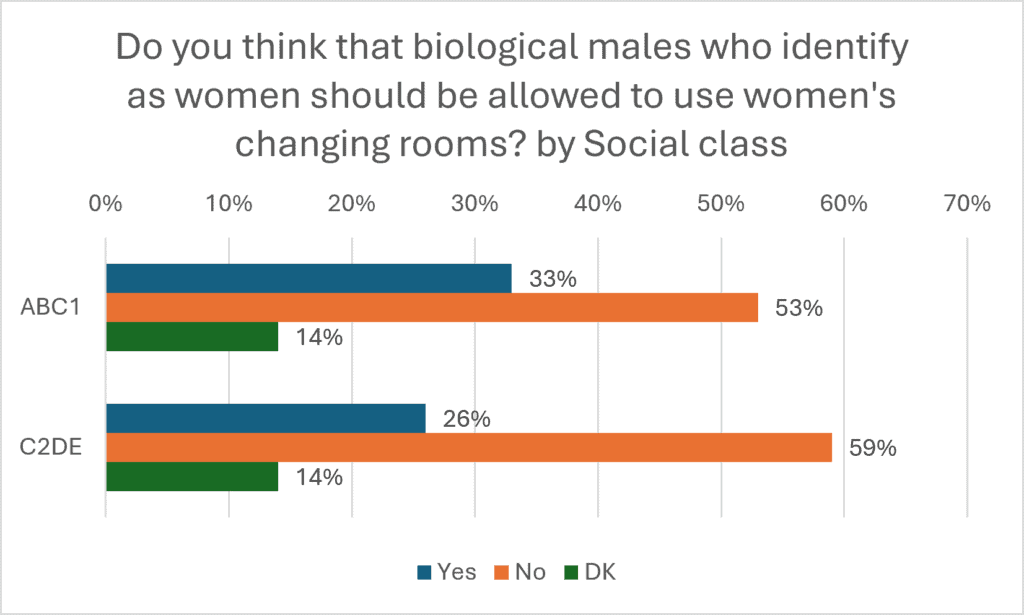
But, clearly, students have a range of views. And these views differ according to factors such as sex, socio-economic class, race, and degree subject. Female students (33%) are more likely than males (26%) to think that ‘biological men who identify as women’ should be able to use the women’s changing rooms. There’s also a substantial difference according to social class origins. 33% of more privileged (ABC1) students approve of ‘biological men who identify as women’ in the women’s changing rooms compared to 26% of working class (C2Des).
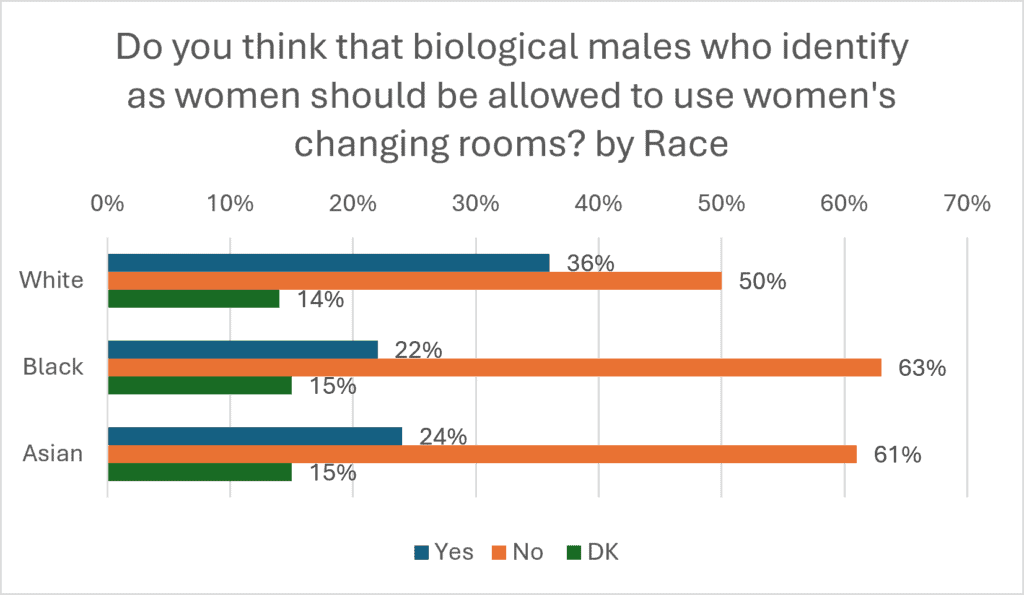
Commentators such as former Scottish First Minister Nicola Sturgeon have accused women who support single-sex spaces of racism, while some academics insist that the sex binary is a Western colonialist imposition. Ethnic minority students might beg to differ. Only 22% of black students and 24% of Asian students support ‘biological men who identify as women’ in women’s changing rooms, compared to 36% of whites.
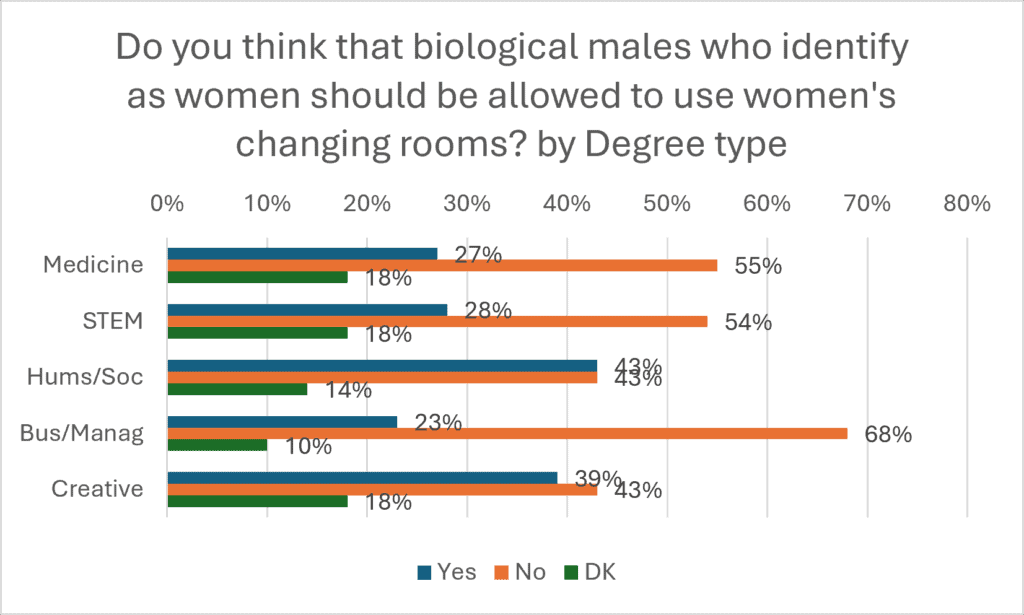
Students’ views also differ substantially according to degree subject. Humanities and Social Sciences students were equally likely to agree as disagree that ‘biological men who identify as women’ should be allowed in women’s changing (43% for and 43% against). In contrast, students in medicine, STEM and Business and Management showed decisive majorities against ‘biological men who identify as women’ in women’s changing rooms, with a smaller majority against for students in Creative Arts and Design.
Past research has suggested more than one mechanism for the fact that Humanities and Social Science students have different political views from their peers in sciences and other disciplines. There is a selection effect, whereby young people with particular political attitudes are more likely to study Humanities and Social Sciences. And this is reinforced by both a curriculum and peer-group which tend to encourage these views so that Humanities and Social Science students become more stereotypically left/liberal on social issues during their degree courses.
HEPI polled just over a thousand students, and there are some questions we would need more data to answer. For example, is the difference between the sexes partly explained by the fact that female students are more likely to study Humanities and Social Sciences? Future research could also ask students about other pertinent characteristics, such as religion and sexual orientation. This study only polled home students, so we don’t know how the views of overseas students may differ.
What the HEPI data tells us clearly is that the loudest voices; on campus, in the student union, and in the student press; don’t represent all students, and in fact only speak for a minority. This should give university managers pause for thought when they think they are doing what ‘the students’ want.
My report on ‘Barriers to Research on Sex and Gender’ describes the chilling effect that has been created by campaigns of bullying and intimidation directed at academics who express ‘gender-critical’ views – meaning the view that sex is real and immutable and at least sometimes relevant. Academics and research students reported that a major barrier to research and discussion was the fear of professional and social sanctions, which created an atmosphere of self-censorship.
Students who express dissenting views may reasonably fear social ostracism by their peers. ‘Preference falsification’ occurs when people publicly express views at odds with their real preferences, meaning that widely disliked policies may appear popular. University managers should be alive to the fact that the students who have mainstream views on sex and gender are those least likely to get a hearing.





Comments
Gavin Dodsworth says:
I’m assuming you also asked the question ‘Should there be trans-inclusion in single-sex spaces?’ in order to check that your question wasn’t giving you the answer it appears you wished for….
Reply
Replies
Red- Handed says:
That question makes no sense.
You could ask: “Should women’s spaces be inclusive of both cis and trans women?”
Or: “Should spaces be single-sex or single-gender?”
But once a space is open to two sexes, it can’t be “single-sex.”
Reply
C Birley says:
HEPI, not Professor Sullivan, commissioned the poll. Professor Sullivan is just commenting on one of twelve questions.
The question you propose is ambiguous – ‘trans inclusion’ can be interpreted as including trans people in facilities and protections for their own sex (eg including trans men in women’s sport categories). As worded, the meaning of the question is clear. If the connotation feels partial, that is because the language preferred by trans activists is deliberately obfuscatory.
Reply
Nathan W says:
Unfortunately that question would not be useful since it is highly ambiguous. The vast majority of people on both sides of the issue believe that single sex spaces should be trans inclusive in that people who identify as trans should have equal access to those spaces as people who do not identify as trans. That tells you nothing about whether sex or self identified gender should be the determining factor.
Reply
Jonathan Alltimes says:
How to ensure justice in higher education?
Academics are governed by rule-making and rule-following employers. The rules and their application should ensure justice. The organizations of higher education may be registered as charities, but their operations occur within a bureaucracy for their employees and students. Student representatives are elected to governing councils and student unions, but a democratic mechanism does not exist for representing the views of most students, as the rules are not put to the students for a vote of consent. The student representatives may not represent the most students or even argue and vote on the rules in governing councils. If higher education were parliamentary democracies, mechanisms for debate would exist for minorities to argue and persuade. The rights of students to govern is limited and must be so, as they are not owners and employees. Higher education providers themselves have limited authority, which they may abuse. Sometimes they are the unjust, but I can not say they are despotic. If one were to add up all the political campaigns from students at one time, it is a wonder any of you attend for work given the toxic atmosphere in some places (the students themselves are not governed). Higher education providers must obviously know their own mind.
What is the purpose of a university?
Reply
Katherine Mary Roddy says:
I live in the San Francisco Bay Area of California, which is governed by liberal politics. The policies of the Democrat legislators align with the desires of trans activists. But there is a marked difference between the opinions of young whites, and the opinions of young black and Hispanic people. Young, college educated whites seem ardent about “trans rights” such as allowing males in the women’s bathroom. That’s especially true of young white women. Young blacks and Hispanics are much more skeptical, whether or not they attend or have graduated from college.
Working class people and rural people are also skeptics.
Reply
Alice says:
Loaded question. The provided commentary is yet another example of Sullivan’s poor academic record of allowing personal bias influence her ability to interpret data.
Reply
Add comment