
WEEKEND READING: Why including only a ‘handful’ of Level 7 modules from the LLE is a huge, missed opportunity
This blog was kindly authored by Dr Michelle Morgan, Dean of Students, University of East London.
So, the Lifelong Learning Entitlement will come into effect in September 2026.
It will replace:
- higher education student finance loans; and
- Advanced Learner Loans for Levels 4, 5 and 6 qualifications.
From September 2026, learners will be able to apply for LLE funding for courses and modules starting from January 2027 onwards. The Government argues that the LLE will allow people to develop new skills and gain new qualifications at a time that is right for them. This will help drive sustained economic growth, break down barriers to opportunity, broaden access to high-quality, flexible education and training and support greater learner mobility between institutions.
However, yet again, the sector’s postgraduate taught provision has largely been ignored. Originally, no Level 7 courses were included. The latest iteration does now include certain Level 7 courses, specifically PGCE teaching qualifications, undergraduate degrees with an integrated Master’s (e.g. LLM, MEng, MPharm) and specific postgraduate healthcare courses.
By failing to include a significant proportion of the sector’s postgraduate taught provision from the LLE, the ambitions the Government has of creating a skilled workforce will not be as great as it could be. It will be a huge missed opportunity for business and industry (especially for small and medium business) as well as a missed opportunity for higher education to super proof the UK-domiciled postgraduate taught provision. This is why.
The first problem: declining PGT participation of UK-domiciled students
Over the past 10 years, the higher education sector has increasingly relied on international Master’s students, primarily to maintain financial viability in the face of frozen domestic tuition fees and reduced government funding.
Of all the postgraduate taught qualifications offered, EU and Non-EU enrolments are nearly all for Master’s qualifications. In 2024/25, Master’s qualifications accounted for 88% of new EU entrants and 97% of Non-EU, with nearly all studying full-time. However, for UK-domiciled students, Master’s qualifications only constituted around 56% of all postgraduate taught enrolments (see Figure 1). This has been the pattern of postgraduate taught participation for UK domicile students for many years. Additionally, the HESA data shows that just 60% of UK-domiciled students were undertaking full-time study.
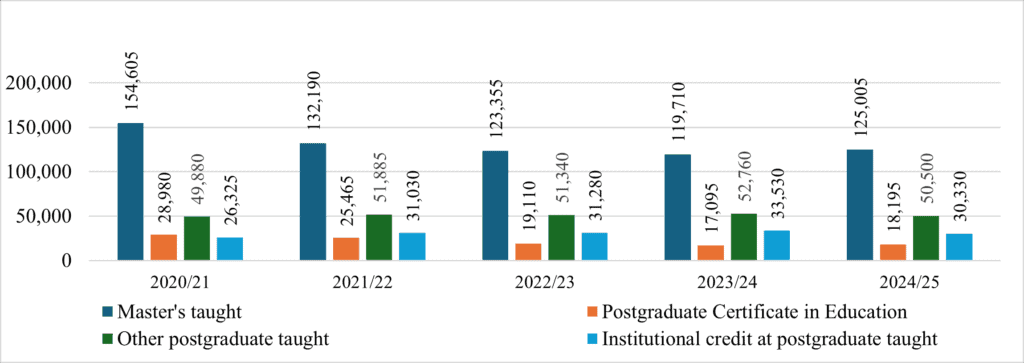
Source: Who’s studying in HE? | HESA
Since 2021/22, UK-domiciled Master’s enrolments have continued to decline (apart from 2024/25 when there was a slight increase: see Table 1). This pattern mirrors that which occurred leading up to 2010/11 and until 2016, when the £10,000 Postgraduate Loan was introduced to re-energise the UK-domiciled market. The aim of the loan was to cover both fees and some maintenance.
| UK | EU | Non-EU | |
| 2018/19 | 118,930 | 20,650 | 115,370 |
| 2019/20 | 123,785 | 20,560 | 148,020 |
| 2020/21 | 154,595 | 20,500 | 159,375 |
| 2021/22 | 132,190 | 12,350 | 232,550 |
| 2020/23 | 123,345 | 11,545 | 304,400 |
| 2023/24 | 119,710 | 11,720 | 271,760 |
| 2024/25 | 125,005 | 10,740 | 244,080 |
Source: Who’s studying in HE? | HESA
The challenges post introduction of the postgraduate loan
As soon as the PG Loan was introduced, you could hear an audible sigh of relief across the sector – there was an attitude of ‘that will solve the problem so let’s just focus on growing the Master’s market’.
However, immediately there were problems.
- As soon as the Postgraduate Loan was introduced, most universities immediately raised their fees to around £9-10K, meaning the loan could only cover the fees and not maintenance.
- The Postgraduate Loan also differs between UK countries. In England, the loan does not cover stand-alone postgraduate certificates and diplomas, unlike in Scotland (iIf they were included, then the LLE as it stands would not be quite as restricting in enabling participation). In England, under the current funding regime, a student has to register for a Master’s in order to obtain the Postgraduate Loan, leading to some then choosing to withdraw after they have achieved the PG Certificate or Diploma they only need.
- The sector did not consider the demands of business and industry, especially for Small and Medium Enterprises (SMEs) regarding other PGT qualifications.
As the 11 University Postgraduate Experience Project (one of 20 projects funded as part of the HEFCE Phase 1 Postgraduate Support Scheme 2013-15 to identify ways to re-energise the UK-domiciled market) found many SMEs did not need Master’s Graduates. Most useful to them was for higher education to provide short courses and modules that provided their staff with advanced skills in key areas such as business and IT, as well as emerging ones such as Generative AI.
The Department for Business and Trade’s report on Business population estimates for the UK and regions in 2024 highlights that there were 5.6 million UK businesses in 2024, of which 5.5 million were SMEs, accounting for 99.8% of all businesses. By ignoring the needs of business and industry, we are losing an opportunity to engage with a critical market.
Where is the postgraduate taught demand?
If an individual needs a Master’s to show that they meet specific industry standards, quality benchmarks, and competency requirements (professional accreditation), this will not stop them from doing a Master’s, even if they have to do it part-time (quite common for UK domiciled students). The current LLE approach may see an increase in integrated undergraduate degrees being undertaken, but this is not where there is demand for UK-domiciled students.
When we start to look at the other 44% of non-Master’s enrolments for UK-domiciled entrants, a very clear pattern emerges. PGCE courses have experienced a notable decline in the past 5 years, hence the logic now of including these courses in the LLE. However, for other Postgraduate and PG Institutional Credit courses, the dominant mode of study for both qualifications is part-time (see Table 2). When you look at the permanent address of the UK-domiciled student by each year, it is England which does not cover these postgraduate courses (see figures in italics).
| Other Postgraduate Taught | Institutional PG credit | PGCE | ||||
| FT | PT | FT | PT | FT | PT | |
| 2020/21 | 12,575 | 37,305 30,540 | 165 | 26,160 | 28,150 | 830 |
| 2021/22 | 12,185 | 39,700 33,115 | 120 | 30,910 | 24,650 | 815 |
| 2022/23 | 11,205 | 40,135 33,705 | 260 | 31,020 | 18,245 | 865 |
| 2023/24 | 10,175 | 42,585 35,605 | 200 | 33,330 | 16,145 | 950 |
| 2024/25 | 10,260 | 40,240 33,575 | 245 | 30,085 | 17,295 | 900 |
Source: Who’s studying in HE? | HESA
The financial demand on UK-domiciled students (especially English) is impacting on postgraduate taught study
When the PG Loan was introduced in 2016, only one cohort had graduated under the £9k a year fee regime introduced in 2012. Now we have 13 cohorts. There has been a decline across all age groups, as Table 3 shows, but the most notable is across UK-domiciled 21-24 year old participants. Therefore, it is not a surprise that the largest group investing in postgraduate taught study are those with the smallest amount of undergraduate debt (older students). This is only going to get worse.
| 2020/21 | 2022/23 | 2024/25 | ||||
| UK | Non-EU | UK | Non-EU | UK | Non-EU | |
| 20 and under | 565 | 2,160 | 620 | 5,075 | 575 | 7,215 |
| 21-24 years | 98,515 | 96,900 | 74,955 | 149,625 | 73,265 | 143,640 |
| 25-29 years | 50,045 | 42,540 | 43,005 | 91,205 | 40,335 | 67,685 |
| 30 years + | 110,615 | 22,295 | 106,465 | 64,050 | 109,835 | 32,17 |
Source: Who’s studying in HE? | HESA
We need a rethink
The LLE in its current form will not super-proof the pipeline for longevity of postgraduate taught study, nor provide the advanced skills that are meaningful and needed for the individual, society and business and industry. It will not enable our most debt-ridden students to engage in postgraduate level study and it will continue to reinforce a divide between students from advantaged and disadvantaged backgrounds.
A Times and Sunday Times article showed how parental financial support differs by student groups and universities. The universities where parents pay the most – up to £30,000 – are mainly Russell Groups. And recently, the National Union of Students published a report showing that 86% of parents support their child financially at university .
When you explore postgraduate taught participation by ethnicity, the UKCGE Equity, Diversity, and Inclusion in Postgraduate Study 2022/23 report highlighted that 69% are white. How will the factors highlighted above enable widening participation at the postgraduate level, which delivers advanced skills, competencies and knowledge?
Nor can we assume that the SMEs will have the financial resources to pay for other postgraduate courses due to the facing severe financial pressure they face – primarily driven by record-high tax burdens, increased labour costs (National Insurance), and high utility bills.
So, we need to start thinking now about the long-term implications of student debt, and social and economic needs so we can develop policy, strategy and practice.
To do this though, the sector needs to start thinking about how we can reimagine and do things differently. This includes offering postgraduate certified modules and short courses. Government needs to listen to key stakeholders, the requirements of business and industry and review the current student loan system. Universities must proactively work together and not against one another to drive change.




Comments
Jonathan Alltimes says:
The argument offered here attempts to prove a gap between the supply of postgraduates and the demand for postgraduates from the private sector, which should be closed by the government providing subsidies. The previous blog on a decade of student enrolment presents data for postgraduate taught and research studies, which was unclassified by where students were domiciled. But what is the constitution of the demand from the private sector? The original policy of lifelong has been promoted by the OECD since the early 1990s, as a government response to deindustrialization, automation, R&D intensification, international competition, and information processing technologies causing unemployment. The OECD Adult Skills Survey 2023 reports that only 7% people need more skills in information processing for their job. The unacknowledged gap in the government policy for the lifelong entitlement is payment for accumulated living costs while studying again and again, which explains why after 35 years the policy has not even been supported in the OECD countries. Businesses will not pay for skills training which can be acquired more cheaply through the international labour market. The LLE is an attempt to target funding and its administration costs. So obviously the government and employers agree there are skills gaps, but appear not to be the same as argued here. As the LLE develops, more priority areas for study may be included. Students and parents should understand the match between postgraduate education and employment before paying.
Reply
Alan Jones says:
How is APEL (basically, prior learning, be it formal academic study or work and life experience) going to be accommodated into LLE modular courses and assessment, whether at undergraduate or postgraduate courses?
Reply
Johnny Rich says:
Thanks, Michelle, for – as ever – a brilliantly insightful piece of work that comes at an issue from a largely unexplored angle.
The Government’s thinking in excluding L7 from LLE funding was understandable given two factors:
(i) They saw that the apprenticeship levy had been used to, in effect, provide in-work management training rather than targeting the skills growth that the government wanted to support. The took the view – rightly, in my opinion – that, if employers would value their managers having better qualifications, then they should pay for it rather than being subsidised by the public purse. The exclusion of L7 from the Growth & Skills Levy is part of the same coin.
(ii) The government sees NEETs and L4 and L5 skill gaps as a higher priority than uplifting L6 to L7. Given that the money is finite, they’ve decided to spend it on their priorities.
This thinking makes sense, but it ignores the unintended consequences for postgraduate courses that Michelle has clearly spelled out. Who is left to do them when you can’t get funded?
It is a relief that some L7 provision has been included in LLE, but beyond those limited areas, we are turning back the clock on access and wider participation in the highest levels of learning, especially in the most selective (and expensive) institutions.
Meanwhile, the government runs the risk of leaving gaping holes in the labour market in, for example, engineering where we already have severe shortages and more than two-thirds of postgraduates students are international. The industrial strategy is reliant on high level skills in engineering; four of the IS8 sectors are directly engineering-focused and the other four rely on engineering less directly.
If no one can afford to study to that higher level because it involves a level of personal financial risk few can afford, then the LLE will fail to serve the public and economic interest.
Instead it will become just a different way of funding roughly the same system we have now, but narrower and, potentially, with lower returns for the taxpayer or individuals.
The reason I say it’s roughly the same system is that the demand for new courses funded by LLE is not only unproven, but the two trials to date both suggest it may not exist without a Herculean effort of marketing to create it. Sometimes, ‘build it and they will come’ just doesn’t work if the evidence says they’re not interested.
And the reason I say ‘lower returns’ is that, if employers really do value courses that people aren’t doing because of the current funding system, then why aren’t they paying for them already?
The LLE runs the risk of not being the longed-for opportunity for people to get just the extra qualification they need to get their dream job (or at least their foot on the next rung), but rather a way of acquiring debt to do a course that isn’t sufficiently valued by employers for them to pay for it themselves. If that’s what it becomes, then the learner will get the qualification and the debt, but not the career boost, the taxpayer will get the cost of providing that loan that is unlikely to be repaid, and the employer still won’t have their real skills gaps filled because they’re waiting for students to turn up who’ve taken the financial risk at their own expense.
Employers will think, why pay to train people when the government has said that people can and should borrow to train themselves or, failing that, why not outsource and shop for skills in the international labour market? In reality, they may do neither and accept the lower productivity of make-do skills levels, which has, to a large extent, been exactly the UK story of the past couple of decades.
The promise of lifelong learning is a grand one. The reality is not easy as the past few governments have discovered. If they want to realise the promise, they need to grasp the grandness of the vision and allow LLE to be part of radical change. At the moment, that’s not what’s happening. Instead LLE is being slotted into existing mechanisms where it fits most easily. Other supports are being removed in the process and, as Michelle has shown, there is a risk to the entirety of the edifice.
Reply
Pete says:
@Johhny Rich
I think more pragmatically a key driver was Treasury nervousness about the introduction of the LLE residual entitlement increasing demand. Postgraduate Loans attract a supplementary 6% graduate contribution which provides an additional reason for the restriction.
The new tuition fee loan age limit of 59 years old being introduced for new students from January 2027 is another manifestation of that
Reply
Replies
Michelle Morgan says:
If you have a UG and a PG loan you are paying 9% and 6% concurrently = 15% is taken from an individual’s disposable income. This is a key factor in individuals not wanting to incur further debt hence a decrease in UK dom PGT participation. If the Treasury doesn’t want the LLE to cover PGT then the English loan system must offer PG loans for PG Certs and Dips as stand alone qualifications and not just for Master’s.
Reply
Add comment