
WEEKEND READING: Part Two: ‘Belonging’ is in the eye of the beholder – steps to creating a sense of ‘belonging’: a practitioner’s approach
This blog was kindly authored by Dr Michelle Morgan, Dean of Student, University of East London, Dr Emily Mcintosh, Chief Student Officer, Harper Adams University, Professor Claire Hamshire, Pro-Vice Chancellor Education, Oxford Brooks University and Rebecca Page-Tickell, Academic Director for Inclusive Practices, University of East London.
As highlighted in part one, there are major challenges with the use of the term ‘belonging’ in higher education institutions. The term is not uniformly defined and is used in relation to a range of factors: from academic success, to social integration and student engagement. The conclusion of part one of this blog series was that creating a sense of trust and mattering so students feel seen, heard and valued within an institution is critical in contributing to a sense of belonging. But how do we do this? What questions do we need to ask, and what else do we need to consider when creating effective steps to enabling a sense of ‘belonging’?
Questions to ask
- Can all students belong?
- What do we need to know in terms of student priorities for the coming year and what helped them fit or settle into their last place of study?
- What helps them feel valued and that they matter?
- What is important in increasing engagement?
Can all students belong?
When looking at the concept of belonging, an important question to ask is whether it is possible for all students to belong, especially with such diversity, different modes of study and different life demands?
Does a student need or want to belong to their institution where they are studying? Are they able to? For example, a commuter student may have a 1.5-hour trip to campus each way, so struggles to stay on campus to undertake extra-curricula activities. A mature student may already have an identity that feeds into their community where they live, so they may feel that they do not need to get involved in institutional co or extra-curricular activities. But if these students are told that engaging in these activities helps create a sense of belonging at their institution, then are we not giving them a deficit message, thus not helping them belong? In fact, we could be alienating them. The institutional messages we send are important.
We also need to challenge the notion that belonging is ‘conformity’. Students should not be expected to change themselves or their identity in order to conform/fit in (which often feels like a requirement with campus club/society initiations). This also feeds into a wider debate around institutions using the term belonging that are not typically widening access or participation focused.
Students may also experience different ‘belonging’ needs across their learning journey, especially in relation to their professional identity. Universities encourage a career focus in which students build their professional identity, and the locus of their belonging develops into their profession. Furthermore, a unitary and simplistic construct of belonging is likely to hinder this journey (Ajjawi et. al, 2023).
What do we need to know?
To create an environment of trust and mattering that can lead to belonging, we need to understand a few things about our students on entry, such as:
- What are students’ priorities in the first few months?
- What were important activities that had helped them fit or settle in to their previous study and feel valued by their university?
- Is it the same by student characteristics and level of study?
These questions were asked as part of the first national pilot of an undergraduate and postgraduate taught pre/post-arrival Academic Questionnaire funded by the Office for Students, and led by AdvanceHE, JISC and the University of East London. It was informed by the work of Michelle Morgan, who has been undertaking pre-arrival academic questionnaires at undergraduate and postgraduate taught levels for many years.
What are student priorities?
Students’ priorities on entry from the 15 participating institutions in Phase 1 of the national pilot are listed in Table 1. The top priority for undergraduate and postgraduate taught students are the academic side of life followed by balancing work and study. The social side is third for undergraduates but seventh for postgraduates. For both, involvement in clubs and societies is the lowest priority, yet this is often suggested as a key activity to increase belonging.
| Priorities | UG | PGT |
| Academic side of university life | 88% | 91% |
| Social side of university life | 46% | 39% |
| Involvement in clubs and societies | 27% | 29% |
| Balancing life with work and study | 59% | 65% |
| My physical health | 41% | 50% |
| Planning or preparing for future employment | 45% | 62% |
| My mental health and wellbeing | 41% | 52% |
| Making friends and creating study support group | 44% | 49% |
What was important in helping students fit in/settle into their last place of study?
When looking at the responses of students regarding what helped them settle or fit into their studies, their priorities are linked to interactions with others in the study realm and the support being provided by their institution (see Table 2).
Table 2 highlights that study-related activities are key. The top three for both undergraduate and postgraduate taught respondents were my course, connecting with others on my course, and my teacher/academic adviser/personal tutor. There are differences in importance by level of study.
| What was important | UG | PGT |
| Having a support network (formal or informal outside of my course) | 38% | 66% |
| Societies, clubs and organised events at my last place of study | 16% | 30% |
| Getting on with the people I live with | 43% | 28% |
| My course | 58% | 73% |
| Connecting with others on my course | 56% | 64% |
| Support from staff/teachers and tutors | 22% | 66% |
| My teacher/academic adviser/personal tutor | 48% | 57% |
| Meeting people I feel I can get on with | 17% | 46% |
| Mental health support | 16% | 31% |
| Disability support | 42% | 7% |
| Knowing there is /school university support if I need it | 16% | 45% |
| Support from family and friends | 39% | 44% |
Note: that the terminology used for support from teachers/tutors/staff was bespoke to the undergraduate and postgraduate taught questionnaires.
Understanding student priorities and what is important in helping them fit or settle in can lay the foundations for targeted support and activities. These findings reaffirm the Building student engagement and belonging in higher education at a time of change work led Professor Liz Thomas and AdvanceHE, which argues for the need to expand the curriculum as co and extra curricula activities are not sufficient to deliver inclusivity (Thomas.et.al., 2017).
Feeling they matter and are valued
Students were asked to state what made them feel valued and that they mattered in their last place of study. The words they provided were about feelings, relationships, information and activities. There were differences by level of study, as Table 3 highlights. For undergraduates, words often related to kindness and patience. For postgraduates, it was being recognised and seen. These words will have been influenced by their previous experience, whether that was direct from study or from the world of work. These all help with encouraging engagement. It also provides a rationale for relational approaches as a fundamental underpinning activity when designing and developing pedagogy, learning and teaching and support provision.
| Common words by new UGs and PGTs Academic support Building relationships Check-ins Clear communication Encouragement Equality and Inclusiveness Fairness Feedback (regular and helpful) Feeling understood Genuine authentic and understanding of student needs Good communications Heard/listened to Help provided Inclusion Not lonely Opportunities Respect and kindness Safe space to be challenged Useful support available | Common words by new UGs Accepted Caring environment Clear guidance Encouragement Honesty Patience Personal interaction Reassurance Understanding Welcoming Common words by new PGTs Acknowledgement Appreciated Fair treatment Friendly environment Known by my name My performance Personalised support Recognition for efforts |
The importance of the environment in enabling engagement
The environment is critical in facilitating feelings of value and mattering, thus helping with engagement. William Kahn, Business engagement expert (1990), argued that to achieve engagement, there needed to be meaningfulness, safety (including trust) and availability across structures, management, resources, policies, strategies and activities.
- Meaningfulness – individuals need to feel a deepened purpose with what they are doing.
- Safety – individuals need to feel safe in expressing how they are feeling without fear of reprisals or criticism, which requires trust.
- Availability – an individual’s personal engagement is affected by the available resources and demands on the individual.
Ed Foster argues that, for the individual to engage within an environment, they need knowledge and understanding, skills and abilities, motivation and self belief and personal capacity (Foster, 2022).
And lastly, as McIntosh and May highlight in their 3 C model of co‑creation, consisting of community, collaboration and cohesion, these are essential in creating an environment that enables and fosters engagement that can then lead to belonging not just for students but also staff (McIntosh and May, 2025).
Three key steps for enabling a sense of belonging
There are interlinking multifaceted factors that are required to enable a sense of belonging to be achieved. Steps One and Two are essential, but Step Three must be considered desirable because you cannot guarantee that a student needs, wants or is able to belong to their institution.
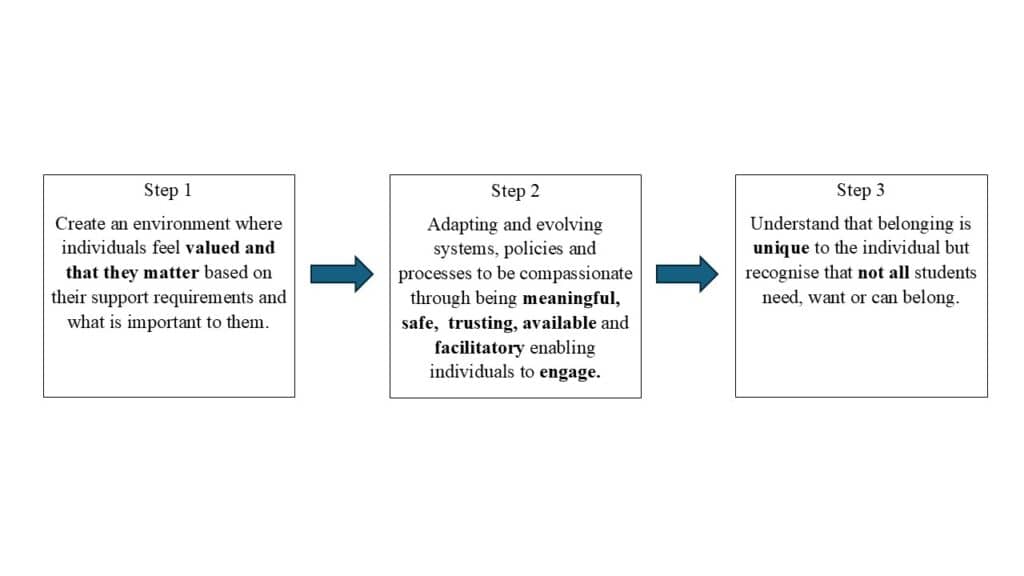
We have come a long way, but we need to listen to the needs of our ever-changing student body by understanding what their priorities are and what helps them settle/fit in may be different. We need to avoid a one-size-fits-all approach. Critically, this involves recognising the diversity of expectations, assumptions and needs for mattering and belonging as our students transition into places of study as well as places of work. We need to bridge the divide of perception and lack of knowledge with facts, openness and flexible, person-centred support.






Comments
Ronald Barnett says:
These 2 articles offer insights both conceptually (between ‘belonging’ and ‘mattering’) and empirically. In further work, some more foundational issues might be probed, some of which require more of a longitudinal approach:
– are students more instrumental, such that belonging is of lesser importance than in the past?
– are students less inclined to identify (feel a sense of belonging) with their university and now construct their student identity more around their courses and their immediate social circle?
– to what extent do students vary on these issues across social class, gender, ethnicity and – most important of all – discipline?
Much of the scholarly work on students over the past 40 years has portrayed students (understandably) as living up to their framing as customers and so have taken on materialist and instrumental attitudes in being a student – to the extent of approaching the epistemological aspects of their students in an instrumental way (‘What is the use of this knowledge?’) – with all of this being exacerbated in an AI world. That scholarly work is crying out for more hard-nosed and discriminating empirical work.
Ron Barnett
Reply
Jonathan Alltimes says:
The first part did not establish the definition for the concept of belonging as it did not provide any descriptive examples and it did not prove an argument for the concept of belonging as the causal determinant of student success, yet another vague notion. The second part, in imitation of the physical or natural sciences presumes the existence of the a thing called the student whose properties are invariant in time and space. The student thing can be acted on by various means. The causal logic of the first part and of the second part are different.
What students want could align with what academics require from students, but they have no idea about the resources currently committed and utilised for student support or how much their ideas will cost them to put into effect. If the University of East London want students to be ‘successful’, they should ask what success means for their students, as that was the test of first part, but it may be nothing to do with what academics, the management and the OfS want. London can be a very alienating place for students, particularly international students.
The University of East London has been experiencing a student enrolment and cost crisis since at least 2014, so needs a basis for competitiveness other than reputation, admission criteria, and location for enrolment, continuation rates, and completion rates, which is becoming more intense. Providing academic, moral, and pastoral support may work, but it is not about understanding, predicting, and causally controlling states of nature. They have got the wrong model. What is distinctive about the academics of the University of East London and their community and its organization?
Reply
Les Ebdon says:
As Chair of the Steering Group for the national pilot of the Pre-Arrival Questionnaire (PAQ), I feel that I must advise Jonathan that the data collected in the pilot is national and while it is possible for individual universities to disaggregate it, the national data is remarkably consistent. I say this because Jonathan seems to think that this is UEL data when it is open to any registered higher education provider to apply to participate free of charge in the OfS funded pilot.
Secondly as Senior Independent Governor at UEL, I note that Jonathan is seriously out of date with his information about UEL. While I accept many universities are experiencing enrolment and cost challenges, this is not true for UEL. Income has increased from £155m in 2020 to £297m in 2025 yielding a surplus of 5% of income. Hopefully this is at least in part due to listening to students and acting upon it.
Reply
Add comment