Student Academic Experience Survey 2026
Student perceptions of their academic experience reach a decade-high despite the pressures facing higher education.
The 2026 Student Academic Experience Survey, published by Advance HE and the Higher Education Policy Institute (HEPI), finds more students reporting good value for money and feeling positive about their choice of university than at any point in over a decade, even as financial pressures continue to shape the student experience.
The 2026 Student Academic Experience Survey (SAES), now entering its third decade since its launch in 2005-06, canvassed the views of more than 10,000 full-time undergraduate students studying at higher education institutions across the UK. The findings paint an encouraging picture of a sector delivering high-quality provision for students who are increasingly well-prepared to navigate the demands and opportunities of undergraduate life.
Value for money at its highest in more than a decade
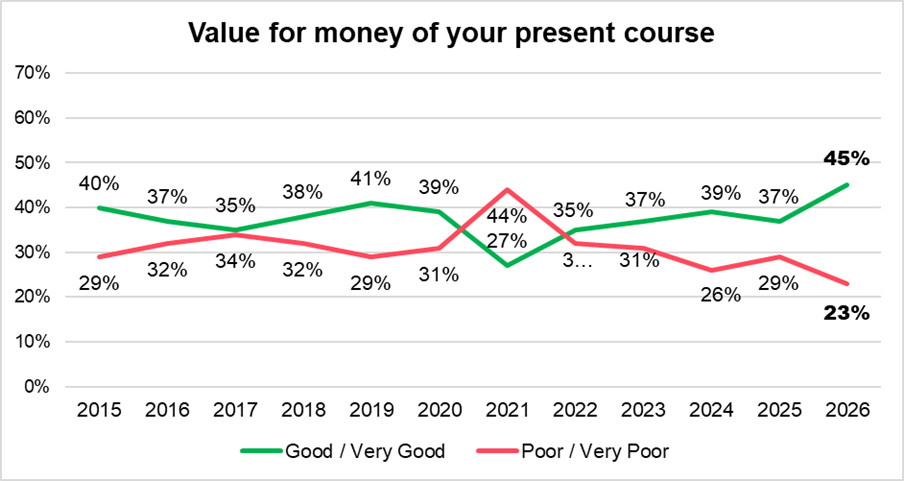
The proportion of students rating the value for money of their course as ‘good’ or ‘very good’ has risen to 45% in 2026, up from 37% in 2025, the highest figure recorded in more than ten years. This improvement is consistent across different student groups, including students from all parts of the UK, home and international students, and students from a range of ethnic backgrounds, giving weight to the conclusion that this represents a genuine and significant positive shift.
Teaching quality remains the principal driver of positive value perceptions, alongside course content and facilities. The data also suggest that more students this year feel better equipped to manage the financial pressures of student life, a finding that, while modest, points to the impact of improved financial guidance and institutional support.
Teaching quality and assessment: strong and improving
Ratings of teaching quality have risen across almost every measure in this year’s survey, with several indicators reaching their highest recorded levels. Students are particularly positive about staff who motivate them to do their best work, clearly explain course requirements, and use contact hours to guide independent study. Ratings of feedback on assessments have also improved significantly, with the proportion of students saying their experience of feedback ‘has been positive’ now markedly higher than it was a decade ago.
Students’ contact hours are largely steady this year, at 15.5 hours a week, remaining materially higher than before COVID. However, independent study hours have fallen somewhat recently, reflecting the pressures on students’ lives, and now amount to an average of 11.1 hours a week. Students say an average of nearly four (3.95) academics know their name and the progress they are making on their course: while one-third of students say five or more academics know this, nearly as many say only two or fewer do so.
More students happy with their choice – and fewer considering leaving
Two-thirds of students (66%) say they are happy with their choice of course and institution and would not change anything, a marked increase from 56% in 2025. The proportion who say they would have chosen an option entirely outside of higher education has fallen to just 7%, reversing the increase seen last year.
Separately, only 22% of students say they have considered withdrawing from their course – the lowest figure in recent years – with 76% reporting that they have not contemplated leaving at all.
These findings are consistent across demographic groups: older students, younger students, home and international students, and students from a range of ethnic backgrounds have all reported higher levels of satisfaction with their choices in 2026.
However, the picture is more nuanced for students studying vocational qualifications. Students on Degree Apprenticeship courses are notably less likely to be satisfied with their choice, with 18% saying they would have preferred to get a job or pursue an option outside higher education entirely. Institutions delivering qualifications beyond the traditional Bachelor’s degree may wish to give particular attention to how student expectations are set and supported for these groups.
Paid employment: widespread but better managed
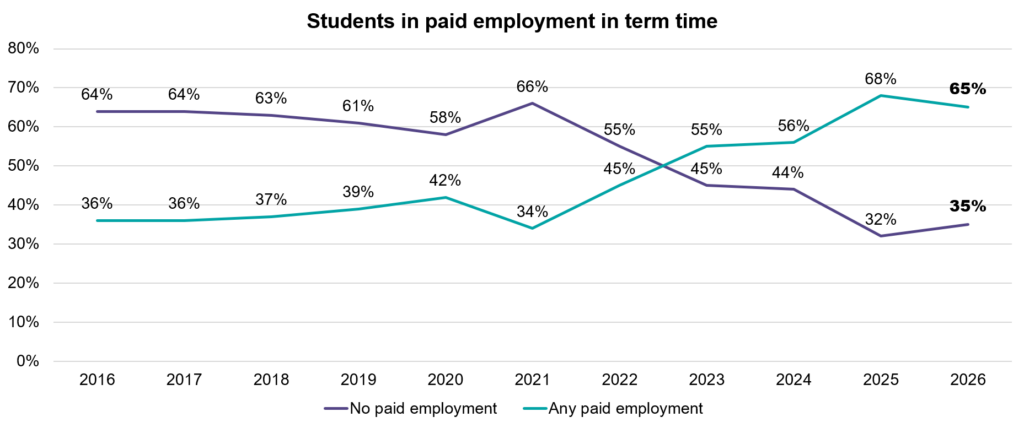
The proportion of full-time undergraduates in paid employment during term time stands at 65% in 2026, consolidating the landmark shift first recorded in last year’s survey. Paid employment is now firmly established as the norm rather than the exception for a clear majority of students, a fundamental change in the nature of undergraduate life that shows no sign of reversing.
Students in employment work an average of nearly 14 hours per week, meaning that those who combine study with paid work face total weekly commitments of 44.2 hours. This is materially higher than the national average for full-time employees as measured by the Office for National Statistics (36.6 hours).
New questions introduced in this year’s survey reveal a positive picture of institutional support: more than eight in ten employed students report that their university has provided support of some kind. The most meaningful forms include offering flexibility around assessment deadlines, compressing the teaching timetable to free up days when students can work, and helping students recognise the skills they are developing through employment. Institutions are also working with local employers to maximise opportunities, and many are advertising part-time roles directly. International students, who often find it more challenging to navigate the local labour market, are significantly more likely to have sought and received this kind of support
Freedom of expression and confidence to air views
Seven in ten students (70%) say they feel comfortable expressing their views on campus even if others disagree, up six percentage points from 2025. Where students feel uncomfortable doing so, the most common reasons relate to personal confidence, a lack of confidence in public speaking (52%) or perceived weaknesses in debating skills (33%), rather than to any sense of institutional restriction. Students who attended a private school were significantly less likely (38% for those who attended private school versus 55% for those who attended a state school) to say that a lack of confidence in public speaking made them uncomfortable in expressing their viewpoint. This points to a clear area for development: fostering the skills and environments that enable all students to participate in campus discussion and debate, particularly those from disadvantaged or underrepresented backgrounds.
Harassment: a new area of focus
A new question introduced in this year’s survey asked students whether they had experienced harassment related to protected characteristics in a university or college environment in the past 12 months. One in five students (22%) reported having done so, with the findings highlighting particularly elevated levels of reported harassment among Trans students, Jewish students, disabled students, and those who identify as LGB+. These are important findings that will be monitored carefully in future surveys.
Rural students: a less positive experience
New analysis in this year’s survey examines the experience of students who live and study in rural areas. Students living in small towns and villages report lower wellbeing scores, a weaker sense of belonging and a greater likelihood of their experience falling short of expectations compared to their urban peers. They are also more likely to have longer commutes or to study entirely online, raising questions about access to in-person teaching and the adequacy of transport provision for students in rural communities.
Alistair Jarvis CBE, Chief Executive of Advance HE, commented:
The 2026 survey results are encouraging. More students are recognising the quality and value of their higher education experience, and that is a testament to the sustained efforts of staff right across the sector. It has been clear in our work that, despite financial pressures, higher education institutions are prioritising supporting student success. Helpfully, the survey also identifies where the experience falls short for particular groups of students, and it is our collective responsibility to understand those gaps and act on them.
Nick Hillman OBE, Director of HEPI, commented:
The Student Academic Experience Survey is the longest-running comprehensive student survey in the UK, delving into areas other surveys dare not go. This year, we see impressive resilience among students and staff, who are seeking to do their best in often trying circumstances. Higher education is profoundly different from when most policymakers attended universities, so it is vital they understand – for example – that most students now have to do paid work even in term time. The survey also reminds us of the funding challenges that are making it harder for institutions to give students the support they need to thrive.
Notes to editors
- The Student Academic Experience Survey 2026 is produced jointly by Advance HE and the Higher Education Policy Institute (HEPI) and has been written by Jonathan Neves (Advance HE), Rose Stephenson (HEPI) and Charlotte Armstrong (HEPI). Online fieldwork was independently conducted by Savanta between 6 January and 7 April 2026. A total of 10,065 full-time undergraduate students from institutions across the UK completed the survey. Data were weighted to reflect the UK full-time undergraduate population.
- New questions introduced in the 2026 survey cover: the types of paid employment undertaken by students; institutional support provided for students in employment; experiences of harassment related to protected characteristics; commuting time; and the experiences of students living in urban and rural settings.
- The full report and accompanying data tables will be available free of charge at advance-he.ac.uk and hepi.ac.uk.
- About Advance HE Advance HE is a member-led charity that works with institutions and higher education across the world to improve higher education for staff, students and society. We tackle the most important challenges facing higher education with our research, knowledge and programmes.
- About HEPI The Higher Education Policy Institute (HEPI) is the UK’s only independent think tank devoted to higher education. HEPI aims to improve the quality of debate about higher education policy in the UK.



Comments
Add comment