
Missing the target? A response to Stefan Collini’s latest onslaught on the state of universities
Nick Hillman OBE, HEPI’s CEO, offers a personal take on Stefan Collini’s long scream about the direction of higher education policy, which is in the current edition of the London Review of Books.
The other day I asked someone where Stefan Collini had gone. This Cambridge academic was everywhere a few years ago complaining about how policymakers were pushing universities to hell in a handcart. It turns out this was a timely question because Professor Collini has just popped up in the latest London Review of Books (LRB) to – once more – critique universities’ strategies and university policy.
The third sentence of his new article lists the problems as he sees them, from institutions on the edge of bankruptcy to graduates overloaded with debt. Coming in at 343 words, this one sentence brings to mind those eccentric novels that are just a single sentence long. Despite Collini’s cry for help, his is not a collegiate approach: he gives short shrift to others’ critiques of the university sector’s problems, claiming ‘political and media discussions remain at an almost wilfully superficial level’.
As anyone who has read Collini before might expect, he identifies 2010 as the watershed moment. That was the time when the Tory-Lib Dem Coalition (for which – to declare an interest – I worked) took office, wrestled with austerity and set in train a big increase in student tuition fees and loans (in England).
That administration, he says, is ‘the chief architect’ of the higher education system we have, conveniently ignoring the fact that both the foundations and the main structure were built by Tony Blair’s Higher Education Act (2004). It is a reminder that Collini’s attacks tend to have a political tinge to them. In his new LRB piece, Collini’s political purpose is explicit where he critiques the parameters of Plan 2 student loans in a similar way to Kemi Badenoch before condemning her for ‘cheap electioneering’. Apparently, it is okay for academics to complain about policy but not for the Leader of the Opposition to do so, even though her job is literally to oppose the status quo.
Collini also makes the surprisingly common error of assuming that Cameron, Osborne, Clegg, Cable, Willetts and the rest of the old gang wanted a pure market in higher education akin to that for ‘soap powder’. There are many problems with this claim. For one thing, there has never yet been a Minister for Universities who has wanted a pure market, which is why we continue to have tuition fee caps, subsidised maintenance support, write-offs for the loans of graduates who end up in lower-paid work, high entry costs even for pukka new providers and ginormous (though still not big enough) taxpayer-funded research budgets. A truly marketised system would have none of these.
Collini attacks policymakers who have elevated the idea of student choice, but he does so in a rather nonsensical way. After all, even if the student funding mechanisms were different, people would still have to make a choice of what to study and where. Even if we were to return to something like the 1970s, as Collini seems to favour and when the number of institutions and the number of places were more limited, choices would still have to be made.
(Other systems are possible too of course: when I holidayed in North Korea a few years ago, my local guide told me she had studied English at university rather than her desired Engineering course because the Government had decided it must be so. I do not think Collini is arguing for such a system but, then again, it is not at all clear what a UK university system based on an anti-choice perspective would actually look like in practice and he does write with extraordinary disdain about democratically elected politicians.)
Collini dislikes choice in part because he does not think higher education is like other choices. Of course, in many respects that is right – I can change my breakfast cereal regularly, but I cannot change my degree choice so easily. But while complaining about the consequences of giving people choice, he also underestimates the level of choice in the system we have, comparing university to ‘a one-off decision: it’s more like getting married than going on a date.’ That is a nice line but one that might feel a bit insulting to those school teachers who give advice on different routes, those university staff who run open days and oversee admissions and all those other people in places like UCAS who work so hard to ensure a good fit between applicants and places.
Collini also ignores those who change course or institution but, most importantly, he ignores the new Lifelong Learning Entitlement (LLE), which is specifically designed to allow a more pick-and-mix approach. I cannot work out if he should like or dislike this new policy instrument, as it aims to tackle some of the persistent problems in the current system but seeks to do so by extending choice further. Despite the length of Collini’s article, the LLE does not merit a single mention.
This silence should be no surprise because Collini’s take has always been a backward-looking and elitist one, focused above all on older subjects taught in traditional ways in the oldest of settings. His LRB piece sneers at subjects like ‘supply chain and logistics’, but surely someone has to supply his Cambridge college with all the things modern Oxbridge Fellows expect? One of Collini’s goals is, he says, to restore ‘the right people’ to positions of power inside universities by which, I think, he means people like him. It is all reminiscent of nothing so much as Margaret Thatcher’s preference on the other side of the political aisle for individuals who are ‘one of us’.
Ironically for someone who is so rude about others’ grasp of facts, Collini’s piece is far from bulletproof. He claims, for example, that the Office for Students (OfS) oversees 140 universities and ‘a further eighty or more “other providers”’. This is massively out – there are well over 400 providers on the OfS Register. This matters in part because it means Collini’s critique of choice is based on a false assumption about how much choice is already embedded in the system and because materially reducing current levels of choice would mean much more upheaval (including risking new cold spots) than he assumes.
Collini also wrongly claims the Starmer Government extended the loan repayment term for current students from 30 to 40 years when in fact it was their predecessors who did this. I would be more sympathetic to such errors if Collini were not so quick to condemn others – he is a bit like a cartoon character spinning around and fighting all-comers all at once – and also if it were not in a section of his essay that begins by claiming discussions about student loans are ‘plagued by misunderstandings.’ Collini even appears to misunderstand how maintenance loans work, wrongly assuming the minimum standard loan is £9,000 (rather than the c.£5,000 it is). Perhaps pointing this out sounds ridiculously pernickety but, if your argument is that every feature of the current university model is wrong, it helps if you convey the details accurately.
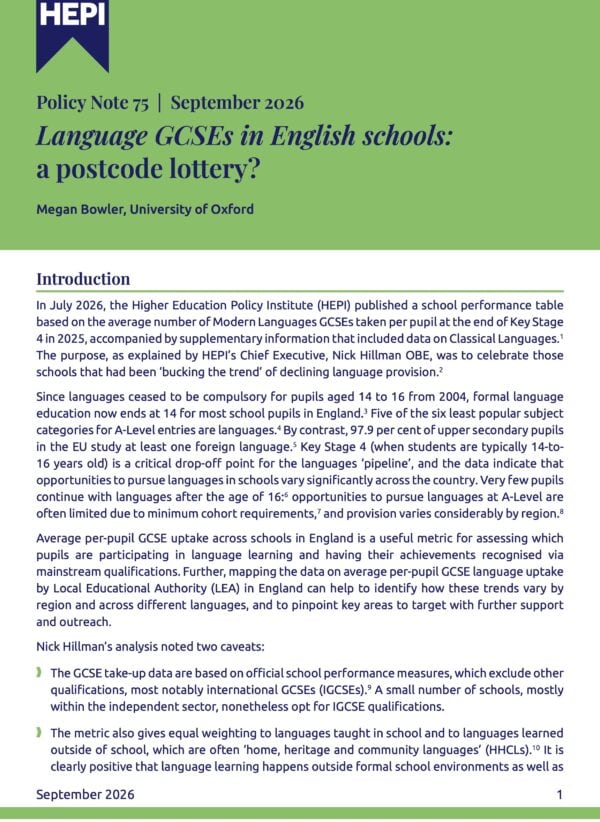
To be fairer, much of Collini’s critique lands, although the best bits are the least original bits. For example, it IS true the higher education sector needs more strategic oversight of the health of weaker disciplines; it IS true that the split in Whitehall between the Department for Education and the Department for Science, Innovation and Technology continues to be deeply unhelpful (as shown in the recent Post-16 Education and Skills white paper); and it IS indeed surely true that Collini’s own discipline of English has been beset at school level by ‘unimaginatively traditional’ texts and an ‘emphasis on formulaic answers.’ It is also undeniably true that the collapse of modern languages has been ‘nigh-on catastrophic’ – indeed, I’m grateful to Collini for the way in which his piece quotes from Megan Bowler’s brilliant HEPI report summarising the matter.
Collini saves his best for his dénouement, however, which takes the form of a plea for regulators, policymakers, other interested parties (like learned societies) and universities to collaborate to ensure at-risk provision is maintained. This makes much sense; it may be a cliché to say the higher education sector has been too focused on competition and not focused enough on collaboration, but it is no less true just because it has been said before.
Yet Collini may have missed the real challenge here: he says such collaboration could enable institutions to weather ‘short-term fluctuations in student numbers’. But the main problem, as Bahram Bekhradnia’s new HEPI report on future student demand makes clear, is that there is no obvious light at the end of the tunnel. In other words, there may be nothing ‘short-term’ about the ‘fluctuations’. Quite the opposite in fact, once you factor in the coming demographic decline in the number of school leavers, not to mention the possible impact on some of the disciplines Collini cares most about from the Government’s decision to kill the English Baccalaureate (EBacc).
In the end, while Collini’s searing analysis paints a picture of a hollowed out university sector resembling a bombed-out city, his fix is not much more than ‘make do and mend’ while hoping for brighter days. It is not much of a prospectus for the future. In the terminology of the past week, it seems more Burnham than Blair.




Comments
Paul Wiltshire says:
The real problem is that far too many young adults are spending an extra three in education that doesn’t genuinely improve their ability to perform well in the workplace. and they are ending up paying an extra 9% tax for life.
Reply
Peter Scott says:
Nick Hillman must be one of the few people in the world who has gone to North Korea on holiday (apart from a few Russians tempted over the border from Vladivostok)…
Two comments:
1. For Nick to argue that the Coalition Government, for which he worked as a special political adviser, was merely building on the previous Government’s plans is disingenuous. The Brown did increase fees after the Blair Government had reintroduced them. But the money raised was additional to existing HEFCE allocations. I know – I was there running a university. The Coalition Government’s plans were quite different, to replace all but a vestigial Government grant by fees. It is that Government, and its successors (up to an including the present one), that must own the current mess.
2. It is equally disingenuous to imply that before the Willetts / Hillman reforms there was no student choice in UK higher education, or in other systems not based on the highest fees charged in any public system in the world. That is nonsense. Student choice has always been the dominant influence over the shape of the system. Scottish teenagers fill in their choices on UCAS forms just like English ones. Students in mainland European countries that have maintained free, or very low, tuition and guaranteed access for bacc, abitur etc holders exercise even greater influence over the subject balance in their universities than UK students do.
Stefan Collini’s core critique (I urge everyone to read the original piece in the LRB) still stands. The reputation of English higher education is now on the line – the initial ‘sugar rush’ of high fees has long gone; universities are struggling to cope with rising costs and (effectively) static fee income by various expedients (dipping deeper into the attainment pool on the part of some Russell Grouo universities, over-expansion of international students who can be charged higher fees,, dodgy franchising deals…); the proliferation of dubious ‘alternative providers’, in some of which their appetite for profit extraction is inversely correlated with their enthusiasm for teaching their students); a lengthening list of course closures and staff redundancies; and indebted graduates, whose contracts can be unilaterally varied and many of whom will end up paying back far more than the cost of their higher education… What’s not to hate.
Reply
Stephen Graham says:
Thanks for this. The seeming wall-to-wall praise for Collini’s piece has been dispiriting.
I found it unhelpfully binary about university managers (either bad actors brought in from outside to wield the axe or presumably benevolent, semi-reluctant members of the professoriate) and about the culture of university’s in crisis (a picture is painted of either managerial adversarialism or, I guess, consensus-led shared governance).
The reality is much more mixed, and the motivations of the people involved far more human (ie, complex), in my experience.
In terms of what Collini thinks we should do, this is the telling line:
‘If the right people can be in the room when the question of how to meet a potential budgetary shortfall is first raised then they may have some hope of channelling discussion in a less damaging direction’
But in what direction? How is the budgetary shortfall to be met? As NH’s article states, the suggestion seems to be for subject groups and sector bodies and universities and so on to work together to weather the storm. But it’s a long storm and there will be a general feeling that the boat needs to stay afloat.
So what should be done? The one concrete suggestion related to budgets and provision in his piece is evasive about the point that jobs would still be lost if Loamshire and Brickville only have enough pooled demand for one of them to offer the subject (it wouldn’t just be a case of staff having to move institution, unfortunately). It is not a bad suggestion in itself though it would be difficult to manage.
But what if there isn’t even the demand to sustain the subject in 1 of the 2 (or 1 of the 6 or whatever)? Again, what should senior managers do if the storm is not going away and the ship is at risk of going down?
I tried to read Collini’s piece with charity but in the end found it to be another example of reductive and somewhat self-satisfied moral grandstanding.
Reply
Jonathan Alltimes says:
I agree, there is masses of choice in the system compared with 10, 20, or 30 years ago. Government controlled conditions on exchange does not of itself cause a market of buyers and sellers for goods and services and neither is competition a feature solely of market exchange. Once you understand that higher education is neither a good nor a service, the whole market rationale for promoting competition collapses and so do the various laws designed to implement the idea, as academic judgments are non-justiciable. What should be the limits on student choice and who will pay, as Margaret Thatcher would have asked? Presumably, if student loans are a government asset, why not raise tuition fees?
Price x Volumes = Sales. It is the rapid expansion of volume which has caused the predicament the core providers experience and not only the rise in tuition fees, as until the current government, student loans were counted as a liability on the government balance sheet, when the accounting convention changed it to an asset, but it is still a liability if the student repayments do not meet their expectations. The expected cost limits were exceeded and a tuition fee rise would add tens of billions to government borrowing, even if recounted as an asset.
The government has proposed a fix, but the universities do not like the Post-16 skills white paper and the International Student Levy and the priority subjects. The government wants to move in the direction of further education and firm-specific training, away from the idea of the knowledge economy based on software and the sciences, chiefly promoted by the University of Cambridge since 1999, that is, the Liberal Democrats, who aligned both with New Labour and then the Coalition Government. I argue the policy idea has not provided the promised economic growth and has not protected us from deindustrialization, which is not to say that software and the life sciences should not be supported by the government. But what should be the limits?
I agree, the reputation of UK higher education is in danger.
https://keirstarmer.substack.com/p/tony-blair-might-not-like-my-plan
https://www.ons.gov.uk/economy/grossdomesticproductgdp/bulletins/regionaleconomicactivitybygrossdomesticproductuk/1998to2023
Reply
Emilia Alexe says:
The discussion focuses on funding and marketisation, but what about qualification integrity?
My experience with a publicly funded HND in Law suggests that the sector has a deeper problem: qualifications can be marketed, funded and quality assured under one narrative while their actual status remains disputed. Regulators, funding bodies and awarding organisations may all become aware of the contradictions, yet the system continues.
Until higher education is willing to confront questions about accountability and the true value of the qualifications being awarded, debates about funding alone risk missing the target.
Reply
Add comment