
A degree of regulation: Building a more financially sustainable and resilient higher education sector
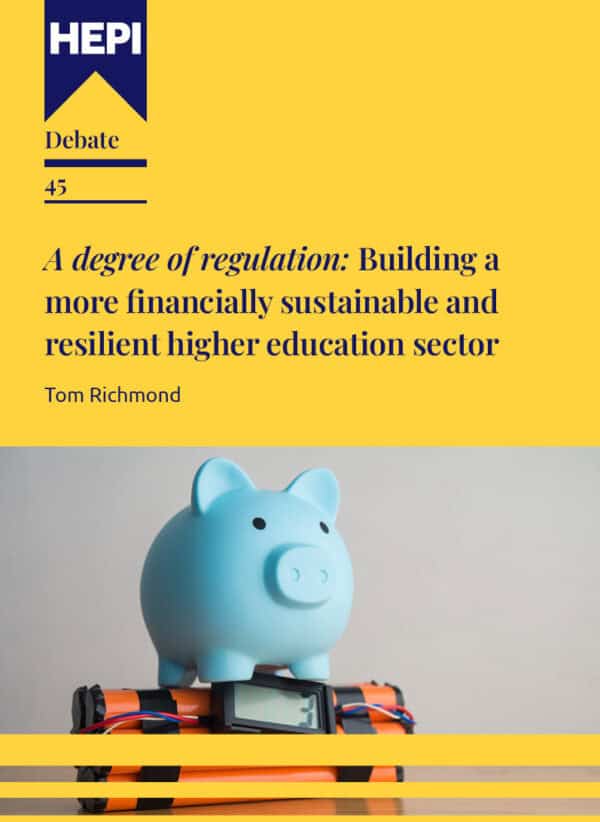
Excessive risk-taking by higher education providers must be curtailed.
With concerns mounting over the financial health of the English higher education sector, a new report from the Higher Education Policy Institute (HEPI) – written by Tom Richmond, a former adviser to ministers at the Department for Education – argues many universities have taken too many financial risks, which not only threatens their survival but also that of other institutions.
The report, A degree of regulation: Building a more financially sustainable and resilient higher education sector (HEPI Debate Paper 45), calls on the Government to introduce new measures to curb the most damaging behaviours now evident across the sector.
The report identifies many examples of providers taking too many risks. Some providers have increased their student numbers very quickly. For example, Canterbury Christ Church University has almost tripled in size over the last decade while Arden University has grown by over 30 times. Moreover, an overreliance on international students has left some universities too exposed to the volatility in international recruitment, with 10 institutions accepting over 5,000 students a year each from China and five universities accepting over 5,000 from India. The report’s analysis confirms the widespread concerns expressed by Government Ministers and others about franchised provision, with Global Banking School seeing its franchised student numbers growing from 2,140 in 2019/20 to 32,110 in 2023/24. Excessive borrowing is another risk to financial sustainability, with the University of Northampton having debts equivalent to 137 per cent of its annual income.
The report also highlights how some providers’ failure to prioritise sustainability and resilience is having a detrimental impact on the student experience. Higher-tariff providers have hoovered up thousands of additional students since the pandemic, yet this does not appear to have been accompanied by a commensurate increase in staffing. In addition, universities recruiting more students than there is available accommodation has become a widely reported phenomenon. Meanwhile, the unjustified growth in top degree classifications– more than quadrupling from 7 per cent to 30 per cent over the past two decades – strongly suggests some providers are willing to use generous final grades as a marketing tool to prospective students, despite the damage this could do to the value of a student’s degree certificate and even the reputation of UK higher education on the global stage.
The report offers a ‘toolkit’ of eight separate measures that could be taken to prevent excessive risk-taking without affecting the autonomy of providers that have acted appropriately.
Protecting society’s interests:
- Constraining provider growth: providers would be limited to 5 per cent annual growth in student numbers;
- Reducing the reliance on international students: the International Student Levy should only be charged on fees above the maximum tuition fee loan for domestic undergraduates and postgraduates;
- Restricting franchising arrangements: providers would require government approval for any franchising deal (including existing ones), and providers should be capped at receiving no more than 20 per cent of their income from franchising.
- Imposing financial buffers: providers would be required to hold ‘capital buffers’, adhere to limits on debt levels and meet minimum liquidity requirements as well as being subject to ‘stress tests’ to assess their financial resilience;
Protecting students’ interests:
- Implementing a ‘teaching resource cap’ on the number of undergraduate students that can be recruited: providers would be barred from accepting more undergraduates than they are able to support in terms of their overall teaching capacity;
- Ensuring providers have enough physical space for the students they enrol: providers would be made responsible for ensuring that any student who requires accommodation can secure a suitable living space within a very short travel distance of their place of learning, and every student on a course can be seated within a single venue (for example, a lecture hall) regardless of the course size;
- Introducing transparency over the maximum number of students on every course: at the start of each application cycle, providers would be required to publish (and subsequently adhere to) the maximum number of students they will admit onto each course;
- Standardising degree classifications: all providers would be limited to awarding 15 per cent of classifications as a ‘First’, 35 per cent of classifications as an ‘Upper Second’, 35 per cent as a ‘Lower Second’ and 15 per cent as a ‘Third’.
Tom Richmond, author of the report and former adviser to two Education Secretaries, said:
There is so much good work being done by so many higher education providers and academics to deliver a great experience to their students, but my analysis suggests that some providers have taken too many risks, ignored students’ interests and damaged the reputation of the sector by pursuing extra tuition fee income above all else.
Given the pivotal role of higher education in our society and economy, the Government should set new boundaries that aim to curtail excessive risk-taking and promote financial sustainability because, ultimately, the interests of the sector are more important than the interests of any single provider.
Rose Stephenson, Director of Policy and Strategy at the Higher Education Policy Institute, adds:
This report sets out a series of recommendations that are intentionally forthright. We recognise they may be challenging and will prompt a range of views across the sector.
However, they reflect the scale and urgency of the issues facing higher education today. If we are serious about building a more sustainable and resilient system, it is important that we engage with these ideas and foster an open, constructive debate about the sector’s future.
Notes to Editors
- HEPI was founded in 2002 to influence the higher education debate with evidence. We are UK-wide, independent and non-partisan. HEPI is funded by organisations and higher education institutions that wish to see vibrant policy discussions.
- Tom Richmond is an education policy analyst and host of the ‘Inside Your Ed’ podcast. He has spent over 20 years in the world of education, which has included working as a teacher, think tank director and advisor to two Education Secretaries and ministerial teams at the Department for Education.





Comments
Richard Harris says:
Degree classifications need reform but standardising a fixed maximum proportion to be 1st, 2:1, 2:2, etc. makes little sense: it means that a strong cohort of students would, in effect, be marked more harshly than a weaker one, even if they studied hard and met all the requirements of their assessment. It also sets the members of each cohort in competition with each other. Personally, I am not entirely clear why we need to put students into these rigid and dated grade classes at all. It could be pass/fail, like a driving test. Or, we could have a system where people can try again having received a classification and see if they can improve on their performance. Why not?
Reply
Paul Wiltshire says:
At first glance this appears to be a sensible report exposing the worse excess’s of the commercially motivated HE sector.
But is it really just a smoke screen from the HE sector itself, seeking to appear to look at bit tough but is in fact just doing only a very limited ‘mea culpa’ about the extremes of the gross behaviour and exploitation of our young adults ?
Because I can’t see anywhere in this document (I admit to not yet reading every word, so I might be wrong) a proposal to reduce the overall %HE participation level. Nor an admittance that the growth of the sector is on the backs of students with lower prior academic attainment, for whom it is proven beyond doubt, that very few are getting any benefit career pay wise , and so are destined to just have a debt for life and high marginal tax to contend with (and leave a huge loan write off for the taxpayer)
Reply
Replies
Jonathan Alltimes says:
Growth is only to be constrained by 5% per annum. I assume the author advised David Willetts about the removal of the control on student numbers at higher-tariff universities and the implications of a removal of the cap on student numbers for each university after HEFCE was abolished.
Reply
Paul Vincent Smith says:
I’ve liked Tom Richmond’s work for a while and there are some interesting things here. However, I’m less than credulous of the last proposal, on degree classifications.
The reasons for “unexplained” grade inflation are complex. For each Frank Furedi there is a Liz Morrish, or someone who might assert that students are better prepared (or success is more important to them), teaching staff are better trained and so on. “In the absence of any supporting evidence of an underlying rise in teaching standards or learning outcomes” – HE instructors are certainly better credentialed if not qualified than previously. A “rise in learning outcomes”… no idea what that means if not the phantom that is “learning gain”.
The big picture is that in a marketised and competitive sector, degree outcomes will climb no matter what the mechanism. If “this strongly suggests some providers have used their higher degree classifications as a means of marketing themselves to potential applicants at home and abroad”, I’d like to see those marketing materials.
The proposal is simply (and a little ironically) to remove a standards-based system for a distribution-based system. Essentially, this is the bell curve model, and I am not sure how well this maps on to the classification system. It would certainly achieve the swapping out of one clunking machinery for another. No longer would there be a need for detailed marking criteria, as we would not be able to justify saying “a 2:1 student will be able to X” under conditions where the top 50% will receive the top classifications regardless. It might make life in exam boards easier if institutions do the obvious thing in response to working out “how the allocations of degree classifications are distributed among students and faculties”, and give each exam board the injunction to use the same bell curve.
At the same time, we introduce competition among students. We also retain the illusion that a first at one university is the same as at a quite different university.
The really innovative thing to do would be to remove the classification system, retain course marks, and compel students and employers to have meaningful conversations about what these marks mean.
Reply
Jonathan Alltimes says:
The report provides a few indicative qualitative examples out of the hundreds of providers over the last 23 years. Is it enough to prompt more recommendations? The recommendations would require new legislation and may be legally contested by the universities. The current government has no intent for such reforms, having already been advised and published their white paper, so that is that. Managerially-incompetent providers will experience the consequences as the reforms already announced limiting revenues take effect at the same time as cost pressures rise. There will be a sequence of mergers where incompetent boards are replaced, beginning with the University of Kent, which will be a model worked out for later mergers to proceed rapidly. The new wave of inflation is going to speed up mergers. As supported by the DfE, the OfS will be able to demand changes as a condition of each merger, which is where a limited number of the recommendations may occur, but will have to be applied consistently along with what else the OfS wants, as judged by their metrics.
The report provides the Dearing Report as the policy background by which to judge progress in the higher education sector. Dearing was the origin of the justification for a rise in tuition fees and not the origin of the growth in student numbers, it was the 2003 White Paper ‘The future of higher education ‘, which proposed justifying the rise in tuition fees by expanding numbers through widening access or participation. The rationale for which was education being a route out of poverty and closing the wage gaps with other nations. The expansion has failed on these terms and the nation is left with paying for student fees subsidised through government debt, now accounted for as an asset against which to borrow. I do not see these recommendations as salvaging many of the lower-tariff universities, brought into existence by the too late Wilson reforms of the 1960s and 1970s for technical education against deindustrialization and became the post-1992 universities: it took 30 or so years to wind them up and 30 or so years to wind them down.
Reply
Replies
Jonathan Alltimes says:
Reviewing the options in more detail.
Option 1. In what other sector does the state limit growth?
Option 2. In what other sector does the state tax revenue for financial risk?
Option 3. In what other sector does the state limit franchising?
Option 4. Banking is a false analogy for universities, universities, as banks trade in finance and not tuition fees. In what other sector does the state regulate financial reserves?
Option 5. In what other sector does the state regulate resource ratios?
Option 6. In what other sector does the state regulate space in the workplace?
Option 7. Agree, publish the data. Do the ratios of international students to UK-domiciled students for each course and degree determine the quality of the student experience?
Option 8. Academic judgments are non-justiciable, so you can not look at whether there has been an erosion of standards, as objective standards do not exist: the judgments may be agreed intersubjectively among specialists in the same academic discipline. The evidence shows the academic norms have changed as a consequence of subjecting universities to the conditions of a market and bureacratic enterprises along with a regulator.
Reply
Robert Dover says:
The removal of the student number cap is where the pressure began to form on many HEIs. Then as PGTi numbers also came under pressure from government hostility to mobility / migration (even though student migration is palpably different to the migration the government is mostly concerned about) those HEIs with extensive cost bases adopted far more aggressive behaviours in the UGh market. All of this we know, as does the report. The measures seem mostly sensible, but I would still want a fundamental sector-wide engagement on the notion of the cap, and also of what government sees the roles of HEIs (eg it might incentivise or not, particular types of educational practice).
Reply
Add comment